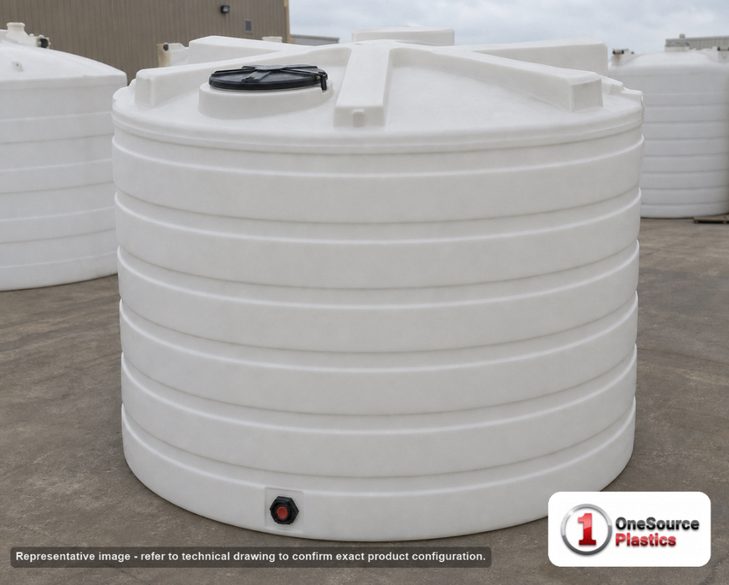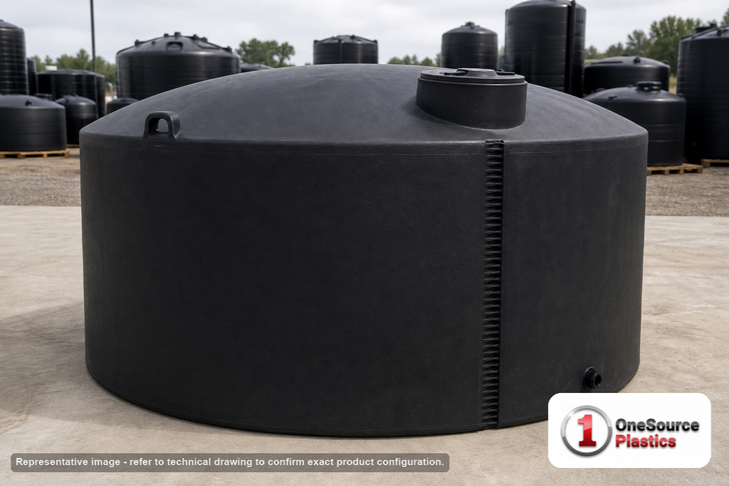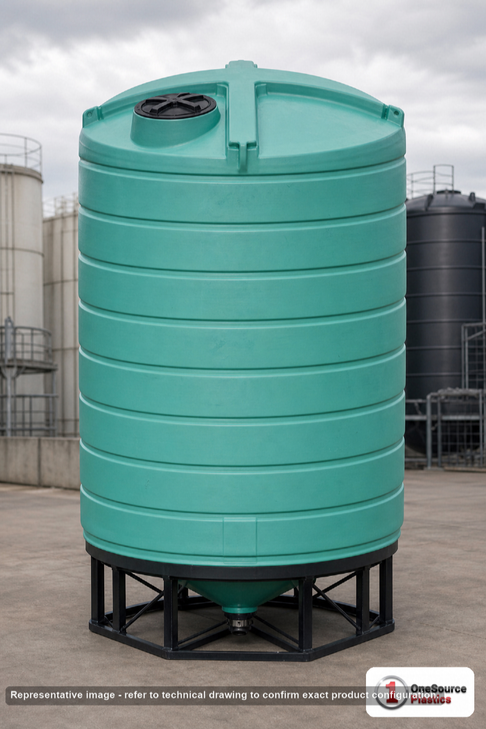
The Enduraplas 5000 Gallon Green Cone Bottom Tank (SKU THC05000G) is a 5,000-gallon polyethylene cone bottom built for full-drain bulk chemical service.It stands 166 inches tall on a 110 x 110 inch footprint and carries a 1.9 specific gravity rating, so the resin and wall are sized for dense, aggressive liquids that a 1.0 or 1.9 SG tank cannot safely hold.The apex-drain cone empties to a near-zero heel, which matters when you are batching or dosing reagents like sodium hypochlorite, hydrogen peroxide, DEF, or peracetic acid that degrade or stratify if left standing in a flat-bottom tank.This 1.9 SG build is the top of the structural rating ladder for a cone this size, so there is no heavier-rated step-up to worry about.
Will it work for your application?
Three numbers decide whether this 5000 gallon cone tank fits your site.First, the footprint: 110 x 110 inches square, 166 inches to the top, so confirm your stand opening and overhead clearance before ordering — a cone bottom tank must sit in a matching support stand, not on a flat pad.Second, weight: filled with water this tank carries 41,700 lb, and at its 1.9 SG maximum rated contents it reaches 79,230 lb.That loaded figure drives your stand selection, foundation, and anchoring, so size the structure to the contents you actually plan to store, not to water.Third, freight: this is a single-origin LTL move from one ND plant, so price the delivery before you commit to the size.If you are unsure which capacity matches your throughput, run the numbers with our Tank Sizing Calculator and the Tank Sizing Guide, and review the Cone Bottom Tank Stand Compatibility Matrix so the stand and tank are matched correctly.
Chemical compatibility
This is an Enduraplas cone bottom tank molded in polyethylene (HDLPE) with a 1.9 specific gravity rating.The resin designation carries a question mark in our data, so we will confirm HDLPE vs XLPE in writing before this unit is committed to chemical service — the two resins behave differently with certain reagents, and the fitting and gasket recommendations below assume the OEM resin-resistance chart governs.Compatibility is also concentration- and temperature-specific, so always check that chart for your exact chemical, concentration, and operating temperature before filling.As a quick hardware cue: strong oxidizers and aggressive acids call for Viton gaskets (CPVC fittings for 98% sulfuric), DEF and peracetic acid move to 316SS, and the chlorides, sulfates, and glycols run on PVC fittings with EPDM gaskets.The full rated list:
- Acetic Acid (60%) — PP/PVC fittings, EPDM gaskets
- Aluminum Sulfate (50%) — PVC fittings, EPDM gaskets
- Calcium Chloride (40%) — PVC fittings, EPDM gaskets
- DEF (32.5%) — 316SS fittings, EPDM gaskets
- Ethylene Glycol (100%) — PVC fittings, EPDM gaskets
- Ferric Chloride (50%) — PVC fittings, EPDM gaskets
- Ferric Sulfate (60%) — PVC fittings, EPDM gaskets
- Ferrous Sulfate (20%) — PVC fittings, EPDM gaskets
- Hydrochloric Acid (37%) — PVC fittings, Viton gaskets
- Hydrofluoric Acid (48%) — PP/PVC fittings, Viton gaskets
- Hydrofluosilicic Acid (26%) — PP/PVC fittings, Viton gaskets
- Hydrogen Peroxide (50%) — PVC fittings, Viton gaskets
- Magnesium Chloride (30%) — PVC fittings, EPDM gaskets
- Peracetic Acid (30%) — 316SS fittings, Aflas gaskets
- Phosphoric Acid (85%) — PVC fittings, Viton gaskets
- Polyaluminum Chloride — PVC fittings, EPDM gaskets
- Potassium Carbonate (50%) — PVC fittings, EPDM gaskets
- Potassium Hydroxide (saturated) — PVC fittings, EPDM gaskets
- Propylene Glycol — PP/316SS fittings, EPDM gaskets
- Sodium Bisulfate — PVC/PP fittings, EPDM gaskets
- Sodium Bisulfite — PVC/PP fittings, EPDM gaskets
- Sodium Carbonate (30%) — PVC fittings, EPDM gaskets
- Sodium Hypochlorite (<16.5%) — PVC fittings, Viton gaskets
- Sodium Thiosulfate (40%) — PVC fittings, EPDM gaskets
- Sulfuric Acid (98%) — CPVC fittings, Viton gaskets
- Urea Solution (50%) — PP/PVC fittings, EPDM gaskets
- Zinc Orthophosphate — PP/316SS fittings, EPDM gaskets
- Ozonated Water (up to 10 PPM) — PVC fittings, EPDM gaskets
Matching the gasket and fitting material to the chemical is the most common mistake on a tank like this.An EPDM gasket on a strong oxidizer such as sodium hypochlorite or hydrogen peroxide will fail even though the tank wall itself is rated.Confirm every selection against the OEM chemical-resistance chart and our full Chemical Compatibility Database, and plan your top penetrations using the top-fitting placement strategy guide so vent, fill, level, and drain lines never conflict.
The mistake to avoid
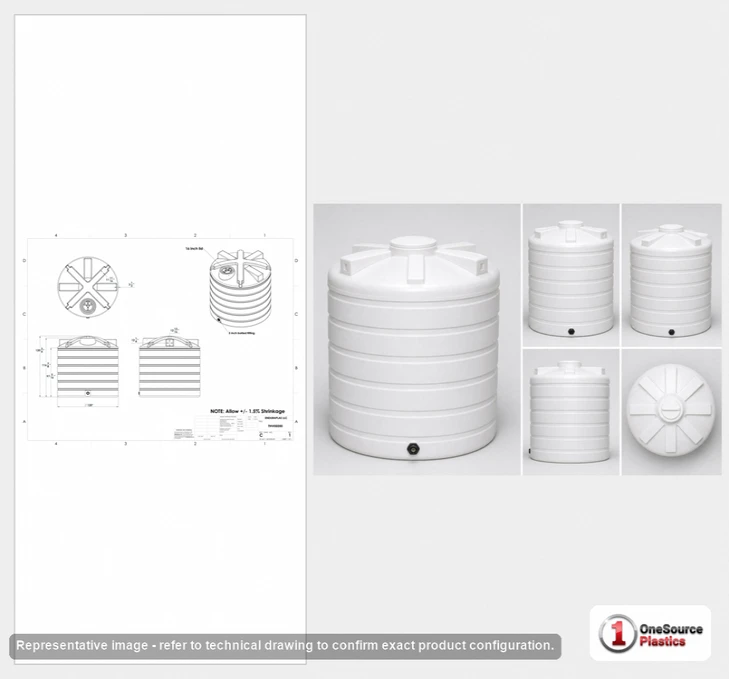
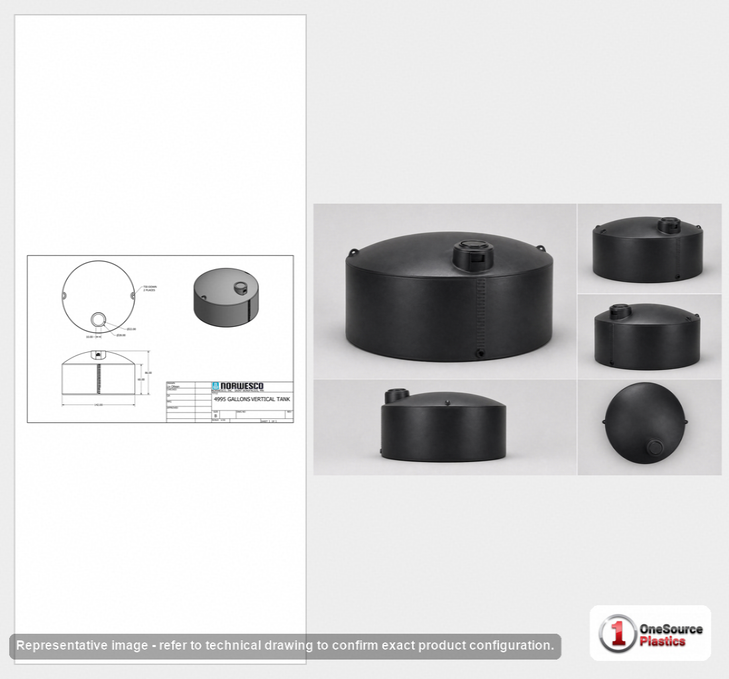
The 1.9 SG rating is the number people misread.It does not mean every liquid is safe in this tank — it means the tank structure is rated for contents up to 1.9 specific gravity, but chemical compatibility still depends on resin, fitting material, gasket material, concentration, and temperature for your specific reagent.Pair that with the right gauge and signage: choose a level gauge suited to the chemical with our level gauge selection guide, and label the installed tank correctly per our tank label and signage compliance guide.Review the technical drawing on this page to confirm fitting locations and dimensions before you finalize your stand and plumbing.
This cone bottom tank ships LTL freight from the Enduraplas plant in Neche, ND, quoted live to your ZIP.Get an exact number with our Freight Cost Estimator or call 866-418-1777 to lock in your stand, fittings, and delivery together.For questions on whether this 5000 gallon cone bottom tank suits your chemical, send your reagent, concentration, and temperature and our team will confirm the build before you order.
Freight and documents
Ships from: Neche, ND. LTL freight is quoted to your ZIP with the freight cost estimator or by phone at 866-418-1777. The listed price is before freight.
Technical drawing (PDF) for Enduraplas THC05000G.
See this tank
Interactive 3D model with live fill. This tank has an interactive 3D model built to its manufacturer dimensions. Rotate it, and set a fill level to see how much liquid it holds at any height. Open the 3D view on the product photo above. Download the 3D model (GLB).
Ready to order?
Add it to your cart at the top of this page, get LTL freight to your ZIP, request a written quote, or call 866-418-1777. The listed price is before freight.