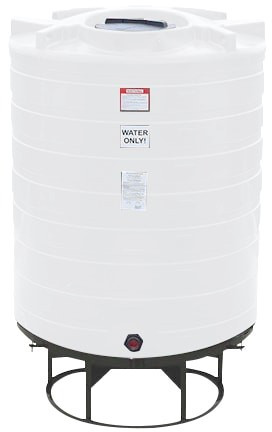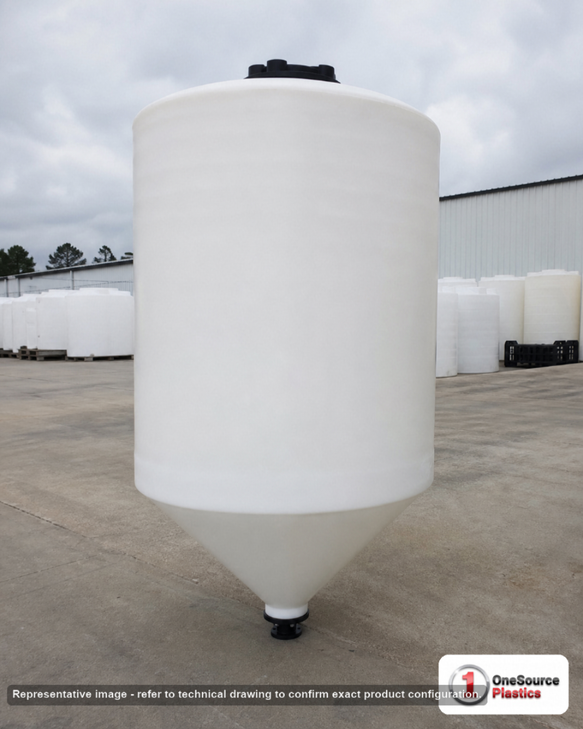
The Enduraplas 870 Gallon White Cone Bottom Tank (SKU THC00870W) is a 1.9 specific-gravity cone bottom tank built for full-drain chemical and process service. It holds 870 gallons in a 60-inch by 60-inch footprint and stands 85 inches tall, and the cone geometry lets you empty viscous and settling chemistries cleanly instead of leaving heel in the bottom of a flat-floor tank. The shell is molded from natural white polyethylene, so you can read liquid level through the wall and spot stratification or sediment at a glance. This tank is configured with fittings to your spec, so you set bulkhead, outlet, and vent placement around your piping and metering plan.
Will this cone bottom tank work for my application?
Start with the loaded weight, because a cone bottom tank carries its full weight on the cone tip and its supporting stand, not the floor. Filled with water this tank weighs roughly 7,256 lb. At its full 1.9 specific-gravity rating the contents alone can reach about 13,786 lb, so the stand, anchor points, and slab all have to be sized for that worst-case load before you commit to a chemical heavier than water. The 1.9 SG rating is the hard limit: confirm the specific gravity of your chemical at your operating temperature stays at or under 1.9 and you are within spec. Note the proportions too - 85 inches of tank height on a 60-inch base sits the filled center of gravity well above the footprint, so outdoor, windy, or seismic sites need the stand anchored and the tank tied down accordingly. Use the Tank Sizing Calculator and Tank Sizing Guide to match capacity to your batch volume and turnover, and check the technical drawing on this page for the cone angle, fitting locations, and overall dimensions before you plan piping. If you are pairing this tank with a stand, the Cone Bottom Tank Stand Compatibility Matrix covers Enduraplas stand pairing.
Chemical compatibility
This tank is molded from polyethylene rated to 1.9 specific gravity. The resin is listed as HDLPE but with a pending designation, so confirm HDLPE versus XLPE with us before putting this tank into chemical service - crosslinked and linear polyethylene behave differently with aggressive oxidizers and solvents. The chemicals below are compatible at the listed concentrations when paired with the correct fitting and gasket materials. Always verify against the OEM chemical-resistance chart, which is concentration- and temperature-specific, for your exact conditions:
- Acetic Acid 60% - PP/PVC fittings, EPDM gaskets
- Aluminum Sulfate 50% - PVC fittings, EPDM gaskets
- Calcium Chloride 40% - PVC fittings, EPDM gaskets
- DEF 32.5% - 316SS fittings, EPDM gaskets
- Ethylene Glycol 100% - PVC fittings, EPDM gaskets
- Ferric Chloride 50% - PVC fittings, EPDM gaskets
- Ferric Sulfate 60% - PVC fittings, EPDM gaskets
- Ferrous Sulfate 20% - PVC fittings, EPDM gaskets
- Hydrochloric Acid 37% - PVC fittings, Viton gaskets
- Hydrofluoric Acid 48% - PP/PVC fittings, Viton gaskets
- Hydrofluosilicic Acid 26% - PP/PVC fittings, Viton gaskets
- Hydrogen Peroxide 50% - PVC fittings, Viton gaskets
- Magnesium Chloride 30% - PVC fittings, EPDM gaskets
- Peracetic Acid 30% - 316SS fittings, Aflas gaskets
- Phosphoric Acid 85% - PVC fittings, Viton gaskets
- Polyaluminum Chloride - PVC fittings, EPDM gaskets
- Potassium Carbonate 50% - PVC fittings, EPDM gaskets
- Potassium Hydroxide saturated - PVC fittings, EPDM gaskets
- Propylene Glycol - PP/316SS fittings, EPDM gaskets
- Sodium Bisulfate - PVC/PP fittings, EPDM gaskets
- Sodium Bisulfite - PVC/PP fittings, EPDM gaskets
- Sodium Carbonate 30% - PVC fittings, EPDM gaskets
- Sodium Hypochlorite <16.5% - PVC fittings, Viton gaskets
- Sodium Thiosulfate 40% - PVC fittings, EPDM gaskets
- Sulfuric Acid 98% - CPVC fittings, Viton gaskets
- Urea Solution 50% - PP/PVC fittings, EPDM gaskets
- Zinc Orthophosphate - PP/316SS fittings, EPDM gaskets
- Ozonated Water up to 10 PPM - PVC fittings, EPDM gaskets
Notice how the gasket material shifts with the chemistry: oxidizers like hydrogen peroxide, sodium hypochlorite, and sulfuric acid call for Viton rather than EPDM, and peracetic acid is the one chemistry on this list that steps past Viton to Aflas. Getting that elastomer choice right at every flanged and threaded connection is where most chemical-storage installs go wrong. This tank also handles DEF at 32.5% and urea solution at 50%, both common in ag and energy operations near its North Dakota ship point - just hold to 316SS fittings on the DEF side. For the full picture, search the Chemical Compatibility Database. If you are metering sodium hypochlorite or peracetic acid, the level gauge selection guide for chemical service walks through non-contact options.
The mistake to avoid
The single most common error on a 1.9 SG cone tank is treating the rating as a suggestion. Density matters more than chemistry here: a 50% ferric chloride or 98% sulfuric acid charge pushes toward that 1.9 ceiling, and exceeding it overloads the cone and stand long before the polyethylene itself complains. Pin down your chemical's specific gravity at temperature, confirm it sits at or under 1.9, and size the stand for the full 13,786 lb worst case. Second, do not assume the resin type - get HDLPE versus XLPE confirmed in writing before you order for any oxidizer service.
This Enduraplas cone bottom tank ships LTL freight from Neche, ND, with freight quoted live to your ZIP code - get an instant number with our Freight Cost Estimator or call 866-418-1777 to talk through fittings, stands, and delivery. Reach out before you order if you need help confirming SG headroom or matching this white cone tank to your chemical program.
Freight and documents
Ships from: Neche, ND. LTL freight is quoted to your ZIP with the freight cost estimator or by phone at 866-418-1777. The listed price is before freight.
Technical drawing (PDF) for Enduraplas THC00870W.
See this tank
Interactive 3D model with live fill. This tank has an interactive 3D model built to its manufacturer dimensions. Rotate it, and set a fill level to see how much liquid it holds at any height. Open the 3D view on the product photo above. Download the 3D model (GLB).
Ready to order?
Add it to your cart at the top of this page, get LTL freight to your ZIP, request a written quote, or call 866-418-1777. The listed price is before freight.