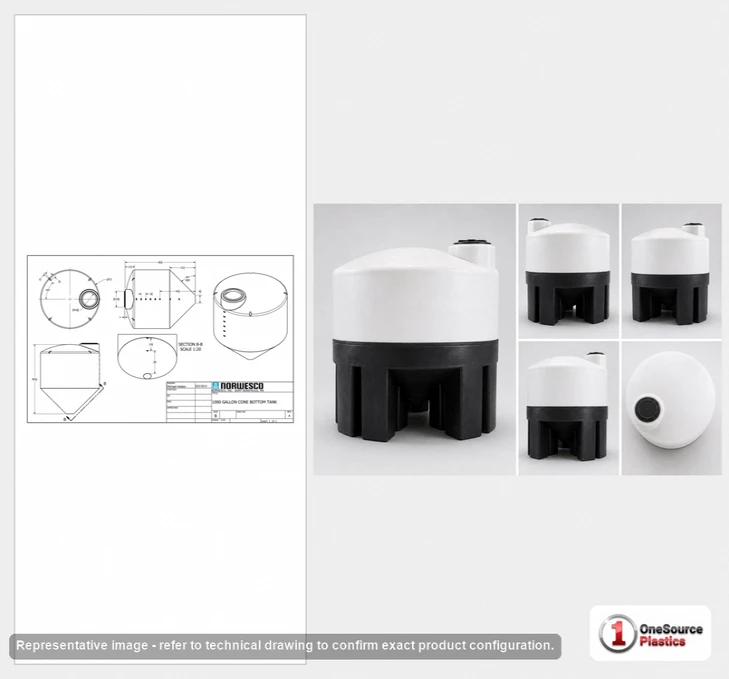
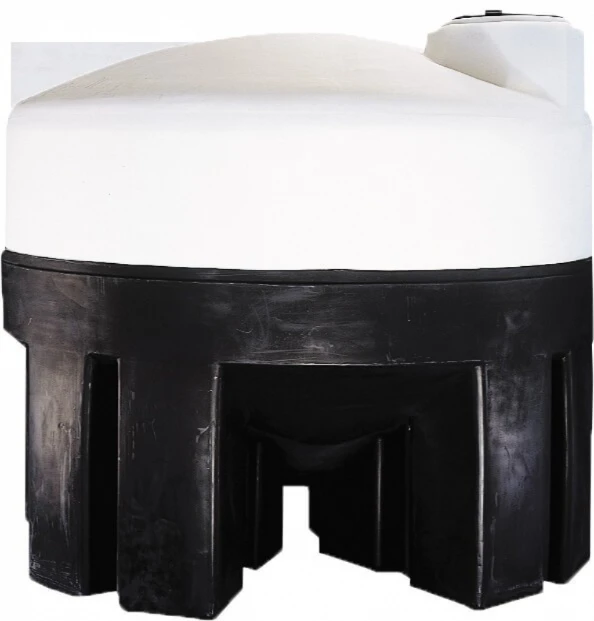
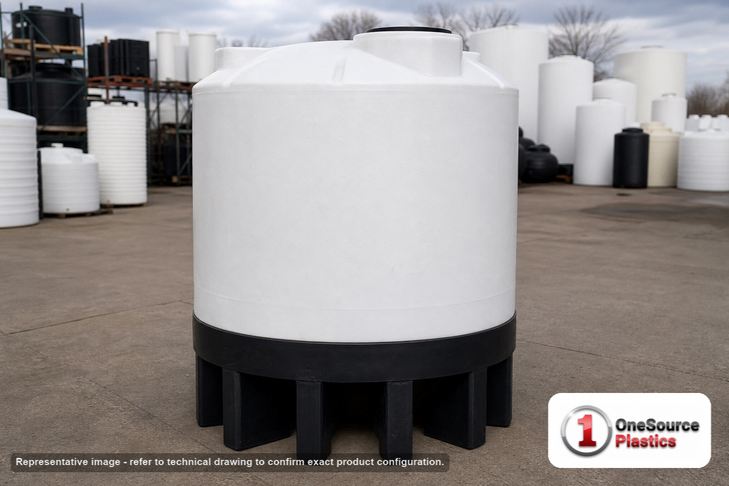
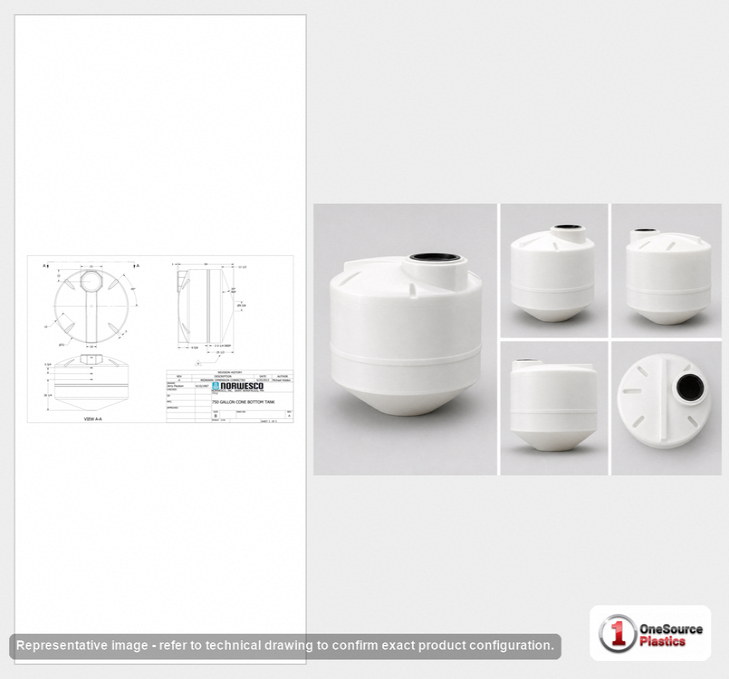
Eight hundred and fifty gallons over a 15 degree cone
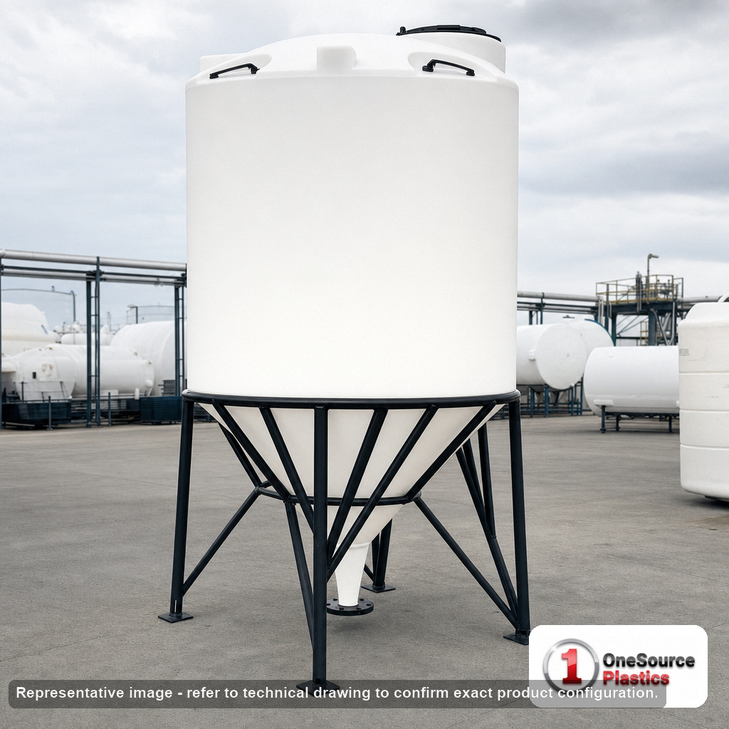
The Snyder SII-1810100N45 is an 850 gallon 15 degree cone bottom tank with a closed top, moulded in white polyethylene. Its sheet lists the tank at 48 inches long, 48 inches wide and 48 inches tall with a 48 inch diameter, and gives 126 pounds empty. The wall is rated at a specific gravity of 1.9, with 7,089 pounds for 850 gallons of water at 8.34 pounds per gallon and 13,469 pounds of max contents. The opening is 18 inches. The 15 degrees comes from the product's own name; the sheet carries no cone angle field, no stand, no outlet and no inlet, and no maximum operating temperature and no warranty term, so this page states none of them. A stand is a separate item. It is moulded at Lincoln, Nebraska, and ships under NMFC 156600-03.
Talk to a person first? 866-418-1777 reaches a tank specialist, not a call center; or see freight to your ZIP and add the 850 gallon tank to your cart above.
Lincoln, Nebraska, and an LTL lane at 126 pounds
Start where the tank starts. This one is moulded at Lincoln, Nebraska, and it moves as ordinary LTL freight at 126 pounds under NMFC 156600-03 rather than as an oversize load, and that combination is the practical argument for this size of cone. A cone bottom tank at the larger end of the range is a booked movement with a route, a window, a machine at the far end and a conversation with the carrier; this one is a pallet on a regular trailer out of the plains, which means the Midwest and the mid-South see it quickly, both coasts see it without a special arrangement, and the lane is a number you can get today rather than a quotation you wait for. Price yours with the freight cost estimator before you settle the size, because on cone tanks the step from LTL to oversize is often a bigger cost difference than the step between two part numbers. What the plant and the weight do not tell you is how the tank is held up, and on a cone that is the whole installation. A cone bottom tank has no flat floor to stand on: the contents leave from the lowest point under their own weight, which is the reason to buy the shape, and the price of it is that the vessel has to sit in a structure. This sheet publishes no stand, no legs, no skirt and no ring, so the support is a separate item and a separate decision, taken before the tank is ordered rather than after it is on the ground. The cone bottom stand compatibility matrix is where that gets worked through across makers, and we will confirm what fits this part number when you ask. Underneath the stand, the requirement is the ordinary one: flat, continuous, level bearing that carries the whole load through the stand's feet, because 7,089 pounds of water at 8.34 pounds per gallon and 13,469 pounds at the rating all arrive on a small circle of floor. Check the volume against your real batch in the tank sizing calculator and take the freeboard from the tank sizing guide before the stand height is fixed.
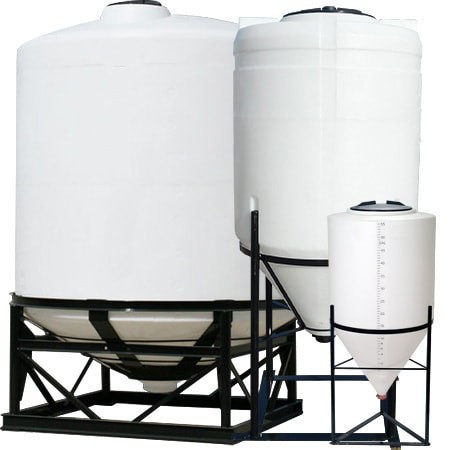
A cone tank, a dry hopper bin and a cone with a poly stand
| Part | Listed as | Length x width x height | Empty weight |
|---|---|---|---|
| SII-1810100N45 (this tank) | 850 gallon, 15 degree cone, closed top | 48 x 48 x 48 in | 126 lb |
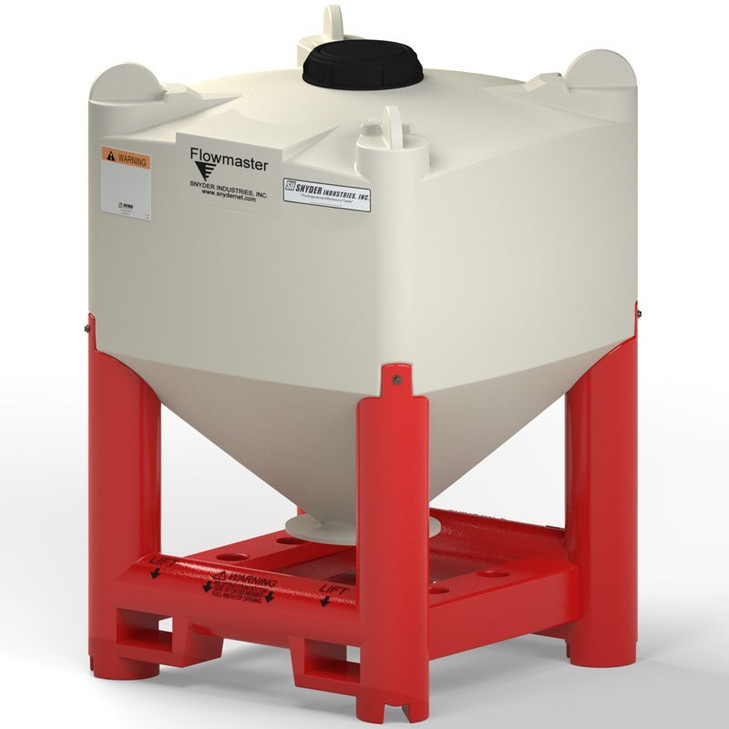
| SII-6370719N95402 (dry hopper bin) | 80 cubic foot, 45 degree cone bottom dry hopper bin | 53 x 48 x 102 in | 385 lb |
| SII-8360037 (cone bottom tank with poly stand 40553) | 3000 gallon cone bottom tank | 95 x 95 x 135 in | 940 lb |
These three are not variants of one another and the middle row is the one to read carefully. SII-6370719N95402 is named on the sheet as an 80 cubic foot capacity 45 degree cone bottom dry hopper bin. If you are storing pellets, powder, granules or feed rather than a liquid, that is the row to ask us about, and the questions are different ones entirely. The third row is a much larger liquid cone: SII-8360037 is listed as a 3000 gallon cone bottom tank at 95 by 95 by 135 inches and 940 pounds, and its own name carries the words with poly stand 40553. We print the name as the sheet spells it and describe no stand, because the sheet describes none. The honest comparison for this 850 gallon tank, then, is against itself. At 126 pounds and a listed 48 inches in every direction it is the small, light, LTL-freight end of the cone bottom range, which is exactly the end where a cone makes sense for a single batch line, a pilot plant or a dosing station rather than a bulk process. The angle in its name is 15 degrees, the shallowest of the common cone angles, and that is the other half of its character: shallow cones pass free-flowing liquid well and hold onto material that packs. If your product settles hard, read the cone angle selection buyer's guide before you commit to this one.
Neighboring size a better fit? Every row links to its own page; freight to your ZIP is quoted on each, or call 866-418-1777.
An eighteen inch opening on a closed top
- Filling: the sheet gives an 18 inch opening on the top of a closed top tank, and that opening is the fill point, the inspection point and the only published route into the vessel. Eighteen inches takes a fill line, a lance, a dip tube and a light; plan the access to it at the same time as the stand, because on a cone the top of the tank is never at floor level.
- What the sheet does not describe: it does not call the opening vented, and it publishes no lid detail beyond the size. We claim no seal, no gasket and no vent arrangement. Tell us how the tank breathes on your duty and we will confirm what this part number carries.
- The discharge: no outlet size and no bulkhead is published on this sheet. The cone ends in a discharge and the sheet does not dimension it, so no number appears here. Give us the line size, the valve type and the product, and we will confirm the part before anything is ordered.
- Supporting the valve: whatever goes below the cone is carried on its own steelwork off the stand, never hung on the tank. That is a rule on a small cone as much as a large one, because the joint at the bottom of a cone is the one place a hanging load has nowhere to go.
- The stand: not on this sheet. No leg, no skirt, no ring and no bolt pattern is published, and a stand is bought as a separate item.
- Limits: the wall is rated at a specific gravity of 1.9. The sheet publishes no maximum operating temperature and no warranty term, and this page states neither.
Where the tank is going to be piped as part of a working line, decide the placement of every opening once rather than drilling twice; the top fitting placement guide sets out how the fill, the vent, the level and the drain are arranged so they do not fight each other or the operator. And where the tank stands over a floor, a drain or ground that would have to be recovered after a release, the containment question is a separate purchase from the tank; the Captor containment comparison puts the contained polyethylene route against the steel one on the points that decide it.
Shallow cone duty where the liquid pours
A cone at this volume is a process vessel for an operation that runs one line rather than a plant. It turns up as a batch or mix tank in a small chemical or coatings shop, a day tank on a dosing skid where the whole charge has to leave between products, a settling or decant vessel in a laboratory or pilot plant, a nutrient or feed tank in a greenhouse or hatchery, a blending tank at an agricultural retailer, and a collection vessel under a process where somebody has to drain the whole thing rather than most of it. The thread through all of them is the changeover. A flat-bottomed tank leaves a layer behind every time the product changes, and at 850 gallons that layer is a rinse, a disposal and an argument about contamination; a cone leaves it in the line instead. The 15 degrees in the name is the shallow end of that trade, which suits a liquid that runs and suits a tank whose height matters, and suits a solids-bearing product considerably less well.
Rated chemistries for this tank
The manufacturer lists these liquids for this resin at the concentrations noted, with the fitting and gasket material to specify. Check the concentration and temperature you actually run on the linked page or in the chemical compatibility database before ordering.
- Acetic Acid (60%) - PP/PVC fittings, EPDM gaskets
- Aluminum Sulfate (50%) - PVC fittings, EPDM gaskets
- Calcium Chloride (40%) - PVC fittings, EPDM gaskets
- DEF (32.5%) - 316SS fittings, EPDM gaskets
- Ethylene Glycol (100%) - PVC fittings, EPDM gaskets
- Ferric Chloride (50%) - PVC fittings, EPDM gaskets
- Ferric Sulfate (60%) - PVC fittings, EPDM gaskets
- Ferrous Sulfate (20%) - PVC fittings, EPDM gaskets
- Hydrochloric Acid (37%) - PVC fittings, Viton gaskets
- Hydrofluoric Acid (48%) - PP/PVC fittings, Viton gaskets
- Hydrofluosilicic Acid (26%) - PP/PVC fittings, Viton gaskets
- Hydrogen Peroxide (50%) - PVC fittings, Viton gaskets
- Magnesium Chloride (30%) - PVC fittings, EPDM gaskets
- Peracetic Acid (30%) - 316SS fittings, Aflas gaskets
- Phosphoric Acid (85%) - PVC fittings, Viton gaskets
- Polyaluminum Chloride - PVC fittings, EPDM gaskets (tested concentration not on file)
- Potassium Carbonate (50%) - PVC fittings, EPDM gaskets
- Potassium Hydroxide (saturated) - PVC fittings, EPDM gaskets
- Propylene Glycol - PP/316SS fittings, EPDM gaskets (tested concentration not on file)
- Sodium Bisulfate - PVC/PP fittings, EPDM gaskets (tested concentration not on file)
- Sodium Bisulfite - PVC/PP fittings, EPDM gaskets (tested concentration not on file)
- Sodium Carbonate (30%) - PVC fittings, EPDM gaskets
- Sodium Hypochlorite (
- Sodium Thiosulfate (40%) - PVC fittings, EPDM gaskets
- Sulfuric Acid (98%) - CPVC fittings, Viton gaskets
- Urea Solution (50%) - PP/PVC fittings, EPDM gaskets
- Zinc Orthophosphate - PP/316SS fittings, EPDM gaskets (tested concentration not on file)
One pallet, one machine, and a short unload
The plant is Lincoln, Nebraska, the freight class reads LTL, which is a shipping mode rather than a numeric class, under NMFC 156600-03, and the shipping size matches the sheet's tank figures at 48 inches in each direction and 126 pounds. Take your lane price from the freight cost estimator; the listed price is before freight. At 126 pounds this is the rare cone bottom tank that does not need a crane booked in advance: a forklift takes it off the trailer and two people can move it on the ground, which means delivery day is an ordinary delivery rather than an event. Use that to your advantage by having the stand assembled and set, and the pad level and cured, before the tank arrives, so the shell goes straight into its structure rather than sitting on a yard where somebody will lean a ladder on it. Set it, seat it fully in the stand, and then fill it with clean water and hold that 7,089 pound load while somebody reads the discharge joint and looks at the stand feet. Take a photograph of the assembled stand and the seated tank before the insulation, the pipework or the cladding goes on, because that picture is the only record of how it was put together. Once it is full and holding, leave it alone for a day before the plumbing goes on; a settled tank is a quiet one.
Freight and documents
Ships from: Lincoln, NE. LTL freight is quoted to your ZIP with the freight cost estimator or by phone at 866-418-1777. The listed price is before freight.
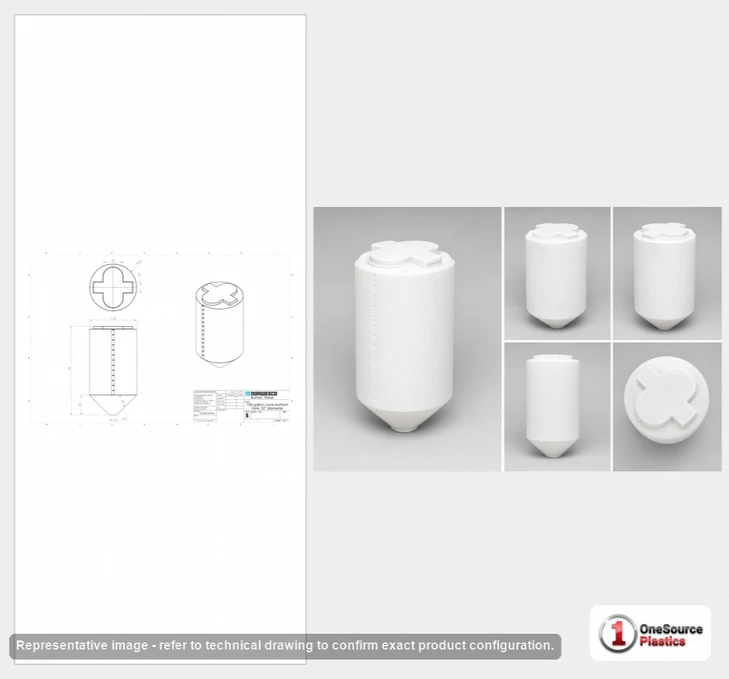
Technical drawing (PDF) for Snyder Industries 1810100N45.
See this tank
Product video. Watch the Snyder Industries 850 Gallon 15 Degree Plastic Cone Bottom Tank video (68 seconds) with dimensions, fittings and shipping notes.
Ready to order?
Add it to your cart at the top of this page, get LTL freight to your ZIP, request a written quote, or call 866-418-1777. The listed price is before freight.