
Hydroponics & Indoor-Ag Tanks: Reservoirs & Nutrient Dosing
Hydroponics & Indoor-Ag Tanks — Reservoirs, Nutrient Dosing, Drain-to-Waste
OneSource Plastics supplies the plastic tank inventory that hydroponic growers, vertical-farm operators, greenhouse fertigation crews, and controlled-environment-agriculture (CEA) facilities use to mix nutrient solution, hold reservoir volume between dosing cycles, separate stock A and stock B concentrate, and capture drain-to-waste effluent. Five OEM brands — Norwesco, Snyder Industries, Chem-Tainer, Enduraplas, and Bushman — cover the small vertical reservoir tanks that fit inside a grow room, the 100- to 500-gallon NSF/ANSI 61 nutrient reservoirs that buffer a small commercial system, the open-top batch tanks for nutrient solution mixing, and the cone-bottom inductors for clean dry-concentrate dissolution.
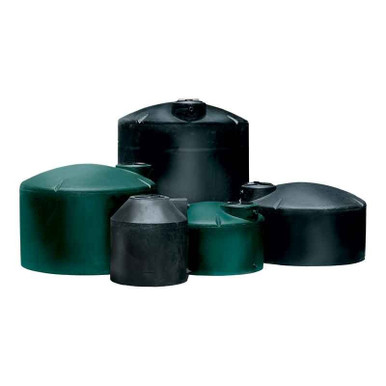
Featured: Snyder Industries 1100 Gallon Plastic Vertical Water Storage Tank in Black — the 1,100-gallon vertical configuration is the standard reservoir size for medium-scale recirculating hydroponic systems and small commercial CEA facilities.
1. Hydroponic and indoor-ag tank applications — an overview
A modern hydroponic or controlled-environment-agriculture facility relies on multiple plastic tanks running different duties at the same time. The main reservoir holds the working nutrient solution between dosing cycles, sized at one to three days of system demand to buffer the pH and EC drift that happens through plant uptake. Stock A and stock B concentrate tanks (calcium-nitrate-bearing stock A and phosphate / sulfate / micronutrient stock B kept separate to prevent in-tank precipitation) hold the concentrated mix that the dosing pump injects into the irrigation line. The pH-up (potassium hydroxide or potassium bicarbonate solution) and pH-down (phosphoric acid or nitric acid solution) day tanks hold the buffering chemistry. Drain-to-waste effluent capture tanks collect runoff for either re-mineralization or proper disposal under local water-quality rules. Cone-bottom inductor tanks support the dry-salt dissolution step at the start of each new batch.
Each duty has a distinct tank choice. Small vertical reservoirs (50 to 250 gallons) cover the residential and tight-footprint commercial spaces. Medium vertical reservoirs (500 to 1,500 gallons) buffer mid-scale recirculating systems and small commercial CEA facilities. Open-top batch tanks (250 to 500 gallons) with covers support nutrient-solution mixing where an operator needs lid access for stir-paddle agitation. Cone-bottom inductors (15 to 60 gallons) handle dry concentrate dissolution. Free-standing applicator skid tanks support fertigation injection on greenhouse benches.
The pages below cover the spec discipline (NSF/ANSI 61 potable rating for any reservoir feeding an FDA-regulated produce operation, opaque versus translucent for algae control, reservoir sizing for the system EC and dosing cadence), the federal regulatory framework (FDA cGMP and the FSMA Produce Safety Rule for commercial food-grade operations), and the chemistry compatibility intelligence that keeps a polyethylene tank inside the manufacturer warranty envelope when the reservoir holds a high-EC nutrient solution or an aggressive pH-down acid.
2. Why OneSource for hydroponic and indoor-ag tanks
Five OEM brands, one catalog. Snyder Industries fills the vertical water-storage range from 100 to 5,000 gallons (the WB42 1,100-gallon and WB46 1,500-gallon are the most-specified mid-scale reservoirs). Norwesco covers the small vertical 15- to 500-gallon tank line plus the cone-bottom inductor configurations. Chem-Tainer fills the small 7- to 250-gallon vertical reservoirs and open-top batch tanks for tight grow-room footprints. Bushman supplies the small vertical configurations for residential and tight-commercial CEA. Enduraplas adds the transport tank with integrated steel frame for relocating reservoirs between facility build-outs. We carry every geometry and walk the operator through the trade-offs before quoting.
NSF/ANSI 61 for water-contact safety. Reservoir tanks supplying water and nutrient solution to an FDA-regulated produce operation should carry the NSF/ANSI 61 designation, the consensus material standard for products in contact with drinking water. Every Snyder, Norwesco, and Bushman water-storage SKU on this catalog ships from FDA-compliant resin and the OEMs publish NSF/ANSI 61 certification on the product line; we label this on every product page and decline to misrepresent a non-rated tank as NSF/ANSI 61 to close a sale.
Opaque versus translucent. Translucent tanks pass light through the wall and accelerate algae growth in any nutrient solution; the green tint that appears in a translucent reservoir within days of filling is photosynthetic algae using the dissolved nutrients. Opaque tanks (black, dark green, dark mocha) block light and prevent the algae bloom. Specifying opaque is the default for any nutrient-bearing reservoir; translucent should be reserved for clear-water applications where the operator needs visual fill-level reading.
Pricing transparency. Every product page lists a current price before freight. LTL freight to the destination ZIP is quoted separately through the freight cost estimator or by phone at 866-418-1777. List prices on this site exclude freight; nothing on this catalog ships freight-included by default. Multi-tank facility build-out orders benefit from quote-desk freight consolidation across SKUs.
3. Tank solutions for hydroponics and indoor-ag
The product strip below pulls live inventory from our hydroponic and indoor-ag catalog — small vertical reservoirs in the 50- to 250-gallon range for tight grow-room footprints, medium 500- to 1,500-gallon vertical reservoirs for mid-scale recirculating systems, open-top batch tanks for nutrient-solution mixing, and cone-bottom inductors for dry-concentrate dissolution.
Need a specific size or fitting layout? Use our tank sizing calculator to translate system EC plus daily uptake into the right reservoir capacity, or open a custom-fabrication request for non-stock geometries such as low-profile reservoirs that fit under bench tops, multi-compartment stock tanks that segregate A and B concentrate in a single footprint, or temperature-controlled jacketed reservoirs.
4. Chemical compatibility intelligence for hydroponic chemistries
Hydroponic nutrient solutions and pH buffering chemistries cover a defined set of single-salt and multi-salt formulations. The pillars below cover the chemistries that drive the largest share of CEA-facility tank purchases. Each pillar covers the resin compatibility matrix, the working-concentration envelope, and the operator handling protocol.
- Calcium Nitrate (Ca(NO3)2)
- Potassium Thiosulfate (0-0-25-17S blend)
- Potassium Hydroxide (pH-up base)
- Phosphoric Acid (pH-down)
- Hydrogen Peroxide (root-zone oxidizer)
The full chemical compatibility database indexes 500+ chemistries; an operator running custom multi-stage fertigation or a CEA facility working with non-standard amendments should cross-check every chemistry on the chemistry pillar before refilling a polyethylene tank.
5. Regulatory considerations for hydroponic and indoor-ag tanks
Federal regulations governing controlled-environment-agriculture and hydroponic produce production rest on the FDA food-safety framework. The compliance officer at a commercial CEA facility should treat each rule as a checklist item during facility design.
21 CFR 110 / 117 — FDA current Good Manufacturing Practice (cGMP). Any operation manufacturing, processing, packing, or holding human food must meet the cGMP rules. For a hydroponic operation the cGMP framework covers the water and nutrient solution that contacts the edible portion of the crop, the equipment and tank materials that contact that water, the sanitation procedures, and the personnel hygiene. Tanks supplying water that contacts the edible crop should carry the NSF/ANSI 61 material designation and should sit in a sanitation program documented in the facility's food-safety plan.
21 CFR 112 — FDA Produce Safety Rule under FSMA. The Produce Safety Rule sets agricultural-water quality standards, sanitation rules, employee training requirements, and recordkeeping for produce growers above the small-farm exemption threshold (operations with average produce sales above 25,000 dollars per year over the prior three years). Subpart E covers the agricultural-water requirements: water that contacts the edible portion of produce during production must meet specific microbial criteria; the facility must perform water testing on a defined cadence and must maintain water-system records. Hydroponic and CEA operators above the exemption threshold must integrate the rule into the food-safety plan.
7 CFR 205 — USDA National Organic Program. Operators marketing CEA-grown produce as organic must work from the National List of allowed substances (7 CFR 205.601 for crop production). The USDA standards apply to soil-bound organic agriculture; certified organic certification for hydroponic and aquaponic systems remains an active policy debate, and certified-organic status for hydroponic produce currently depends on the certifying agent's interpretation. Operators pursuing organic certification for a hydroponic operation should engage the certifying agent during facility design to confirm the agent's position.
NSF/ANSI 61 — material safety for water-contact products. The consensus material standard published by NSF International covers the chemical leaching characteristics of products that contact drinking water. Tanks rated NSF/ANSI 61 are produced from FDA-compliant resin and have completed the certification testing. Specifying NSF/ANSI 61 reservoirs is the default for any commercial CEA facility supplying produce to retail or institutional buyers.
NSF/ANSI 51 — food-equipment materials. The companion standard NSF/ANSI 51 covers the materials used in food equipment (tanks, lines, fittings, fixtures). The standard is the reference for any equipment surface that contacts food during processing, holding, or packing. CEA facility designers selecting tanks for post-harvest rinse, sanitation, or product-contact duty should specify NSF/ANSI 51 rated tanks.
State and local water-quality overlays. Several states (California, Washington, Oregon, New York) impose state-specific water-quality rules on commercial agriculture and CEA operations beyond the federal baseline. State-specific rules are summarized on our state regulatory pages linked from the state regulations index.
6. Field handling and procurement for CEA operators
Sizing the reservoir. Hydroponic system water demand depends on plant species, growth stage, system type (deep-water-culture, nutrient-film, drip-to-waste, ebb-and-flow), light intensity, and ambient conditions. A working rule of thumb for medium-light leafy-green production is 0.25 to 0.50 gallons per plant per day at full canopy; tomato and cucumber production runs 0.5 to 1.5 gallons per plant per day. The reservoir should hold one to three days of system demand to buffer pH and EC drift between dosing cycles. A 1,000-plant leafy-green system at 0.40 gallons per plant per day plans on 400 gallons per day — a 1,100-gallon Snyder WB42 reservoir holds two-and-a-half days of demand. Larger systems split the reservoir across multiple tanks to enable rotation through cleaning cycles.
Stock A and B segregation. Concentrated calcium-bearing stock A solution mixed with phosphate-bearing or sulfate-bearing stock B will precipitate calcium phosphate or calcium sulfate inside the concentrate tank, plug the dosing line, and block the discharge nozzle. Segregating stock A and stock B into separate concentrate tanks is the standard CEA practice; the dosing pump injects each concentrate into the irrigation flow downstream of the reservoir, where dilution prevents the precipitation reaction. Two 50- to 100-gallon vertical or doorway-style tanks colocated with the dosing skid satisfy the duty.
pH buffering chemistry handling. pH-down (typically phosphoric acid at 75 percent or nitric acid at 60 percent for higher-pH-suppression duty) requires a tank rated for acid service; HDPE tolerates dilute solution but the concentrated stock should sit in a chemical-rated XLPE tank or a smaller vented carboy with appropriate secondary containment. pH-up (potassium hydroxide solution at 25 to 50 percent or potassium bicarbonate solution) handles cleanly in standard HDPE. The operator should never combine pH-up and pH-down in the same secondary containment dike; the neutralization reaction produces heat and a foaming overflow.
Sanitation cycle. Reservoirs should rotate through a full sanitation cycle on a defined cadence (every 7 to 30 days depending on the system and the operator's food-safety plan): drain the reservoir, scrub the interior with a non-foaming detergent, rinse, sanitize with a hydrogen-peroxide or peracetic-acid solution at the labeled concentration, rinse, refill with fresh water, and re-mineralize before returning to service. The sanitation cycle is the most common reason an operator runs paired reservoirs — one in service, one in cleaning rotation.
Procurement cadence and pricing. Standard hydroponic and CEA plastic tanks ship from manufacturer warehouses in two to four weeks for stock SKUs; specialty colors and the larger 5,000-gallon configurations run four to eight weeks. List prices on this site reflect the current OEM published pricing before LTL freight; freight to the destination ZIP is quoted separately through the freight estimator or by phone. Multi-tank facility build-out orders benefit from quote-desk freight consolidation.
7. Custom fabrication when stock will not fit
Specialty hydroponic and CEA geometries route through our specialty & metal fabrication network. Typical custom builds: low-profile reservoirs that fit under greenhouse bench tops or vertical-farm racking, multi-compartment stock tanks that segregate A and B concentrate in a single footprint, jacketed temperature-controlled reservoirs for cold-climate or warm-climate buffering of root-zone temperature, and integrated dosing-skid mounts that bolt directly to the reservoir top. Lead times run six to twelve weeks depending on complexity; the quote desk runs the spec dialogue with the fabricator and stays involved through commissioning.
8. Next steps for the CEA operator
Quote the freight to the facility. Every product page lists a price before freight. Get the LTL freight quote to your facility ZIP through the freight cost estimator, or call 866-418-1777 for a phone quote with the SKU plus destination ZIP plus dock-or-residential delivery indication.
Match the chemistry to the resin. Use the chemical-to-tank recommender to filter by amendment chemistry plus capacity; the tool returns the ranked stock options with current pricing.
Open a custom request. If the facility build-out spec falls outside the stock-tank envelope, the custom-fabrication request form routes the project to the right shop and the quote desk follows up the same business day. Include the system type, plant count, daily water demand, and any footprint or temperature-control constraints.