
Oil and Gas Plastic Tanks - Produced Water, Methanol, Brine, Frac Storage
Oil and Gas Plastic Tanks — Produced Water, Methanol, Brine, Frac Storage
OneSource Plastics supplies the upstream and midstream oil-and-gas operator with the bulk plastic tank inventory needed for produced-water gathering, methanol storage, brine handling, frac-fluid stage tanks, and chemical-injection skids at the wellhead. Five OEM brands — Norwesco, Snyder Industries, Chem-Tainer, Enduraplas, and Bushman — cover the configurations that meet the resin-and-specific-gravity envelope demanded by oilfield chemistry. The Snyder Captor double-wall line at 1.9 specific gravity sits at the center of the catalog for produced water with elevated chloride and TDS, methanol storage, and any chemistry that benefits from integral secondary containment without a poured concrete dike.
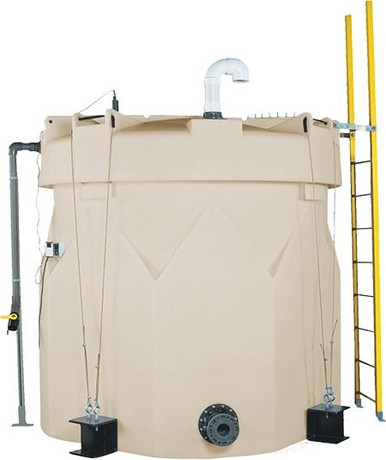
Featured: Snyder 10,000 Gallon XLPE Captor Double Wall Liquid Storage Tank - 1.9 Specific Gravity — the workhorse 10,000-gallon XLPE Captor configuration for high-SG oilfield service where the chemistry, the regulator, and the operations footprint all push toward integral double wall.
1. Oil and gas applications — an overview
Oil-and-gas tank duty splits across the well-life cycle. Drilling phase: water-based and oil-based mud storage, mud-pit auxiliaries, freshwater make-up tanks, and the chemical-additive day tanks for viscosifiers and weighting agents. Completion phase: frac-fluid mix tanks, slickwater stage tanks, hydrochloric acid stage tanks for matrix and acid-frac jobs, friction-reducer storage, and produced-water collection during flowback. Production phase: produced-water gathering and recycling tanks, methanol injection storage at the wellhead and along gas-gathering lines for hydrate prevention, glycol regeneration tanks at dehydration units, and the chemical-injection skid tanks for scale inhibitor, corrosion inhibitor, paraffin inhibitor, biocide, and demulsifier.
Each phase carries distinct chemistry, distinct regulatory exposure, and distinct field logistics. Drilling tanks come and go with the rig; production tanks sit on a battery for years. Frac stage tanks are deployed and demobilized inside a 30-to-90-day completion window. Chemical-injection skid tanks at a producing well live in the open weather of the basin for the full economic life of the well. The pages below explain the spec discipline, the resin-versus-chemistry compatibility matrix, the federal and state regulatory framework that governs each tank class, and the procurement reality of buying tanks in the oilfield segment.
2. Why OneSource for oil and gas
1.9-SG discipline for high-density chemistry. Oilfield brines, produced water with elevated chloride, methanol, and many of the heavy-mud feedstocks carry specific gravities above 1.5 and into the 1.7 to 1.9 range. The Snyder Captor double-wall line and the Snyder vertical chemical-storage line at 1.9 SG are engineered for these chemistries. Specifying a 1.5-SG tank for a 1.7-SG fluid voids the manufacturer warranty and accelerates wall fatigue. Our oilfield catalog flags the SG rating on every product page, and the chemical-tank recommender filters by SG plus chemistry plus capacity in one query.
Captor double-wall for integral containment. Outdoor wellhead and battery sites often lack the pad space for a poured-concrete dike around a single-wall tank, and the regulator may require secondary containment regardless. The Snyder Captor line at 550, 2500, 3000, 3500, and 10,000 gallons provides factory-built integral containment in a single shipped unit; the tank arrives, lands on the pad, and is in compliance with secondary-containment rules from the day the gauge stick goes in.
Methanol storage that handles the chemistry. Methanol storage at gas-processing and gathering sites pushes XLPE and FRP, not HDPE alone. The chemical compatibility data for methanol against linear HDPE shows acceptable short-term service but elevated stress-cracking risk on long-term outdoor exposure with thermal cycling. The Captor XLPE configuration is the standard upgrade for methanol storage above the 500-gallon scale; we keep the spec conversation grounded in the published Snyder and Enduraplas chemical compatibility charts rather than third-party reseller marketing copy.
Five-brand discipline. Norwesco, Snyder Industries, Chem-Tainer, Enduraplas, and Bushman cover the legitimate domestic plastic-tank market for oilfield service. We do not pad the catalog with off-brand imports. The five-brand discipline keeps the spec conversation grounded in published OEM technical-bulletin data.
Pricing transparency. Every product page lists a current price before freight. LTL freight to the destination ZIP is quoted separately through the freight cost estimator or by phone at 866-418-1777. List prices on this site exclude freight; nothing on this catalog ships freight-included by default. Listed at $X is the convention used across this catalog.
3. Tank solutions for oil and gas
The product strip below pulls live inventory across the Captor double-wall line, the 1.9-SG XLPE vertical chemical-storage line, and the higher-volume single-wall configurations used at battery and produced-water-recycling sites. Cards refresh from the live BigCommerce catalog so the price, stock status, and image reflect the current state at page load.
Volume programs for multi-well batteries and basin-scale produced-water deployments are coordinated through our quote desk at 866-418-1777. Provide the chemistry, the SG, the capacity per location, and the count, and the desk routes a unit-price quote against the manufacturer volume program back the same business day.
4. Chemical compatibility intelligence for oilfield chemistries
Oilfield chemistry is one of the more demanding compatibility envelopes in industrial storage. Produced water carries chloride, TDS, dissolved hydrocarbon, dissolved gas (CO2 and H2S in sour-service basins), and a temperature window that depends on the produced-fluid arrival temperature at the tank. Methanol service combines a flammability concern (NFPA 30 Class IB flammable) with a polymer compatibility constraint that pushes toward XLPE over HDPE. The pillars below cover the chemistries that drive the largest share of oilfield tank purchases.
- Produced Water
- Methanol
- Hydrochloric Acid (Frac Acid)
- Slickwater Frac Fluid
- Drilling Mud (Water-Based)
- Drilling Mud (Oil-Based)
- Scale Inhibitor (Phosphonate)
- Corrosion Inhibitor (Imidazoline)
- Paraffin Inhibitor
- Ethylene Glycol (MEG)
The full chemical compatibility database indexes 500+ chemistries, including the friction reducers, biocides, and demulsifier blends used in completion and production chemistry programs. Sour-service basins should also reference the H2S-handling notes in the produced-water pillar.
5. Regulatory considerations for oil and gas tanks
Oil-and-gas operations sit at the intersection of federal environmental rules, federal worker-safety rules, federal transportation rules, and state oil-and-gas conservation rules. The operator should treat each rule as a checklist item during tank specification rather than as background reading.
40 CFR 144 / 40 CFR 146 — Underground Injection Control (UIC). Class II injection wells (saltwater disposal and enhanced recovery) are regulated under the UIC program at 40 CFR 144 and 146. Surface tankage at a saltwater-disposal facility holds produced water before injection; the tankage is governed by the UIC permit conditions plus the state oil-and-gas conservation rule that delegates UIC authority. Tank integrity, secondary containment, and overflow prevention are inspected as part of routine UIC compliance.
30 CFR 250 — BSEE Outer Continental Shelf operations. Offshore platforms regulated by the Bureau of Safety and Environmental Enforcement use 30 CFR 250 as the master rule for production safety systems, including atmospheric storage tanks for produced fluids and chemical inventory.
49 CFR 178 / 180 — DOT cargo-tank specs and continuing qualification. Over-the-road transport of produced water, frac sand slurry, methanol, hydrochloric acid for completions, and any other oilfield fluid in commerce above the 119-gallon non-bulk threshold requires a DOT-spec cargo tank under 49 CFR 178, with continuing qualification testing per 49 CFR 180. The plastic stationary tanks in this catalog are not DOT cargo tanks; they are stationary storage tanks for site service and for dedicated farm and field exemptions under the appropriate sections of 49 CFR 173.
40 CFR 112 — SPCC. Aggregate aboveground oil storage above 1,320 gallons triggers a written SPCC plan covering secondary containment, integrity testing, and personnel training. Production sites with any combination of tanks (oil, condensate, waste oil) above the threshold maintain an SPCC plan and a Facility Response Plan if the substantial-harm criteria at 40 CFR 112.20 apply.
29 CFR 1910.119 — PSM. The OSHA Process Safety Management standard applies to processes that handle highly hazardous chemicals above the threshold quantity in Appendix A. Gas-processing facilities holding flammable hydrocarbon mixtures above 10,000 lb fall under PSM; the chemical inventory at a wellhead chemical-injection skid typically sits below the threshold but should be confirmed against the Appendix A list during the project hazard analysis.
API 12 series — Tank specifications. The American Petroleum Institute publishes the canonical specifications for oilfield production tanks: API 12B (bolted tanks), API 12D (large welded shop-built tanks), API 12F (small welded shop-built tanks), and API 12P (fiberglass-reinforced plastic tanks). The plastic tanks in this catalog are not API-12P FRP; they are rotomolded polyethylene tanks built to ASTM D1998 (the standard specification for polyethylene upright storage tanks). Specifiers requiring API-12P FRP route through our custom-fabrication network.
API 510 / API 653 — Inspection of in-service tanks. API 653 governs the inspection, repair, alteration, and reconstruction of welded steel aboveground storage tanks. Polyethylene tanks fall outside API 653 scope; the in-service inspection cadence for polyethylene production tanks follows the manufacturer recommended interval (typically annual visual inspection with full-discharge inspection at five years).
State oil-and-gas conservation rules. Every producing state has a conservation agency with rules covering tank registration, secondary containment, spill reporting, and produced-water management. Texas Statewide Rule 8 (16 TAC Chapter 3, Rule 8) covers waste from oil-and-gas operations. New Mexico Oil Conservation Division Rule 19.15.34 NMAC covers pit construction and tank standards. North Dakota Industrial Commission rule chapter 43-02 covers oilfield production tanks. The state pillars at our state regulations index link to each state agency for the project location.
6. Field handling and procurement
Resin selection by chemistry. HDPE (1.5 SG, linear polyethylene) handles freshwater make-up, low-chloride produced water, and many of the chemical-injection feedstocks at ambient temperature. XLPE (1.9 SG, cross-linked polyethylene) raises the engineering margin for methanol storage, high-chloride produced water, brine, and any chemistry where the published HDPE compatibility shows borderline service. FRP vinyl ester (Derakane 411 / 441 series) takes the chemistries that polyolefins cannot hold — concentrated mineral acids for completion fluids above ambient temperature, certain solvent mixtures, and high-temperature glycol-regeneration service.
Specific gravity discipline. The single most common spec error in oilfield tank purchasing is under-rating the SG of the stored fluid. Produced water with high TDS can carry SG above 1.20; saturated brine pushes 1.20 to 1.24; calcium chloride completion brine at 11.6 lb/gal density has SG 1.39; calcium-bromide-zinc-bromide heavy completion brines push 1.7 to 2.3. Match the SG rating on the tank wall plate to the actual fluid SG, not to the historical-average SG for the fluid name. When in doubt, specify up to the next 1.9-SG configuration.
Secondary containment in field deployments. Captor integral double wall is the lowest-friction path to compliance at outdoor wellhead, battery, and disposal sites. The alternative is a single-wall tank inside a steel-ring bermed pad with a chemical-resistant liner, which adds installation cost, takes pad real estate, and accumulates rainwater that must be tested and managed. The integral double-wall configuration eliminates the rainwater-management workflow and arrives ready to commission.
Cold-weather considerations. Polyethylene tank impact strength drops as temperature drops; ASTM D1998 specifies the design temperature window. Northern-tier basins (Bakken, Niobrara DJ basin north of I-70, Marcellus, Western Canadian Sedimentary Basin) should specify XLPE or impact-modified HDPE for outdoor service, and the tank should sit on an unobstructed pad to avoid stress-concentration loading from frost heave or uneven ice formation.
Procurement cadence and pricing. Standard plastic oilfield tanks ship from manufacturer warehouses in two to six weeks depending on size, color, and fitting layout. Captor double-wall configurations at 8,000 gallons and above run six to twelve weeks. List prices on this site reflect the current OEM published pricing before LTL freight; freight to the destination ZIP is quoted separately. Volume programs for multi-tank basin deployments are coordinated through our quote desk.
7. Custom fabrication when stock will not fit
Specialty oilfield tank geometries route through our specialty & metal fabrication network. Typical custom builds for the oil-and-gas segment: API-12P fiberglass-reinforced plastic tanks for produced-water service where the operator standard requires API spec; dual-laminate FRP (PVDF or polypropylene liner with FRP structural) for hot acid completion-fluid storage above 150 degrees F; jacketed polyethylene for cold-climate methanol storage where the dispense temperature must stay above the freezing point; and bespoke skid-mounted chemical-injection tanks for multi-product injection programs. Lead times run six to sixteen weeks depending on complexity. The quote desk runs the spec dialogue with the fabricator and stays involved through commissioning.
8. Next steps
Quote the freight. Every product page lists a price before freight. Get the LTL freight quote to the well-site or yard ZIP through the freight cost estimator, or call 866-418-1777 for a phone quote with the SKU plus destination ZIP plus dock-or-residential delivery indication.
Match the chemistry and the SG. Use the chemical-to-tank recommender to filter by chemistry plus SG plus capacity plus configuration. The tool returns the ranked stock options with current pricing.
Open a custom request. If the spec falls outside the stock-tank envelope — API-12P FRP, jacketed polyethylene, dual-laminate, or anything skid-mounted with integrated dispense — the custom-fabrication request form routes the project to the right shop and the quote desk follows up the same business day. Include the chemistry, SG, working temperature, capacity per location, and any pad or footprint constraints.