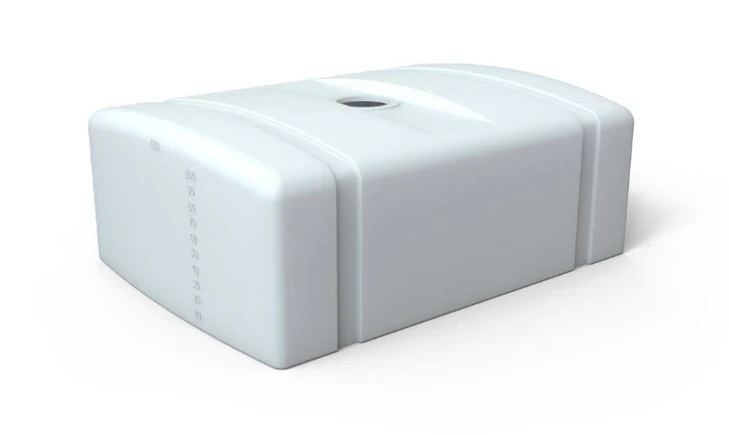
A stainless steel securing hoop, named for a seven hundred and thirty gallon tank
The Snyder SII-45400002 is listed as Hoop 730 Gal (1), a securing hoop in stainless steel, grey, filed by Snyder under metal tank bands. The sheet gives it as 36 inches long, 48.63 inches wide and 42 inches tall, at 45 pounds, with a ship weight of 50 pounds in a crate measured at 36 by 49 by 42 inches. The 730 gallons is part of the product name, not a capacity this part has, and the (1) is part of the name as well; this page prints both as name and reads nothing further into either. That distinction matters, so here it is plainly: the sheet carries no capacity figure for this part, no full-of-water weight, no specific gravity rating, no maximum operating temperature, no warranty and no certification entry, and it carries no load rating, no band length, no hardware list and no list of tanks this hoop is matched to. None of those is claimed anywhere on this page. Freight reads LTL in both the class and the mode field, under NMFC 178690, from a plant list of Albertville, Marked Tree, Merced, Lincoln and Philippi.
Ready to price it? The listed price is before freight; quote freight to your ZIP in a few seconds, then add to cart above or call 866-418-1777.
A hoop is a band, and what its name does and does not tell you
The family question here is the difference between a hoop and every other way of holding a tank down, and it is worth being precise about, because the words get used loosely on site. A hoop is a band that goes around a vessel. It works by encircling, which means it does not need a hole in anything, does not need a fixing through a wall, and does not put a point load anywhere on a moulded surface; it spreads its grip around the circumference. That is why bands exist and it is why they are the right answer on plastic vessels, where anything that pulls on one spot is an argument the plastic eventually loses. What a hoop is not is a strap you tension by feel, a ratchet strap from the back of a truck, or a bracket. It is a sized steel part that belongs to a particular vessel geometry, which is exactly why the name carries a tank size in it. Take the name for what it is. Snyder calls this Hoop 730 Gal (1), and that string is the maker's own designation for the part. This page will not turn it into a compatibility statement, will not tell you it fits your tank, and will not tell you what the (1) counts, because the sheet does not say. If you are ordering a hoop for a vessel you already own, quote us the tank part number and we will confirm the hoop against it with Snyder before anything ships; if you are buying tank and hoop together, order them together and let the pairing be the maker's answer rather than ours. The second half of the question is what the hoop is being asked to resist, and that is where the buyer has to be honest with themselves. An empty plastic tank is light and a full one is not, so the risk window for wind, for movement, for a vessel walking on a slab, is when it is empty or nearly so; that is the moment bands are for. Fit them early, before the first fill and before the first weather, rather than after a windy night has answered the question. The sheet publishes no load rating and no wind figure for this part, so nothing here tells you what it will hold. What it does tell you is the material, the dimensions and the weight, and the rest is a conversation with the tank in front of us.
One hoop on the sheet, nothing beside it
| Part | What the sheet gives it | Dimensions | Weight |
|---|---|---|---|
| SII-45400002 (this hoop, stainless steel, grey) | No load rating and no tank pairing published | 36 x 48.63 x 42 in | 45 lb listed, 50 lb to ship |
The sibling list on this sheet is empty, so there is one row here and no range table. On a part whose whole purpose is to match a particular vessel, that is a real limitation of the published data rather than a stylistic choice, and pretending otherwise would be the wrong kind of helpful. So the route to the right part runs through the tank. Tell us the vessel: the part number if you have it, or the capacity, the diameter and the height if you do not, plus whether it is standing indoors or out and what it is standing on. We will take that to Snyder and come back with the hoop that belongs to it, and with how many the vessel takes. That last question is one people forget until the parcel arrives.
Want us to check the fit? Send the site dimensions to 866-418-1777 or through a written quote request and we will confirm the tank, the pad and the freight.
Stainless steel, grey, and no rating printed on it
- Material: stainless steel, listed grey. No grade, no finish, no coating and no corrosion statement is published on this sheet, so none is stated here. Stainless is the material field's word and that is as far as it goes.
- Load: no load rating, no working limit, no wind figure and no tension specification appears on this sheet. That is the field buyers most want and the one we will not fill by inference; ask us with the tank named and we will get it in writing.
- Fixing: no hardware list, no bolt size, no anchor detail and no fitting instruction is published. What a band is anchored to is part of the installation design, and on any outdoor vessel it is designed with the pad rather than improvised afterwards.
- Dimensions: 36 inches by 48.63 inches by 42 inches as listed, at 45 pounds. Those are dimensions of the part, not a fit list, and the sheet publishes no list of tanks it goes around.
- The tank name in the part name: 730 gallons appears in the product name. It is a name, not a capacity this hoop has and not a compatibility claim, and this page treats it as a name throughout.
- What is not rated: no temperature, no pressure, no warranty and no certification is on this sheet. There is nothing hidden in that sentence; it is simply an accessory with a short specification.
Quote us the tank when you order a band. This is the one part in the range where the vessel is the specification and the part number on its own tells you almost nothing.
What a securing band is actually for
Bands earn their money in a narrow set of circumstances and they earn it decisively. An outdoor vessel standing empty or part full in wind, which is the classic case and the one that costs people tanks. A tank on a slab in an exposed yard where there is nothing upwind of it. A vessel that has to stay where it was set because the pipework going into it is rigid and unforgiving. A tank on a site where a written procedure calls for restraint. A vessel that is drained down regularly as part of its duty, which means it spends real time in the light condition rather than passing through it once a year. What all of those share is that the danger is not the storm, it is the storm plus an empty tank. The practical discipline is short. Get the restraint on before the first fill and before the first weather. Check the tension after the first windy week. Check it again after the first full summer, because plastic in the sun does not stay exactly the size it was in spring, and a band that was right in April can be slack in August. Then look at it on a schedule alongside the tank rather than only when somebody remembers.
Forty-five pounds listed, fifty pounds on the truck
This part is listed against five plants, Albertville, Marked Tree, Merced, Lincoln and Philippi, with Alabama, Arkansas, California, Nebraska and West Virginia as the shipping states, which is the widest plant list in the batch. The class field and the mode field both read LTL, under NMFC 178690. The sheet gives 45 pounds as the part weight and 50 pounds as the ship weight, crated at 36 by 49 by 42 inches, and both figures are printed here as given. That is a freight item rather than a parcel: it comes off a truck, it is awkward rather than heavy, and it wants two people and somewhere to put it down. Price the lane to your ZIP with the freight cost estimator; the listed price is before freight. Check the part against the tank before the crate is broken down, and keep the paperwork with it, because a band that ends up in a yard with nothing to identify it becomes scrap the following winter. If it is going on a tank that is already standing, plan the fitting for a still day; nobody should be working a steel hoop around a vessel in the wind it was bought to resist. A photo of the tank on its pad, full, on day one is worth keeping; it is the baseline every later inspection is compared against.
Freight and documents
LTL freight is quoted to your ZIP with the freight cost estimator or by phone at 866-418-1777. The listed price is before freight.
Technical drawing (PDF) for Snyder Industries 45400002.
Ready to order?
Add it to your cart at the top of this page, get LTL freight to your ZIP, request a written quote, or call 866-418-1777. The listed price is before freight.