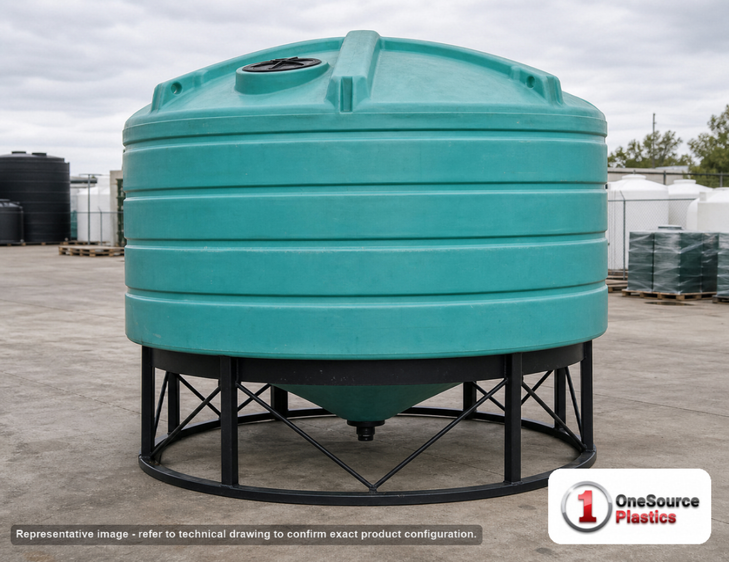
The Enduraplas 2520 Gallon Green Cone Bottom Tank (SKU THC02520G) is a full-drain polyethylene vessel built for bulk chemical storage and metered dosing where you need every gallon to evacuate cleanly. It holds 2,520 gallons, stands 99 inches tall on a 110 x 110 inch footprint, and carries a 1.9 specific gravity rating - meaning it is engineered to hold heavy, dense chemistries, not just water. This is the cone tank, cone bottom tank shoppers reach for when settling solids, sludge, or precise drawdown matter.
Will it work for your application?
Start with weight, because a cone bottom tank lives on a stand and the stand has to carry the load. Filled with water, this Enduraplas tank weighs about 21,017 lbs. At its maximum 1.9 SG rating, contents alone can reach 39,932 lbs - that is the number your stand, anchoring, and slab must be sized against, not the water figure. Before you order, confirm your stand is rated for this diameter and load using our cone bottom tank stand compatibility matrix for Norwesco, Snyder, and Enduraplas. To check that 2,520 gallons matches your turnover and dosing volume, run the numbers through our Tank Sizing Calculator or read the Tank Sizing Guide. No factory fitting package is documented for this SKU on file here, so the outlet size and location are specified per order - confirm them against the technical drawing on this page, which also carries the full geometry and dimensional callouts, and spec your bulkhead materials from the compatibility table below.
Chemical compatibility - confirm resin before oxidizer service
This tank carries a 1.9 specific gravity rating, which is what makes it suitable for dense acids and concentrated solutions rather than water alone. Before anything else: the resin classification on file is recorded as HDLPE with a question mark. Confirm with the manufacturer whether your unit is HDLPE (high-density linear) or XLPE (cross-linked) before committing it to chemical service - that distinction changes long-term resistance to oxidizers, and the compatible list below includes Hydrogen Peroxide (50%), Sodium Hypochlorite (<16.5%), and Peracetic Acid (30%), where it matters most. Do not take the table as resin-verified until you have that answer.
Within the 1.9 SG rating, the following chemicals are compatible at the listed concentrations and fitting/gasket pairings. The dense chemistries here - Ferric Chloride (50%), Sulfuric Acid (98%), Phosphoric Acid (85%), and Calcium Chloride (40%) - are exactly why this tank is rated 1.9 SG rather than a standard 1.5, which would be derated below their density:
- Acetic Acid (60%) - PP/PVC fittings, EPDM gaskets
- Aluminum Sulfate (50%) - PVC fittings, EPDM gaskets
- Calcium Chloride (40%) - PVC fittings, EPDM gaskets
- DEF (32.5%) - 316SS fittings, EPDM gaskets
- Ethylene Glycol (100%) - PVC fittings, EPDM gaskets
- Ferric Chloride (50%) - PVC fittings, EPDM gaskets
- Ferric Sulfate (60%) - PVC fittings, EPDM gaskets
- Ferrous Sulfate (20%) - PVC fittings, EPDM gaskets
- Hydrochloric Acid (37%) - PVC fittings, Viton gaskets
- Hydrofluoric Acid (48%) - PP/PVC fittings, Viton gaskets
- Hydrofluosilicic Acid (26%) - PP/PVC fittings, Viton gaskets
- Hydrogen Peroxide (50%) - PVC fittings, Viton gaskets
- Magnesium Chloride (30%) - PVC fittings, EPDM gaskets
- Peracetic Acid (30%) - 316SS fittings, Aflas gaskets
- Phosphoric Acid (85%) - PVC fittings, Viton gaskets
- Polyaluminum Chloride - PVC fittings, EPDM gaskets
- Potassium Carbonate (50%) - PVC fittings, EPDM gaskets
- Potassium Hydroxide (saturated) - PVC fittings, EPDM gaskets
- Propylene Glycol - PP/316SS fittings, EPDM gaskets
- Sodium Bisulfate - PVC/PP fittings, EPDM gaskets
- Sodium Bisulfite - PVC/PP fittings, EPDM gaskets
- Sodium Carbonate (30%) - PVC fittings, EPDM gaskets
- Sodium Hypochlorite (<16.5%) - PVC fittings, Viton gaskets
- Sodium Thiosulfate (40%) - PVC fittings, EPDM gaskets
- Sulfuric Acid (98%) - CPVC fittings, Viton gaskets
- Urea Solution (50%) - PP/PVC fittings, EPDM gaskets
- Zinc Orthophosphate - PP/316SS fittings, EPDM gaskets
- Ozonated Water (up to 10 PPM) - PVC fittings, EPDM gaskets
Note how the fitting and gasket material shifts with the chemistry - Viton or Aflas on oxidizers and strong acids, EPDM on salts and glycols, and 316 stainless on DEF and peracetic acid. Match these exactly. Every chemistry on this list is covered at 1.9 SG with no need to step up to a denser-rated vessel - this is the top of the practical PE density envelope. For the full picture, search our Chemical Compatibility Database and confirm each chemical at your concentration and temperature against the OEM chemical-resistance chart before service.
The mistake to avoid
The costliest error on a 1.9 SG cone tank is treating the specific gravity rating as optional. The rating tells you the tank can hold liquids up to 1.9 times the density of water - store something heavier than 1.9 SG and you exceed the wall's design envelope and risk failure. The second trap is the unresolved resin question above: do not assume HDLPE versus XLPE; confirm it before introducing oxidizers. The third is fitting selection - bolting a PVC fitting onto a tank holding 98% sulfuric acid (which needs CPVC) or skipping Viton where the chart calls for it will cause a leak at the bulkhead long before the tank itself fails. Plan your top fittings and outlet layout deliberately; our guides on top fitting placement strategy, level gauge selection for chemical service, and hazard labeling and signage compliance walk through doing it right.
This tank ships LTL freight from the Enduraplas plant in Neche, ND - a single far-north origin, so an LTL run to the Southeast or Southwest is long and a flat estimate will mislead you. Get a real number quoted live to your ZIP with our Freight Cost Estimator, and call 866-418-1777 to talk through stand sizing, fitting packages, and lead time for your cone bottom chemical install.
Freight and documents
Ships from: Neche, ND. LTL freight is quoted to your ZIP with the freight cost estimator or by phone at 866-418-1777. The listed price is before freight.
Technical drawing (PDF) for Enduraplas THC02520G.
See this tank
Interactive 3D model with live fill. This tank has an interactive 3D model built to its manufacturer dimensions. Rotate it, and set a fill level to see how much liquid it holds at any height. Open the 3D view on the product photo above. Download the 3D model (GLB).
Ready to order?
Add it to your cart at the top of this page, get LTL freight to your ZIP, request a written quote, or call 866-418-1777. The listed price is before freight.