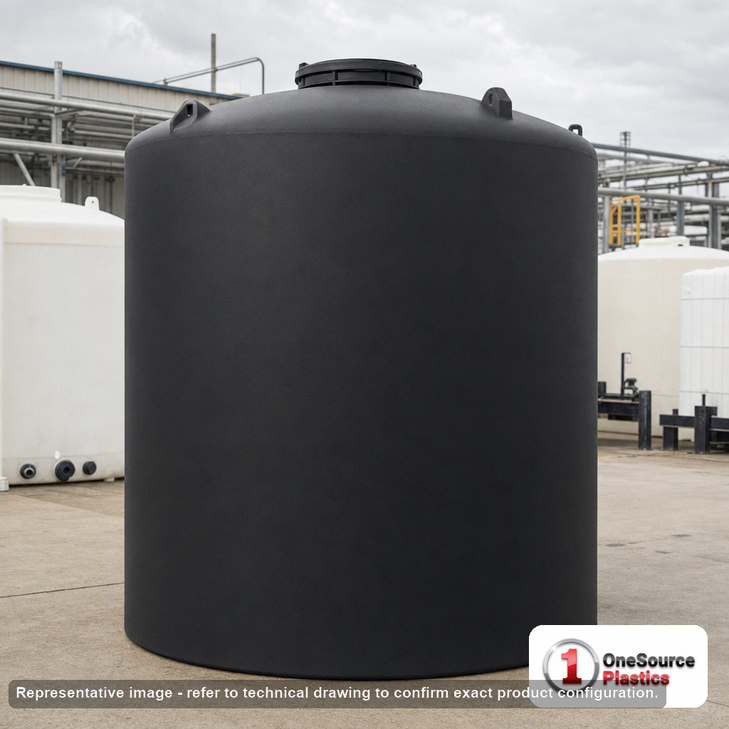
Norwesco 10000 Gallon Black Vertical Storage Tank (43128B)
43128B is a 10000 gallon black polyethylene vertical. Its dimension row reads 160 by 160 by 160 inches while its diameter cell reads 141 inches and its crate line reads 141 inches by 141 inches by 160 inches; both figures are printed here as the sheet gives them. The empty weight cell and the shipping weight cell both read 2056 lb. The outlet is a 3 inch PP female NPT bulkhead fitting with a 2 inch reducer, the top opening is a 22 inch threaded vented manway, and the inlet row is a dash. The specific gravity cell reads 1.5 and a full shell of water is 83400 lb at 8.34 pounds per gallon; the maximum contents cell on this record is a dash. Service ceiling 120 F / 48 C, warranty cell three year, freight class 300, LTL. Four plants are named: St. Bonifacius in Minnesota, Washington Court House in Ohio, Hanford in California and Fairfield in Texas.
Engineer on the job? Request a written quote with the spec attached, or get freight to your ZIP and add to cart above; 866-418-1777 answers the technical questions.
Vent sizing is the reading this record deserves
Of everything linked from this page, one guide belongs at the top for a tank of this capacity: our worked examples on atmospheric vent capacity for polyethylene storage tanks. It covers thermal inbreathing, outbreathing during liquid movement and the combined case, and it works the arithmetic on verticals up to this size. A pump moving liquid out of a 10000 gallon shell faster than air can get back in is the single most damaging thing anybody does to a tank like this, and it is entirely preventable arithmetic.
The pad is the other half. Our pad sizing guide for above-ground polyethylene tanks covers the framework and the boundary past which a designer takes it over, and with 83400 lb of water resting on a perimeter ring, you are firmly in designer territory.
Beyond that the duty splits the usual two ways. A standing reserve on a site with no hydrant has our reservoir design guide; a plant recovering and re-using process streams has our reuse topology piece. Size the volume first with the sizing calculator and the sizing guide, because 10000 gallons is a number people reach for because it is round rather than because it is right.
A sheet with an empty contents cell
Who buys this record and what goes in it: a bulk liquid storage duty at plant scale, with a specific gravity cell reading 1.5 and a water reference of 83400 lb for a full shell at 8.34 pounds per gallon. That is where the plain reading stops, because the maximum contents cell on this particular record is a dash. It publishes no pound figure for the maximum contents at all.
Say that clearly rather than quietly, because it changes what a buyer should do. On a water duty the grade line and the water figure are the numbers you need and this sheet gives you both. On anything denser than water, the cell that would normally govern the decision is simply not filled in on this listing, and the right move is to ask us to confirm the contents figure with the manufacturer before the order is placed rather than to reason around the gap. A blank cell is a question, never a permission.
The rest of what this record commits to is short: a service ceiling of 120 F / 48 C, a warranty cell reading three year and a freight class of 300. The application cell and the structural cell are both empty, so no anchoring, restraint or mounting provision is published anywhere here either, and that work belongs to whoever engineers the slab.
The port, the reducer and the 22 inch lid
- Outlet as printed
- a 3 inch PP female NPT bulkhead fitting. Design the suction side from that figure outward, and support the pipe on a stand rather than on the fitting, because the gasket's job is sealing and not carrying steel.
- Reducer
- a 2 inch reducer is named with the outlet, so the port can serve a 3 inch pump directly or step down once, cleanly, at the wall. Pick one and build it in a single step rather than changing size twice on the way to the pump.
- Access opening
- a 22 inch threaded vented manway. Big enough to work through and vented so the shell can breathe; an obstructed vent on a shell this size is the fastest way to ruin one.
- Fill row
- a dash. This record publishes one port, so liquid goes in through the manway unless you arrange a route of your own.
- Contents cell
- also a dash, which is the one blank on this sheet worth a phone call before ordering for anything heavier than water.
The install specific is a consequence of the height: the manway sits 160 inches up, and the vent that keeps this tank safe is at the top of that climb. Whatever inspection routine you write, make looking at the vent part of the same trip as reading the level, because a vent that nobody can reach conveniently is a vent that nobody checks. Decide the access arrangement while the tank is still horizontal.
A record with no siblings printed
Most records in this family arrive with four or five sibling rows on the sheet, which makes the comparison easy and the choice obvious. This one carries none. The sibling list on 43128B is empty, so there is no table on this page, and rather than fill one with rows borrowed from a neighbouring product we say plainly what the sheet says: this listing stands alone.
It also prints two different plan figures for itself. The dimension row gives 160 by 160 by 160 inches and the diameter cell gives 141 inches, with the crate line agreeing with the smaller number at 141 by 141 by 160 inches. Both appear at the top of this page exactly as the sheet carries them. For clearance planning, measure against the larger of the two and you cannot be caught out; for anything where the difference actually matters, ask us to confirm before you pour.
Why this record, then: it is a 10000 gallon black polyethylene vertical at 160 inches tall with a 3 inch bulkhead and a 2 inch reducer, a 22 inch vented manway, a grade cell of 1.5 and four possible plants behind it. If your specification is written around those cells, this is the listing that prints them, and the two blanks on the sheet are flagged above rather than papered over.
Two numbers for one tank: 160 and 141
The crate line reads 141 by 141 by 160 inches at 2056 lb, matching the empty weight cell, so no dunnage allowance is published. Class 300, LTL, and although four plants are named on the sheet the ships-from column is left empty, so treat the origin as something to confirm on the order rather than something to plan a lane around. Price the move with the freight cost estimator once the origin is settled; the listed price is before freight.
Receive this one with a tape, for the reason the rest of the page has already given: two plan figures are printed and only one of them is going to match the tank on the trailer. Measure the actual footprint across the widest point and write that figure on the paperwork, so your dock, your crane operator and your pad all work from a measured number rather than from a cell that disagrees with itself.
Do it before the carrier leaves and it costs five minutes; do it after the tank is on the pad and it is the kind of discrepancy that turns into a week. The vent screen is the cheapest part on the tank and the one that saves it; look at it every time the manway opens.
Freight and documents
Ships from: St. Bonifacius, MN; Washington Court House, OH; Hanford, CA; Fairfield, TX. LTL freight is quoted to your ZIP with the freight cost estimator or by phone at 866-418-1777. The listed price is before freight.
Technical drawing (PDF) for Norwesco 43128B.
Ready to order?
Add it to your cart at the top of this page, get LTL freight to your ZIP, request a written quote, or call 866-418-1777. The listed price is before freight.