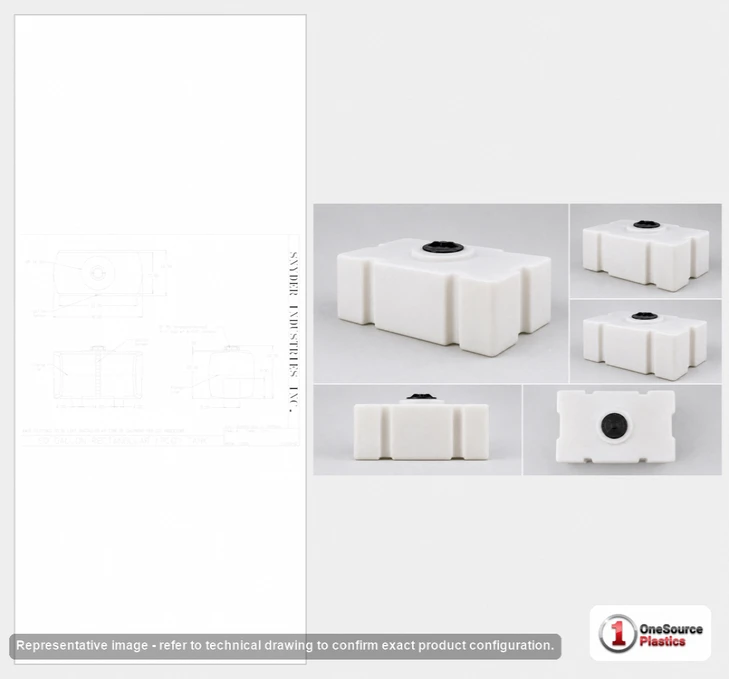
60 gallons in a 36 inch square that stands seventeen and a half inches tall
The Snyder SII-1032000N95401 is a 60 gallon cubetainer with a brass dispense fitting: a white high density linear polyethylene container 36 inches by 36 inches on the floor and seventeen and a half inches tall, weighing 44 pounds empty and the same 44 pounds to ship. It is a square, shallow vessel built to be filled, set down and drawn from, not a standing tank. The sheet rates the wall at a specific gravity of 1.9, which is where the 951 pound figure for maximum contents comes from against 500 pounds for 60 gallons of water at 8.34 pounds per gallon. Access is an 8 inch lid. The service limit is 120 F / 48 C. The sheet publishes no warranty term for this item, so this page states none; ask us and we will get Snyder's current terms in writing.
Want it on your site? Get LTL freight to your ZIP, add it to your cart above, or call 866-418-1777 and a tank specialist will confirm the fit.
Where it sits: a pallet footprint, a bench top, or the bed of a truck
Start with the footprint, because on a cubetainer that is the specification that matters. Thirty-six inches by 36 inches is a square that lands square on standard pallet-scale handling, which means this container goes where a pallet goes: onto a forklift or pallet jack while it is on its pallet, into a bay of pallet racking, onto a flatbed beside other pallet loads, into the back of a box truck without wasting a corner. Seventeen and a half inches of height is the other half of the argument. That is low enough to sit under a shelf, low enough to stand on a bench and still be worked over by hand, low enough to ride in a pickup bed below the line of the sides, and low enough that a person can look into the 8 inch lid without a step. A tall, round tank of the same volume does none of that; it wants floor it does not need and height nobody asked for. What the square shape costs is the ground it covers: nine square feet of floor for 60 gallons is a poor trade if floor is what you are short of, and a drum on a dolly beats it on that one measure. Underneath, flat and level is not a nicety. A rotationally molded body bears on the whole surface it is resting on and nothing else, so a bench with a bowed top, a pallet with a cracked deck board, or a truck bed with a toolbox lip under one edge puts the load of 500 pounds of water, or 951 pounds at the rating, onto that one high point instead of across the base. Where this container is set on a slab rather than on a pallet or a deck, the same principle scales up and the framework for getting it right is in the concrete pad sizing guide. Before you settle on 60 gallons, run it against your real draw and the interval between refills in the tank sizing calculator, and take the reserve you should never dip into and the headspace a warming liquid needs from the tank sizing guide.
No family on this sheet, and what that means when you order
| Part | Gallons | Length x width x height | Empty weight |
|---|---|---|---|
| SII-1032000N95401 (this cubetainer, white, brass dispense fitting) | 60 | 36 x 36 x 17.5 in | 44 lb |
This sheet lists no sibling, no alternate colour and no second size, so this page names none. That is worth saying plainly rather than filling the table with guesses, because a family list is a promise that the parts interchange, and we will not make that promise on a part number the manufacturer's own sheet does not group with anything. What it means for you is practical: if 60 gallons is not the number, the answer is not a suffix on this part, it is a different product, and the honest way to get there is to tell us the volume, the liquid and where it has to sit and let us match it. Two questions settle most of those calls. The first is whether the vessel has to be moved while it has liquid in it, because a container that gets handled full is a different buy from one that is filled in place and emptied through the fitting. The second is whether the liquid is drawn by gravity or by a pump; this item is set up for the first, with a dispense fitting as its named feature, and nothing on the sheet describes it as a pump feed. Ask us for the compatibility of your specific liquid before you order rather than after, and tell us the temperature it arrives at as well as the temperature it sits at, because the 120 F / 48 C service limit on this sheet applies to both.
Picked the 60 gallon tank? Add it to your cart above; freight is quoted to your ZIP before you pay anything.
The brass dispense fitting, and the two numbers the sheet gives without units
- The dispense fitting: a brass dispense fitting is what this part number is named for, and it is the reason to buy this cubetainer rather than a plain one. A metal fitting takes handling that a plastic tap does not, which is what a fitting on a container people draw from by hand every day is actually exposed to. Keep the fitting clear of the edge of whatever the container sits on so nobody sets a load against it, and never lift or drag the container by it.
- The outlet as the sheet lists it: the sheet gives the outlet as 1 and gives no unit for it, so this page prints the figure and stops there. It is not a pipe size and we will not present it as one. Tell us what you intend to connect and we will confirm the thread and the fitting against Snyder's current documentation before you buy pipe.
- The inlet as the sheet lists it: the sheet gives the inlet as 2, again with no unit. Same discipline applies. In practice the filling on a container this shape is done through the lid, from a hose or a jug, with the container already in the place it will be drawn from.
- Access: an 8 inch lid. That is big enough to get a hose in, a light in, and a hand in for a wipe-out, which on a container that holds a product people meter out by hand is the maintenance that actually happens. Keep it closed between draws; an open lid on a shallow vessel collects dust, insects and rain faster than a deep one because the whole surface is near the top.
- Service limit: 120 F / 48 C, as the sheet gives it. That covers the liquid and the ambient, and a closed cubetainer in direct sun on a dark bed reaches more than people expect.
The rest is handling discipline, because a shallow square container in service is hurt by people rather than by pressure. Fill it where it will stand. At 44 pounds empty it is a two-person lift or a one-person lift with a bad back, and full it is not a lift at all: 500 pounds of water, or up to 951 pounds of contents at the rating, wants a pallet jack, a forklift or a drum handler. Liquid in a wide, shallow body sloshes with a long, slow wave, so a cubetainer carried part-full on a truck bed pushes side to side far harder than a tall tank does, and it must be strapped down at the pallet rather than around the body. Keep the fitting on the side nobody walks past. Label the container with the one product it holds and keep it to that product, because a shallow vessel is easy to rinse and hard to prove clean. And read the level by eye through the lid rather than by weight; on a 36 inch square, an inch of depth is a lot of gallons.
Small-batch dispensing where a drum is the wrong shape
The work this container is bought for is metering: a maintenance shop drawing lubricant, cleaner or coolant into jugs and pails, a grounds or turf crew filling backpack and hand sprayers off a bench, a car wash or fleet wash station keeping a working supply of detergent at the bay, a food or beverage plant holding a single ingredient at a station, a laboratory or plating line drawing measured volumes, a farm shop keeping an additive at the mixing bench rather than walking to a drum. In all of those the same two things are true: somebody opens a fitting by hand several times a day, and the vessel sits at a working height rather than on the floor. That is exactly what a low square body with a brass dispense fitting is for, and it is why the height on this sheet, seventeen and a half inches, is a feature rather than a limitation. When 60 gallons stops being enough, the honest move is up to bulk storage rather than to more cubetainers, because the handling cost of several small vessels overtakes the price difference quickly. When it is the right size, accept the container properly before you trust it: fill it with clean water, let it stand, and look under the base, around the lid and at the dispense fitting through the hold. The discipline for that first fill, what to watch and how long to hold it, is set out in the hydrostatic test methodology guide, and it is the cheapest hour you will ever spend on this item.
St. Bonifacius, Minnesota, and a parcel class on 44 pounds
This cubetainer is molded at St. Bonifacius, Minnesota, and the sheet gives its freight class as UPS while listing the ship mode as LTL. At 44 pounds and 36 inches square it is at the awkward boundary where a parcel rate and a pallet rate can both apply, so tell us at order whether there is a dock, a forklift or neither at the delivery address, because a 36 inch square arriving at a door with no dock is a curbside drop and two people carrying it. Check the base and the dispense fitting before the driver leaves. Keep the pallet it arrives on: it is the handling equipment for the rest of the container's life, it is what a pallet jack picks up, and it is what keeps the base off a wet floor. One last thing, and it is the one people skip: write the fill date and the product name on the lid in paint marker the day it goes into service, because the first question anybody asks about a container at a bench is what is in it and how long it has been there. Keep the delivery paperwork with the tank; the serial number on the shell is what a warranty claim starts from.
Freight and documents
Ships from: St. Bonifacius, MN. LTL freight is quoted to your ZIP with the freight cost estimator or by phone at 866-418-1777. The listed price is before freight.
Technical drawing (PDF) for Snyder Industries 1032000N95401.
See this tank
Product video. Watch the Snyder Industries 60 Gallon Cubetainer Tank with Brass Dipense Fitting video (69 seconds) with dimensions, fittings and shipping notes.
Ready to order?
Add it to your cart at the top of this page, get LTL freight to your ZIP, request a written quote, or call 866-418-1777. The listed price is before freight.