Fifty gallons at twenty-five pounds empty
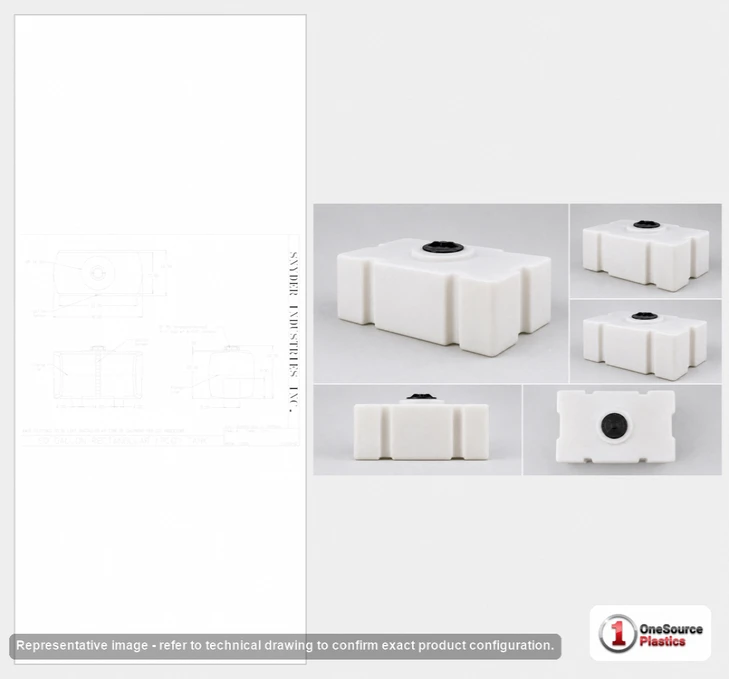
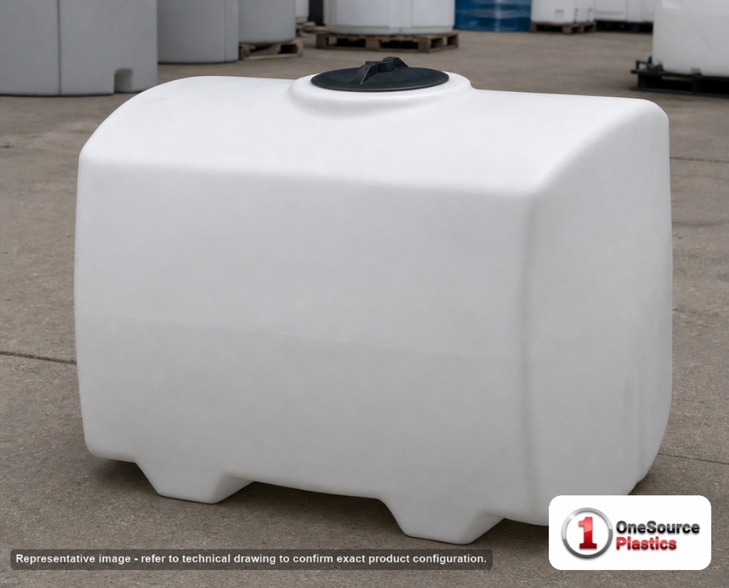
The Snyder SII-1170000W94301 is a 50 gallon pest control operator tank with a lid, in white polyethylene, listed 38 inches long, 19 inches wide and 23 inches tall at 25 pounds empty and 27 pounds shipping. A PCO tank is a sprayer and applicator tank: it holds the mix while the pump, the reel and the gun live elsewhere on the vehicle or the frame. The sheet rates the wall at a specific gravity of 1.5 and gives 417 pounds for 50 gallons of water at 8.34 pounds per gallon with 626 pounds of max contents. The service limit is 120 F / 48 C. The only opening published is a 6 inch lid; there is no outlet, no inlet and no warranty term on this sheet, and no chemical is named on it, so none is named here. Twenty-five pounds is the number that sells it.
Need it before the next delivery? Call 866-418-1777 for the ship date, or get freight to your ZIP and add it to your cart above now.
Three plants, a parcel-class shipment, and why that matters
Start with how it gets to you, because on a tank this small the freight is a real fraction of the decision. The sheet lists three plants for this part, Chowchilla, California, Lincoln, Nebraska, and Philippi, West Virginia, and names California, Nebraska and West Virginia as the states it ships from. Three moulding points spread across the West, the plains and the Appalachians means the lane to almost any address in the country is short. The freight class reads UPS, which is a shipping mode rather than a numeric class, and there is no NMFC code on this sheet at all; we say so plainly rather than print a class that is not there. The shipping size is listed 19 inches long by 19 inches wide by 23 inches high at 27 pounds shipping, against a tank listed 38 inches long. What all of that adds up to is a tank that can be shipped to a branch, a depot or a house without booking a dock or a forklift, which is precisely why a route operation buys this one. Where it sits afterwards is the easy part: 19 inches wide fits between the arches of a pickup bed with room for a reel beside it, 38 inches of length runs fore and aft against the headboard, and 23 inches of height keeps the lid below most bed rails. Support the whole 38 by 19 inch base on something flat and continuous, and strap it down across the body rather than over the lid. Twenty-five pounds is a one-hand lift when it is dry; 417 pounds of water is not, and 626 pounds at the rating is a load that will take a bed side with it if the straps are decorative. Size the volume to the route before you buy the shape, using the tank sizing calculator for the working number and the tank sizing guide for the headspace a mix wants on a hot afternoon.
A sprayer tank listed beside two feed stations
| Part | Gallons | Length x width x height | Empty weight |
|---|---|---|---|
| SII-1170000W94301 (this tank, sprayer and applicator) | 50 | 38 x 19 x 23 in | 25 lb |
| SII-1000123CF42 (chemical feed station with containment basin) | 35 | 47 x 36 x 36 in | 72 lb |
| SII-5680023CF42 (chemical feed station) | 60 | 47 x 36 x 58 in | 108 lb |
The two tanks listed beside this one are not sprayer tanks and nothing here suggests they are. SII-1000123CF42 is a chemical feed station tank with a containment basin, 35 gallons on a 47 by 36 inch plan at 36 inches tall and 72 pounds. SII-5680023CF42 is a chemical feed station tank, 60 gallons on the same 47 by 36 inch plan at 58 inches tall and 108 pounds. Both are fixed installations that stand in a room beside a dosing pump; this one is a vessel that travels. Read the weights and the argument makes itself. At 25 pounds empty this tank is lifted out of a bed by one person at the end of a season; the feed stations are 72 and 108 pounds and are set once on a floor and left. At 19 inches wide it fits a vehicle; at 36 inches wide neither of the others does. And where the feed stations put their volume into height, 58 inches on the larger one, this tank keeps everything under 23 inches so it rides under a cap and out of the wind. If the job is dosing into a line in a plant room, the feed stations are the right family and we would rather point you at them than sell you a sprayer tank for a fixed duty. If the job is mixing a batch, driving to it and spraying it, this is the one. Between the two feed stations, the smaller holds less and brings its own basin; the larger holds more and puts its volume upward on the same plan.
Need a different size? Every tank in the table is in stock programs; ask for a quote on the one that fits, or call 866-418-1777.
A six inch lid, and the fittings the sheet leaves blank
- The fill opening: a 6 inch lid is the only opening on this sheet, sitting 23 inches above the base. That is the fill point, the inspection point and the route for any suction line, all in one. Six inches takes a hose end, a measuring jug, a wand and a strainer basket; it does not take a hand and a forearm, so the rinse routine is planned around a lance rather than around reaching in.
- Filling habit: fill through the opening with the tank on the vehicle and the vehicle level, not on a slope and not while it is being moved. A tank filled on a camber carries a level the operator will misread for the rest of the day.
- Outlet and inlet: this sheet publishes neither. No size, thread or position is claimed here. Tell us how the mix is meant to leave and we will confirm what the part actually carries before it ships.
- Drawing off: with the lid as the only published route, the common arrangement is a weighted suction and a foot strainer dropped through the top to a frame-mounted pump. Clamp the line to the frame so the lid never carries its weight, and keep the strainer just clear of the floor of the tank.
- Opening size in general: six inches is small for any work that involves getting inside a tank, and it is worth understanding what larger openings buy before you specify one on a bigger vessel. The manhole lid engineering guide on operator access sizing sets the sizes against the access they actually give.
- Limits: 120 F / 48 C is the service limit and the specific gravity rating is 1.5. No warranty term appears on this sheet.
Bring us the chemistry when you order. The sheet names a duty and not a product, and the lid seal, the strainer and any fitting we add are chosen against what you are mixing rather than against a category.
Applicator work where the tank is carried, not plumbed
This is the tank for operations that move: pest control and lawn care route vehicles, turf and ornamental crews, nursery and greenhouse applicators, municipal parks and grounds teams, right-of-way and fence-line work, and small contractors running a skid sprayer built on a frame rather than a factory rig. The thing that separates this listing from every other 50 gallon option is the 25 pound empty weight, which decides whether one person can take the tank out of the bed to wash the truck, swap products between jobs, or pull it for the winter. That sounds small. On a crew that does it weekly it is the single most-used feature of the tank. Fifty gallons of finished mix is a full day for a single operator and a morning for a two-person crew, which is the size at which the tank is emptied rather than stored, and an emptied tank is one that never becomes a disposal problem.
Twenty-seven pounds on the scale, shipped nineteen by nineteen
The sheet lists Chowchilla, California, Lincoln, Nebraska, and Philippi, West Virginia as the plants and California, Nebraska and West Virginia as the shipping states, so the lane is short from almost anywhere. The freight class reads UPS, a mode and not a numeric class, and no NMFC code is published on this sheet; the shipping size reads 19 inches long by 19 inches wide by 23 inches high at 27 pounds against a tank listed 38 inches long, and both are printed exactly as given. Price the lane to your ZIP with the freight cost estimator; the listed price is before freight. Twenty-seven pounds means one person signs for it and carries it, with no dock, no appointment and no machine at either end, which is the practical difference between this tank and anything that has to ride a pallet. Set it on its mount and strap it while it is empty, then fill it with clean water and watch the lid seal through a full 417 pound load before any product goes near it. Drive a short loop with that water in and re-tension the straps, because the first mile is where a strap beds in. Then drain it, dry it, and put the contents and the date on the shell before the first batch. The thing that ends a sprayer tank early is almost never the tank; it is a strap nobody looked at twice. Keep the first delivery's paperwork with the tank; strength and date on day one is the baseline for every batch after.
Freight and documents
Ships from: Chowchilla, CA; Lincoln, NE; Philippi, WV. LTL freight is quoted to your ZIP with the freight cost estimator or by phone at 866-418-1777. The listed price is before freight.
Technical drawing (PDF) for Snyder Industries 1170000W94301.
See this tank
Product video. Watch the Snyder Industries 50 Gallon Plastic Pest Control Operator Tank with Lid in White video (67 seconds) with dimensions, fittings and shipping notes.
Ready to order?
Add it to your cart at the top of this page, get LTL freight to your ZIP, request a written quote, or call 866-418-1777. The listed price is before freight.