
Mash Cookers & Wash Fermenters
Mash Cookers & Wash Fermenters
Before a single drop hits the still, the wash has to be made right. Mash cookers and fermenters turn raw grain into fermentable sugar and then into alcohol.
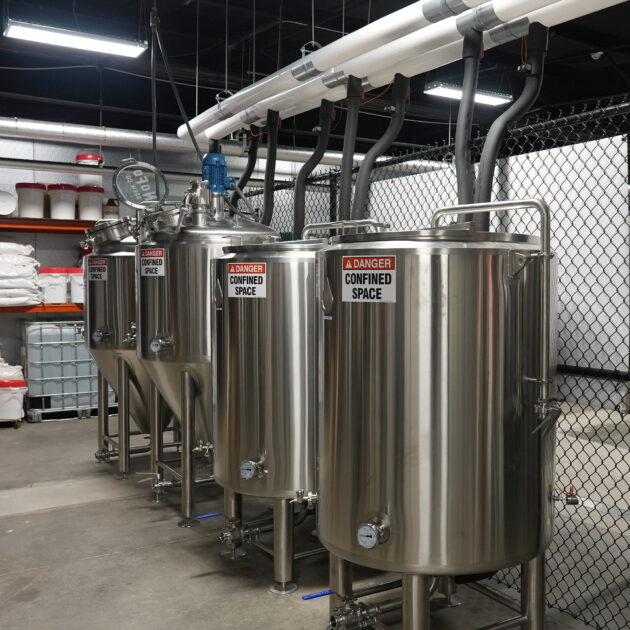
Where Spirit Production Really Begins
A still cannot create flavor or alcohol that was not first developed upstream. The mash cooker liberates fermentable sugar from grain starch, and the fermenter converts that sugar to ethanol and a suite of congeners. Together these two vessels set the ceiling on quality before distillation begins. Underconvert the starch and yield suffers; mismanage fermentation temperature and the wash develops off-flavors no still can fully remove. For this reason, experienced distillers treat the cook house and fermentation room with the same care they give the still, because every problem here is amplified, not cured, by distillation.
The Mash Cooker: Liberating Starch
Grain starch is locked inside granules that enzymes cannot reach at room temperature. The mash cooker solves this through gelatinization — heating the grain-and-water slurry until the starch granules swell, rupture, and become accessible to enzymes. Different grains gelatinize at different temperatures: corn requires the highest heat, while barley, wheat, and rye gelatinize at progressively lower temperatures. A grain-in cooker that processes multiple grains in one recipe must reach the highest gelatinization point among them, which is why corn-based mashes drive the upper temperature requirement for the vessel.
Once gelatinized, the mash is cooled into the working range of the conversion enzymes for saccharification, the step in which alpha- and beta-amylase break long starch chains into fermentable sugars. The enzymes come either from malted grain, which carries its own enzymes, or from added enzyme preparations dosed into the cook. Holding the mash at the correct conversion temperature and pH for the right duration determines how completely starch becomes sugar — and therefore the eventual alcohol yield. A poorly converted mash leaves potential alcohol locked up as unfermentable starch, a loss that no downstream step can recover.
Heating and Agitation
Grain-in cooking is demanding on equipment. A steam jacket provides gentle, controllable indirect heat across the cooker wall, avoiding the localized scorching that direct firing can cause when thick mash contacts a hot surface. Equally important is a robust sweep or anchor-style agitator that scrapes the vessel wall, keeps solids suspended, prevents settling and burn-on, and promotes even heat transfer. Thick, abrasive grain slurry calls for heavier-duty drives, slower speeds, and wear-tolerant impeller geometry than thin-liquid mixing requires. The combination of indirect heat and wall sweeping is what lets a cooker drive corn to its high gelatinization temperature without scorching the batch.
The Wash Fermenter: Sugar to Alcohol
The converted mash — or the clarified wort, depending on whether the producer ferments on the grain or off — is cooled to pitching temperature and transferred to the fermenter. There, yeast consumes sugar and produces ethanol, carbon dioxide, heat, and the congeners that will define the spirit's aroma. A typical grain wash finishes in the range of roughly 7–12 percent ABV, the practical strength a still is designed to receive. The choice of yeast strain, pitching rate, and nutrient program all shape the congener profile that the still will later sort into heads, hearts, and tails.
Fermentation is exothermic, and temperature control is the fermenter's defining duty. Yeast that runs too hot produces excessive fusel oils and stressed, off-character flavors; too cold and it stalls or ferments sluggishly. Glycol-cooled fermenters with dimple or half-pipe jackets, paired with temperature control, hold the yeast in its preferred range and let the distiller reproduce a fermentation profile batch after batch. Adequate headspace accommodates the vigorous foaming, or krausen, of an active ferment, and a way to vent or capture the large volume of carbon dioxide produced is essential for both safety and, in some operations, recovery of the gas.
| Vessel | Primary job | Key features | Thermal need |
|---|---|---|---|
| Mash cooker | Gelatinize and saccharify starch | Steam jacket, sweep/anchor agitator | Heating to high gelatinization temp |
| Wash fermenter | Convert sugar to ~7–12% ABV wash | Glycol jacket, headspace, sample valve | Cooling exothermic fermentation |
On-Grain vs Off-Grain Fermentation
Distilleries choose between fermenting with the spent grain solids still present, known as on-grain, or separating them first, known as off-grain. On-grain fermentation can contribute additional flavor and is common in many whiskey traditions, but it complicates pumping, requires stills tolerant of solids such as steam-jacketed pots with agitation, and makes cleaning harder because solids cling to surfaces. Off-grain fermentation produces a cleaner wash that is easier to pump and distill, at the cost of separation equipment, such as a lauter tun or mash filter, and some lost character. The decision ripples through cooker design, fermenter geometry, transfer pumps, and still selection, so it is best made early in planning rather than retrofitted later.
Sanitation and Material Choice
Fermenters operate in the temperature and pH window where wild yeast and bacteria thrive, so hygienic design is essential to protect the intended fermentation. Smooth interior finishes, full drainability, crevice-free welds, and effective cleaning — typically clean-in-place spray devices — prevent the buildup of biofilms that sour batches and pass off-flavors to every subsequent ferment. Stainless steel, commonly grade 304 for these vessels, balances corrosion resistance, cleanability, and cost. Where lower pH, chlorides, or aggressive cleaning chemistry is involved, the more corrosion-resistant 316/316L grade may be specified for longer service life.
Sized correctly, the cooker and fermenter set must keep pace with the still. A common planning step is to match total fermentation volume to the still's throughput so that finished wash is always ready when the still is, avoiding the bottleneck of a distillery that can ferment faster than it can distill, or vice versa. Many operations run several fermenters on a staggered schedule against a single still so that the still is continuously fed without ever waiting on fermentation. Getting these volumes balanced is one of the most important early decisions in building a distillery, because it determines whether expensive still capacity is fully used.
Mashing in Practice: Time, Temperature, and pH
The cooker is not a single-temperature device. A typical grain-in process steps the mash through several holds: a high-temperature cook to gelatinize the most stubborn grains, a controlled cool-down, and one or more enzyme rests at the temperatures where the conversion enzymes are most active. Each enzyme has a preferred temperature band, and where the distiller holds the mash shapes the balance of fermentable and unfermentable sugars in the final wort. A hotter conversion rest favors enzymes that leave a slightly less fermentable sugar profile, while a cooler, longer rest tends to produce a more completely fermentable wort and a drier wash.
pH is the other lever. Conversion enzymes and, later, yeast both work best within fairly narrow pH ranges, and distillers often adjust mash pH with food-grade acid or by recycling acidic backset from a previous distillation. The right pH speeds conversion, protects against unwanted microbial growth, and contributes to flavor. Because all of these factors interact, reproducible mashing depends on accurate temperature control across the cooker, reliable agitation for even conditions throughout the vessel, and careful timing — the same disciplines that make any batch process repeatable.
Transfers, Cleaning, and Cross-Contamination
Between the cooker and the fermenter sits a transfer step that is easy to underestimate. Hot, dense, sometimes solids-laden mash must be moved and cooled to pitching temperature, often through a heat exchanger, without picking up infection along the way. Every pump, hose, valve, and heat exchanger surface is a potential harbor for spoilage organisms if not cleaned thoroughly. Because fermentation runs in the temperature and pH range that favors microbial growth, sanitation of the transfer path is as important as sanitation of the vessels themselves. Effective clean-in-place coverage of the fermenter interior, along with disciplined cleaning of transfer lines, keeps each batch a clean slate and prevents a single contaminated vessel from souring an entire production run.
Yeast Management and the Final Profile
The fermenter is also where yeast biology meets process engineering. Pitching the right quantity of healthy yeast at the correct temperature gives a clean, vigorous start that outcompetes spoilage organisms and produces a predictable congener profile. Too little yeast or a stressful environment leads to sluggish fermentation and off-flavors; too much vigor without temperature control drives heat and harshness. Some distillers reuse yeast from batch to batch, which demands even tighter sanitation to keep the culture clean, while others pitch fresh each time for consistency. Nutrient additions, dissolved oxygen at pitching, and the timing of the temperature profile all become tools the distiller uses deliberately. The point is that the fermenter is not a passive holding tank; it is a controlled bioreactor, and the care taken with yeast and temperature here is what allows the still downstream to do its job of selecting, rather than rescuing, flavor.
Frequently asked questions
- What is the difference between gelatinization and saccharification?
- Gelatinization uses heat to swell and rupture starch granules so enzymes can reach the starch. Saccharification is the enzymatic step that follows, breaking the exposed starch into fermentable sugars. The cooker performs gelatinization at high temperature, then is cooled into the enzyme range for conversion, and both steps must succeed for the mash to yield its full alcohol potential.
- Why do mash cookers need wall-sweeping agitators?
- Dense grain slurry settles quickly and scorches against hot jacket walls, creating burnt off-flavors and reduced heat transfer. A sweep or anchor agitator scrapes the wall, keeps solids suspended, and ensures even heating throughout gelatinization and conversion, which is what allows a cooker to reach high gelatinization temperatures without burning the batch.
- What alcohol strength should a wash reach before distilling?
- Grain washes typically finish around 7 to 12 percent ABV. That range balances yeast health and fermentation yield against the strength a still is engineered to process. Pushing much higher stresses the yeast and produces off-character congeners, while finishing too low wastes still capacity on excess water.
- Why is glycol cooling important during fermentation?
- Fermentation releases significant heat, and uncontrolled temperature pushes yeast to produce harsh fusel oils and off-flavors. A glycol jacket removes that heat and holds the yeast in its preferred range, which protects flavor and makes the fermentation reproducible from batch to batch so the spirit tastes consistent.
Scope your custom build
Send us your volume, service chemistry, dimensions, and finish or code requirements. We return a full engineering package, firm lead time, and a fixed quote — freight quoted separately to your ZIP.
Request a Custom QuoteCall 866-418-1777