
Spirit Proofing & Blending Tanks
Spirit Proofing & Blending Tanks
Distillation makes the spirit; the spirit-side tanks make it ready to bottle. Proofing, blending, and storage are where the final character is dialed in.
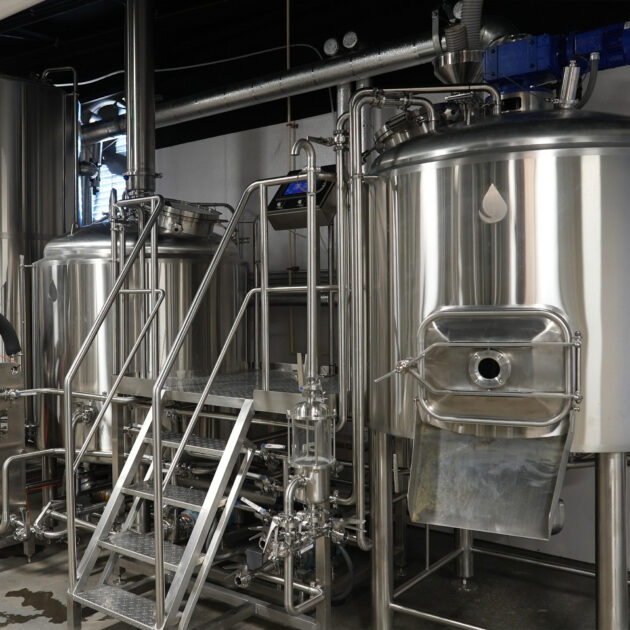
After the Still
High-proof spirit off a still or out of a barrel is rarely at bottle strength and rarely in its final form. The spirit side of a distillery — the tanks where distillate is collected, reduced with water, blended, and held before packaging — is where consistency and brand identity are locked in. These vessels are less glamorous than a gleaming still, but they handle the steps that determine whether every bottle tastes the same, batch after batch and year after year. A distillery can make a brilliant spirit on the still and still fail at the brand promise of consistency if its spirit-side tanks and procedures are not up to the job.
Receivers and Spirit Collection
As the still runs, the distiller separates the distillate into fractions — heads, hearts, and tails — and directs each to the appropriate receiver. Hearts go to the spirit receiver for further finishing; heads and tails may be collected separately for redistillation in a later batch. Receiving tanks are commonly stainless steel, sized to the still's batch output, and fitted with sampling provisions so the distiller can verify the cut by proof and aroma. Because these tanks hold high-proof, flammable spirit, their design and the surrounding area must address fire and electrical-classification concerns, including grounding, venting, and appropriate fittings for hazardous service.
Proofing: Reducing to Bottle Strength
Proofing is the addition of water to reduce a high-proof spirit to its intended bottling strength. It sounds simple, but it requires accuracy: alcohol and water do not add volumes linearly, temperature affects density and therefore apparent proof, and the proof of the finished blend must be gauged precisely for both quality and regulatory recordkeeping. The water used matters too — many distilleries treat, deionize, or carbon-filter proofing water so that dissolved minerals and chlorine do not cloud the spirit, leave a haze when chilled, or alter its taste.
Proofing tanks are stainless vessels, often equipped with agitation to fully homogenize the water and spirit, calibrated volume references for accurate gauging, and sample valves for proof verification. Gentle, thorough mixing prevents stratification, where a partially blended tank reads at a different proof at the top than at the bottom and yields inconsistent bottles. Some producers proof in stages, resting the spirit between water additions, to let the spirit integrate and to avoid the temporary haze and harshness that an aggressive single dilution can cause. Patience at this step often shows up as smoothness in the glass.
Blending for Consistency
Blending combines distillate from different batches, ages, or barrels to build a consistent, signature profile. A blending tank must mix large volumes uniformly without introducing oxygen or stripping volatile aroma; a slow, low-shear agitator that gently turns the whole tank over is preferable to aggressive mixing that would whip in air and dull the nose. Blending is where a brand reconciles natural batch-to-batch and barrel-to-barrel variation into a product customers can rely on, and where house styles, vattings, and limited editions are composed. The blender's skill, supported by a tank that mixes thoroughly and gently, is what turns a collection of individual runs into a coherent brand.
The practical workflow usually involves drawing small samples, building a target blend at bench scale, evaluating it, and only then scaling that recipe into the blending tank, where representative sampling confirms the full batch matches the approved benchmark. A tank that mixes to genuine uniformity is essential here, because a blend that reads correctly in a sample drawn from one point but differs elsewhere in the tank will not bottle consistently. After blending, many spirits benefit from a rest before bottling, allowing the components to marry and any temporary harshness from combining different stocks to settle. Adequate, well-mixed blending capacity, paired with disciplined sampling and recordkeeping of which stocks went into which blend, is what lets a producer repeat a successful blend release after release rather than recreating it by luck.
Spirit Storage
Finished or in-process spirit is held in storage tanks ahead of bottling or further aging. These vessels are stainless steel because, unlike on the distillation side, copper offers no benefit once the spirit is made and dissolved copper would be undesirable in the finished product. Where extended contact or specific finishing is intended, some producers use lined or specialty vessels, but inert stainless is the norm for neutral storage that should not alter the spirit. Tanks are sealed against contamination and evaporation losses, and many operations blanket the headspace with an inert gas such as nitrogen to limit oxidation of sensitive spirits during holding.
| Tank | Function | Key features |
|---|---|---|
| Receiver | Collect distillate fractions | Sample valve, sized to batch, fire-safe siting |
| Proofing tank | Reduce to bottle strength | Agitation, calibration, clean proofing water |
| Blending tank | Homogenize batches/ages | Gentle full-turnover mixing |
| Storage tank | Hold before bottling/aging | Sealed, inert, often gas-blanketed |
Material Selection
Stainless steel dominates the spirit side for its corrosion resistance, cleanability, and neutrality. Grade 304 is common; the more corrosion-resistant 316/316L is chosen where chlorides or aggressive cleaning chemistry are present. Interiors are typically polished to a smooth finish, and many spirit tanks are electropolished or passivated — commonly per a standard such as ASTM A967 — to maximize cleanability and prevent any metallic pickup that could taint the spirit. Crevice-free, fully drainable hygienic design and effective cleaning, usually clean-in-place spray devices, keep the spirit free of contamination and free of residual cleaning agents that could carry into the next batch.
Bonded Custody and Recordkeeping
In the United States, distilled spirits production and storage occur under federal oversight at a distilled spirits plant, where the alcohol authority (TTB) governs proof gauging, tax determination, and the meticulous accounting of spirit quantities through every transfer. Proofing and storage tanks therefore are not just process equipment; they are points of measurement in a regulated chain of custody, and the spirit is held under bond until tax is determined. Calibrated volumes, accurate gauging, and reliable sampling are required so that production records reconcile and tax obligations are correctly determined and paid. Designing the spirit side with measurement and recordkeeping in mind — clear gauge references, accessible sample points, and traceable transfers between identified tanks — makes compliance routine rather than a scramble, and it protects the distillery from the costly errors that vague or inaccurate records can produce.
Gauging Proof Accurately
Determining the true proof of spirit in a tank is a precise procedure because temperature changes apparent strength. A hydrometer reading taken on a warm sample reads differently than the same spirit measured cool, so proof is corrected to a reference temperature using established gauging tables, or measured with instruments that compensate for temperature directly. This is not merely a quality nicety; in a bonded environment the proof and quantity in each tank feed the tax accounting, so accurate, temperature-corrected gauging is a regulatory obligation as much as a recipe requirement. Tanks designed for easy, representative sampling and equipped with reliable volume references make this routine work dependable rather than error-prone.
Layout, Sizing, and Flow
The spirit side should be laid out to follow the natural flow of production: from receivers, to proofing, to blending, to storage, and on to bottling, with transfer lines and pumps sized so a tank can be filled or emptied in a reasonable time without splashing or excessive aeration. Tank sizes are matched to batch and bottling volumes so that a proofing or blending batch corresponds cleanly to a production lot, which simplifies both quality tracking and recordkeeping. Adequate spacing, drainage, and access for cleaning and inspection round out a layout that keeps the spirit moving cleanly from still to bottle.
Protecting Quality Through Holding
Spirit is most vulnerable to quality loss while it sits. Oxidation can dull aroma and alter flavor over time, evaporation loss eats into yield and shifts proof, and any contamination introduced during holding carries straight into the bottle. The defenses are straightforward: keep tanks sealed, blanket sensitive spirits with inert gas, hold at stable conditions, and clean rigorously between batches so no residue lingers. A well-run spirit side treats holding as an active responsibility, not a passive pause, and that discipline is what allows a distillery to deliver the same character in every bottle, which is ultimately the promise behind any spirits brand.
Frequently asked questions
- What does proofing a spirit mean?
- Proofing is adding water to a high-proof distillate to bring it down to its intended bottling strength. Because alcohol and water volumes are not additive and density changes with temperature, the final proof must be gauged accurately at a reference temperature, and clean, often treated water is used to avoid clouding, haze, or off-flavors.
- Why are spirit-side tanks stainless rather than copper?
- Copper's value in distillation comes from reacting with vapor to remove sulfur and catalyze flavor; once the spirit is made, that benefit is gone and dissolved copper would be undesirable. Stainless steel is inert, corrosion-resistant, easy to clean, and neutral, making it the standard for receivers, proofing, blending, and storage tanks.
- How does blending improve consistency?
- Distillate naturally varies between batches, barrels, and ages. Blending combines these in a tank with gentle, full-turnover mixing to produce a uniform, signature profile, so customers get the same product every time and producers can compose house styles or special releases from their stock of individual runs.
- What role do these tanks play in regulatory compliance?
- In a distilled spirits plant, spirit quantities and proof must be measured and recorded through every transfer under federal oversight (TTB), and the spirit is held under bond until tax is determined. Proofing and storage tanks are measurement points in that chain, so calibrated volumes, accurate gauging, and accessible sample valves are essential for records to reconcile and taxes to be paid correctly.
Scope your custom build
Send us your volume, service chemistry, dimensions, and finish or code requirements. We return a full engineering package, firm lead time, and a fixed quote — freight quoted separately to your ZIP.
Request a Custom QuoteCall 866-418-1777