
Cooking Kettles & Sauce Blending
Cooking Kettles & Sauce Blending
A great sauce lives or dies on even heat and gentle, complete blending. The steam-jacketed kettle is the workhorse that delivers both.
Why the Jacketed Kettle Is the Heart of Sauce Production
Cooking a sauce is fundamentally a heat-transfer problem complicated by viscosity, fouling, and the need for uniform texture. A direct-fired pot scorches product against the hot metal, creates flavor defects, and bakes on a burnt layer that becomes a sanitation nightmare. The steam-jacketed cooking kettle solves this by surrounding the product zone with a sealed outer chamber through which saturated steam — or, for cooling, chilled water or glycol — circulates. Heat is delivered across the entire wetted surface rather than at a single hot spot, so the product reaches and holds a target temperature with far less risk of localized scorching.
Because saturated steam transfers heat by condensation, the jacket holds a nearly uniform temperature across its full area at a given pressure. That predictability is what lets a processor write a repeatable cook schedule: a defined steam pressure corresponds to a defined jacket surface temperature, which in turn drives a known heat-up rate for a given batch volume and product. The result is consistency from batch to batch, which matters as much for food safety as it does for flavor.
Jacket Styles and Heat Transfer
Not all jackets are equal. The geometry of the jacket determines how much steam pressure it can hold and how evenly heat spreads:
- Conventional (annular) jacket: a simple second shell spaced off the inner vessel. Inexpensive and effective for atmospheric steam, but pressure rating is limited and flow distribution can be uneven.
- Dimple jacket: a thinner outer sheet spot-welded to the vessel in a dimpled pattern, creating turbulent flow channels. It holds higher pressure, uses less heating medium, and improves heat-transfer coefficient.
- Half-pipe (channel) jacket: pipe sections welded in a coil around the vessel. It carries the highest pressures and is favored where steam or hot-oil temperatures are elevated.
For viscous, fouling-prone sauces, jacket choice is paired with agitation because the limiting resistance to heat transfer is usually the stagnant film of product clinging to the wall. Moving that film is the job of the agitator.
Scraped-Surface Agitation for Viscous Sauces
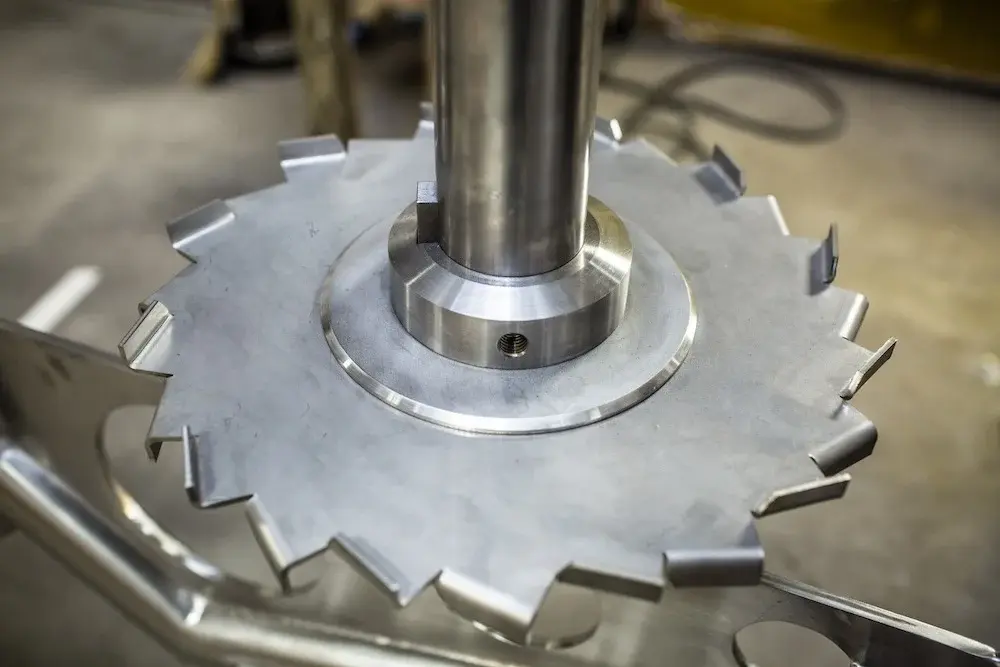
Thin liquids transfer heat readily because natural and forced convection keep refreshing the boundary layer at the wall. Thick sauces — tomato pastes, cheese sauces, caramels, gravies — do not. They cling, insulate, and ultimately burn. A scraped-surface (sweep) agitator carries flexible wiper blades that ride along the kettle wall and bottom, continuously peeling product away from the heat-transfer surface and replacing it with cooler material from the bulk.
This continuous renewal accomplishes three things at once: it dramatically raises the effective heat-transfer rate, it prevents the burn-on layer that ruins both flavor and cleanability, and it homogenizes the batch so that sugars, starches, acids, and particulates distribute evenly. Many kettles combine a slow-turning sweep frame for wall contact with a separate higher-speed mixing element — an anchor, a counter-rotating paddle, or a disperser — to handle bulk blending and powder incorporation simultaneously.
Matching the Mixer to the Rheology
Sauce rheology is rarely simple. Many products are shear-thinning (thinner under agitation, thicker at rest) or thixotropic (viscosity drops with time under shear and recovers). The agitator must be chosen for the behavior of the finished product, not just the water-like base it starts from. The table below summarizes the common pairings.
| Product Character | Heat Transfer Need | Typical Agitation |
|---|---|---|
| Thin pourable (broths, thin sauces) | Convection adequate | Turbine or propeller |
| Medium viscous (gravies, dressings) | Moderate film renewal | Anchor or paddle |
| Highly viscous (pastes, cheese, caramel) | Continuous wall scraping | Scraped-surface sweep + central mixer |
| Particulate-laden (chunky sauces) | Gentle, low-shear | Slow sweep, oversized clearances |
Sanitary Design and Cleanability
Food-contact cooking equipment is built to hygienic-design principles drawn from 3-A Sanitary Standards and the cleanability expectations behind FDA food-safety regulation and a plant's HACCP plan. The governing idea is that any surface touched by product must be cleanable, drainable, and free of crevices where soil and microorganisms can harbor. In practice this means:
- Product-contact surfaces in 316/316L stainless with a smooth polished finish, commonly specified by a maximum roughness average (Ra) so that microscopic peaks do not trap residue.
- Continuous, ground-smooth internal welds — ideally orbital or TIG welds with inert-gas purging — rather than lap joints or fasteners inside the product zone.
- Radiused internal corners instead of sharp 90-degree angles, and a sloped or dished bottom that drains completely to the outlet so no pooled product remains.
- Hygienic fittings such as tri-clamp connections that disassemble for inspection, and outlet valves with no dead legs.
Most modern kettles are also designed for clean-in-place (CIP): a spray device wets the entire interior with a programmed sequence of pre-rinse, caustic wash, acid wash, and final rinse, so the vessel is sanitized without manual entry. Designing the kettle so that CIP solution reaches every surface — including behind the agitator and inside fittings — is part of the original specification, not an afterthought.
Surge Tanks and the Process Around the Kettle
A cooking kettle rarely works alone. Upstream, ingredient mixing and hydration vessels prepare slurries, dissolve powders, and stage minor ingredients. Downstream, a surge or balance tank decouples the batch cook from the continuous fill or packaging line, smoothing out the difference between batch and continuous flow so the filler never starves and the kettle is freed to start the next batch. A well-designed surge tank holds product at temperature, may be gently agitated to prevent settling or skinning, and is itself built to the same sanitary standard as the kettle.
Thinking of the kettle as one node in a sanitary process train — ingredient prep, cook, hold/surge, fill — rather than a standalone pot is what separates a scalable operation from a kitchen that happens to be large. Each vessel is sized to the batch, jacketed and agitated for its specific duty, and tied together with cleanable transfer piping.
Heat-Up, Hold, and Cooling Control
A cook schedule is more than reaching a number on a gauge. Sauces frequently pass through critical control points defined in a plant's HACCP plan — a minimum cook temperature held for a minimum time to assure safety, or a pH and temperature combination that controls microbial growth. The kettle and its controls must be able to reach those conditions reliably, document that they were met, and then cool the product promptly to limit the time spent in the temperature range where spoilage organisms thrive. Rapid cooling is exactly why a jacketed vessel that can switch from steam to chilled water or glycol is so valuable: the same surface that heated the batch now removes heat just as evenly.
Temperature is typically sensed with a sanitary resistance-temperature detector mounted so its probe sits in the product without creating a crevice, and the steam supply is modulated by a control valve to hold setpoint without overshoot. For viscous sauces, the agitator must run during both heating and cooling so the bulk temperature stays uniform — a still kettle reads one temperature at the probe while the wall and core sit far apart, which both threatens safety and produces inconsistent texture.
Vacuum and Atmospheric Cooking
Many sauce and confection kettles operate at atmospheric pressure, but some are built as vacuum kettles. Pulling a vacuum lowers the boiling point of the batch, which allows evaporation and concentration at a gentler temperature, protects heat-sensitive flavors and colors, and speeds moisture removal in reductions. A vacuum-capable kettle is a pressure vessel on the jacket side and a vacuum vessel on the product side, so its design, fittings, and seals are specified accordingly. The trade-off is added cost and complexity, justified when the product quality gains — brighter color, fresher flavor, faster concentration — matter to the finished sauce.
Sizing and Selecting a Kettle
Selecting a kettle starts with the working batch volume, but several other factors shape the final specification. The vessel must have enough freeboard above the working level so that boiling, foaming, or vigorous agitation does not overflow; a common rule of thumb is to size the total volume well above the maximum batch so the product never crowds the rim. The jacket area and steam pressure determine how fast a batch heats, which sets the achievable cycle time and therefore daily output. The agitator drive is sized for peak viscosity and startup torque rather than the thin starting condition. And the geometry of the bottom — a hemispherical or dished bottom drains and sweeps better than a flat one — affects both yield and cleanability.
The economics of a sauce operation ultimately come down to cycle time and yield. A kettle that heats slowly, scorches product, or drains incompletely costs money on every batch through lost throughput, rework, and waste. One that is correctly jacketed, properly agitated for the product's rheology, built to a sanitary standard, and integrated with surge capacity downstream turns out consistent product batch after batch and cleans up quickly between runs. That combination — not raw size — is what makes a cooking and blending system genuinely productive.
Frequently asked questions
- Why use a steam jacket instead of a heating element inside the kettle?
- A steam jacket spreads heat across the entire wetted surface of the vessel, while an internal element or direct fire concentrates heat at a single point and scorches viscous product. Jacket heating gives uniform, controllable temperatures and is far easier to clean, since there are no immersed heating surfaces inside the product zone. It also lets the same jacket cool the batch by switching to chilled water or glycol.
- What does scraped-surface agitation do that a normal mixer cannot?
- Scraped-surface (sweep) blades ride along the kettle wall and bottom, continuously peeling away the stagnant film of product that clings to the heat-transfer surface. That prevents the burn-on layer that ruins flavor and cleanability, and it sharply increases the heat-transfer rate for thick sauces. A standard mixer blends the bulk but leaves that insulating wall film in place.
- How do cooking kettles meet food-safety requirements?
- They are built to hygienic-design principles aligned with 3-A Sanitary Standards and the cleanability expectations behind FDA regulation and a plant's HACCP plan. That means polished 316/316L stainless contact surfaces, ground-smooth continuous welds, radiused corners, full drainage, hygienic fittings, and clean-in-place capability so the vessel can be sanitized without manual entry.
- What is a surge tank and why is it needed after the kettle?
- A surge or balance tank sits between the batch cook and a continuous fill or packaging line. It holds finished product at temperature so the filler never runs dry while the kettle is busy cooking the next batch, decoupling batch production from continuous packaging. It is gently agitated or temperature-held to prevent settling or skinning and is built to the same sanitary standard as the kettle.
Scope your custom build
Send us your volume, service chemistry, dimensions, and finish or code requirements. We return a full engineering package, firm lead time, and a fixed quote — freight quoted separately to your ZIP.
Request a Custom QuoteCall 866-418-1777