
Process Automation in Food & Beverage
Process Automation in Food & Beverage
Automation in a food plant is not about replacing people. It is about making every batch identical and every step recorded.
Why Automate Food and Beverage Processes
Food and beverage manufacturing rewards two things above all: consistency and verifiable safety. A product must taste and perform the same across every batch, and a producer must be able to prove what was made, when, from which ingredients, and under what conditions. Manual operation struggles to deliver either at scale — humans vary in how they read a gauge, time a step, or record a value — which is why process automation has become the backbone of modern plants. Done well, automation locks in the recipe, enforces the process, captures the record, and frees skilled operators from repetitive monitoring to focus on quality and exceptions.
Automation also directly supports food-safety frameworks. A HACCP plan defines critical control points — a cook temperature, a hold time, a pH — that must be met and documented for every batch. An automated control system can monitor those points continuously, hold the process at the validated condition, alarm when a limit is approached, and store the proof, turning compliance from a clipboard exercise into an inherent property of the line.
It is worth being clear about what automation does and does not change. It does not remove the need for skilled people; rather, it shifts their effort from repetitive manual tasks — watching a gauge, timing a step, weighing an addition — toward setting up recipes, responding to exceptions, and improving the process. A well-automated plant typically runs with fewer operators per line, but those operators are doing higher-value work and the line is more forgiving of the normal variation in human attention across a long shift.
The Control System Backbone
Most food and beverage automation is built on a layered control architecture:
- Sensors and instruments: temperature, pressure, level, flow, pH, conductivity, and turbidity probes that report the real state of each vessel and line in real time.
- Programmable logic controllers (PLCs): the rugged industrial computers that read those instruments and drive valves, pumps, agitators, and heaters according to programmed logic.
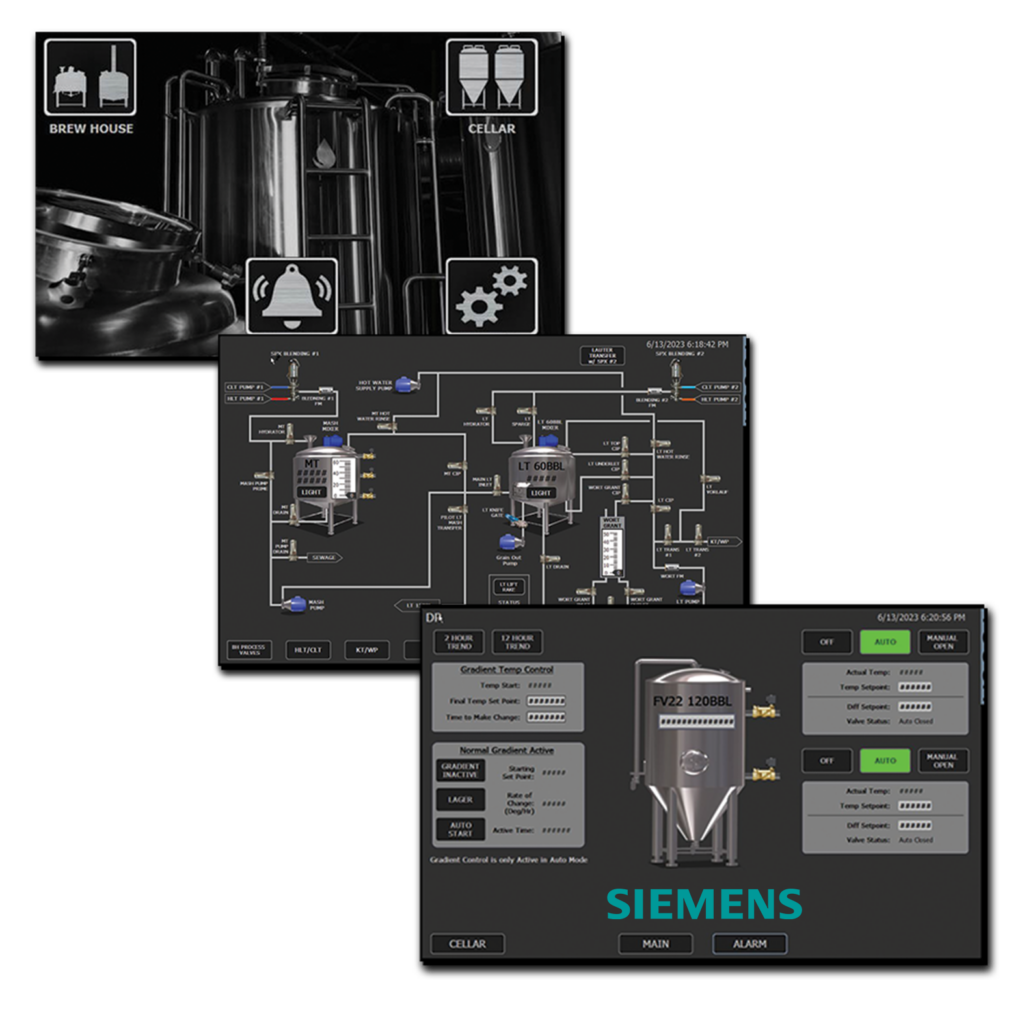
- Human-machine interface (HMI): the operator screens that visualize the process, display alarms, and allow controlled intervention.
- Supervisory and data layer (SCADA / historian): the higher level that coordinates lines, manages recipes, and logs the full process history for traceability and analysis.
Recipe Management and Automated Batching
The single highest-value automation in most food plants is recipe management with automated batching and dosing. A recipe is stored as a defined sequence: add these ingredients in these amounts, in this order, agitate at this speed, heat to this temperature, hold for this time, then cool and transfer. The control system executes that sequence exactly, every time, using metered dosing — by weight via load cells or by volume via flow meters — so that ingredient quantities do not drift with operator attention or fatigue.
The benefits compound: batch-to-batch consistency improves because the process no longer depends on manual timing and measurement; changeovers between products become a recipe selection rather than a manual reconfiguration; and the system records the actual values achieved against the target, so any deviation is captured rather than silently passed downstream.
| Process Function | Manual Operation | Automated Operation |
|---|---|---|
| Ingredient dosing | Operator weighs by hand | Metered by load cell or flow meter |
| Batch consistency | Varies with operator | Identical to the recipe each run |
| Product changeover | Manual reconfiguration | Select a stored recipe |
| Record keeping | Handwritten logs | Automatic electronic batch record |
| Deviation handling | Caught after the fact | Real-time alarm and hold |
Automated CIP and Sanitation
Clean-in-place is one of the most natural processes to automate. A CIP cycle is fundamentally a fixed sequence — pre-rinse, caustic wash at a target temperature and concentration for a set time, intermediate rinse, acid wash, sanitize, and final rinse — that depends on getting time, temperature, chemical concentration, and flow exactly right on every cleaning. An automated CIP system controls the sequence, verifies the parameters with temperature and conductivity sensors, and logs the cleaning record. Because cleaning effectiveness directly underwrites food safety, an automated CIP cycle that proves it ran correctly is far more defensible than a manual wash whose quality depended on who performed it.
Traceability and the Electronic Batch Record
Traceability is the ability to follow a product and its ingredients in both directions: forward, from a raw lot to every finished unit that contains it, and backward, from a finished unit to every ingredient lot and process condition that produced it. Automation makes this practical by tying ingredient lot numbers, metered quantities, equipment used, process values, and operator actions into a single electronic batch record. In a recall scenario, that record lets a producer pinpoint exactly which finished lots are affected rather than recalling everything, and it provides the documentation regulators and auditors expect.
Practical Benefits and the Path In
The combined payoff of food and beverage automation is concrete: tighter consistency and fewer off-spec batches, lower labor cost per unit and redeployment of skilled staff to higher-value work, faster and lower-waste changeovers, and a continuous, audit-ready data trail. A plant rarely automates everything at once. The common path is to start with the highest-value, highest-risk steps — recipe-driven batching at critical control points and automated CIP — and to ensure new vessels and lines are specified with the instrumentation and control connections that let them join the automated system as the operation grows. Building that capability into equipment from the outset is far cheaper than retrofitting controls onto tanks that were never instrumented for it.
Instrumentation That Makes Automation Possible
Automation is only as good as the data feeding it, so the instrumentation on each vessel is the foundation everything else stands on. The sensors must be sanitary in design — mounted flush, with no crevices, and built to withstand the same CIP chemistry and temperatures as the tank they serve. Common measurements and their roles include:
- Level: radar, hydrostatic, or load-cell measurement tells the system how full a tank is, enabling automated filling, dosing by weight, and overflow protection.
- Temperature: sanitary probes confirm cook and hold conditions and govern heating and cooling, central to HACCP critical control points.
- Flow: magnetic or mass flow meters meter ingredients into a recipe and track transfers between vessels.
- pH and conductivity: verify product chemistry and, during cleaning, confirm that caustic and acid concentrations and final-rinse cleanliness meet the CIP recipe.
When these instruments are specified and installed correctly, the control system has a faithful, real-time picture of every vessel. When they are an afterthought — or omitted to save cost — the automation is blind, and operators fall back to manual judgment, defeating the purpose.
Validation, Data Integrity, and Cybersecurity
In a regulated food environment, an automated system that produces records must produce trustworthy records. That means the control logic and its records should be validated — demonstrated to do what they are supposed to do — and the data should be protected against accidental or unauthorized change so that an electronic batch record can be relied upon during an audit or recall investigation. As control systems become networked, basic cybersecurity hygiene — access control, segregation of control networks, and backups — also becomes part of protecting both food safety and production continuity. The point is that automation brings responsibilities alongside its benefits: the same connectivity that captures the record must be managed so the record stays accurate and the line stays available.
A Realistic Automation Roadmap
For most food and beverage operations the smart sequence is incremental. The first investments target the steps where consistency and safety matter most and where manual operation is weakest: recipe-driven batching and dosing, monitoring and control of HACCP critical control points, and automated CIP with verified parameters and logging. These deliver the clearest return in fewer off-spec batches, defensible food-safety records, and reduced cleaning risk.
From there, plants extend automation outward — coordinating multiple vessels and lines through a supervisory layer, adding traceability that links ingredient lots to finished units, and feeding the historian's data into analysis that reveals where yield, energy, or time can be improved. Throughout, the cheapest path is to ensure every new tank, mixer, and line is purchased already instrumented and control-ready, so it can plug into the growing system rather than requiring an expensive retrofit later. Automation, approached this way, is not a single project but a capability the plant builds steadily — one that compounds into consistency, safety, and efficiency as the operation matures.
Frequently asked questions
- What is the difference between a PLC, an HMI, and SCADA?
- A programmable logic controller (PLC) is the rugged industrial computer that reads sensors and drives valves, pumps, and heaters according to programmed logic. The human-machine interface (HMI) is the operator screen that visualizes the process and displays alarms. SCADA and the data historian sit above both, coordinating multiple lines, managing recipes, and logging the full process history for traceability.
- How does automation support food safety and HACCP?
- A HACCP plan defines critical control points such as a cook temperature, hold time, or pH that must be met and documented for every batch. An automated control system monitors those points continuously, holds the process at the validated condition, alarms when a limit is approached, and stores the proof. This turns compliance from a manual clipboard task into an inherent, recorded property of the line.
- Why is automated CIP better than manual cleaning?
- A clean-in-place cycle depends on getting time, temperature, chemical concentration, and flow exactly right every time, and manual cleaning quality varies with whoever performs it. An automated CIP system runs the fixed sequence, verifies the parameters with temperature and conductivity sensors, and logs that the cycle ran correctly. Because cleaning effectiveness directly underwrites food safety, a documented automated wash is far more defensible than a manual one.
- What does traceability mean and how does automation enable it?
- Traceability is the ability to follow a product and its ingredients both forward, from a raw lot to every finished unit, and backward, from a finished unit to every ingredient lot and process condition. Automation enables it by tying lot numbers, metered quantities, equipment used, and process values into a single electronic batch record. In a recall, that record lets a producer identify exactly which lots are affected instead of recalling everything.
Scope your custom build
Send us your volume, service chemistry, dimensions, and finish or code requirements. We return a full engineering package, firm lead time, and a fixed quote — freight quoted separately to your ZIP.
Request a Custom QuoteCall 866-418-1777