
COP & Parts Washing
COP & Parts Washing
Some parts cannot be cleaned in place, no matter how good the spray device. Clean-out-of-place takes them out, washes them in a dedicated tank, and verifies them before they go back.
What Clean-Out-of-Place Is
Clean-out-of-place (COP) is the cleaning of equipment components that have been removed from the process line and cleaned in a dedicated wash station rather than in their installed position. Where clean-in-place (CIP) circulates cleaning solution through assembled equipment without taking it apart, COP takes the opposite approach for the items that CIP cannot reliably clean: small parts, complex fittings, gaskets, valves, hoses, sensors, and other components whose geometry, disassembly requirements, or size make in-place cleaning impractical or unverifiable.
The two methods are complementary, not competing. A well-designed sanitation program uses CIP for the tanks, vessels, and pipework that can be cleaned in place, and COP for the parts that must come out. Some components simply cannot be cleaned where they sit: a valve with internal seats and crevices, a pump head, a filter housing, a fitting with threads, or a flexible hose may have internal geometry that no spray device can reach. Pulling them, cleaning them in a controlled COP station, inspecting them, and reassembling is often the only way to guarantee they are clean.
Why Some Parts Cannot Be Cleaned in Place
The case for COP comes down to reach, verification, and geometry. CIP works only when cleaning solution can physically contact every surface with adequate energy and then drain away. Several common situations defeat that requirement:
- Complex internal geometry. Valves, pump heads, filter housings, and instruments have internal passages, seats, and crevices that a spray device cannot reach and that may trap soil even during a thorough CIP cycle.
- Components requiring disassembly. Parts that must be taken apart to expose their soiled surfaces — multi-piece fittings, certain valves, sample devices — can only be fully cleaned once separated.
- Dead legs and unswept branches. Some fittings create unswept zones in place; removing them eliminates the problem and lets each surface be cleaned directly.
- Inspection requirements. Some parts must be visually inspected or have gaskets and seals replaced on a schedule, and that work happens during disassembly, making COP a natural fit.
- Small, numerous items. Clamps, gaskets, small fittings, and tools are efficiently cleaned in a batch in a wash tank rather than addressed individually in place.
COP Wash Tanks and Carts
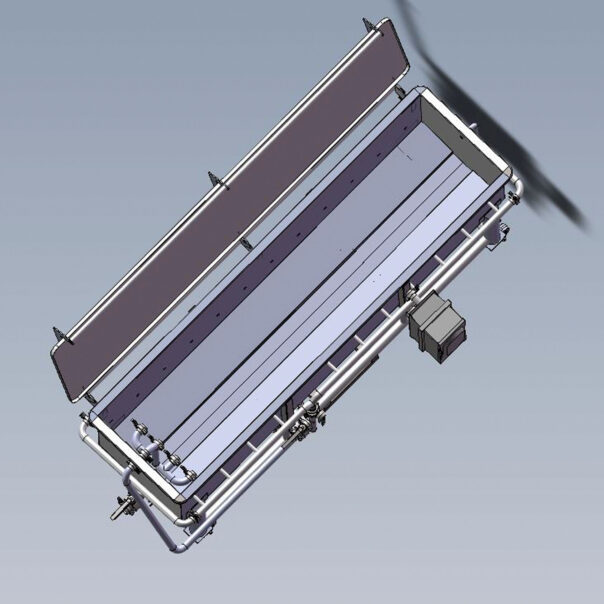
The core of a COP station is a wash tank or wash cart designed to hold cleaning solution and the parts being cleaned. A COP wash tank is typically a stainless tank, often heated and equipped with a means of agitation, into which disassembled parts are loaded in baskets or racks. Wash carts are mobile versions on wheels that can be brought to the work area, particularly useful where parts are dispersed across a facility.
A typical COP tank is built around the same cleaning principles as any wash process. It holds heated cleaning solution — caustic for organic soils, acid for mineral deposits — and provides mechanical agitation to move the solution across the parts. Parts are placed in perforated baskets so the solution flows freely around and through them and so they can be lifted out, rinsed, and transferred between steps as a batch. Many COP tanks recirculate solution, filtering out loosened soil and replenishing chemistry, for the same water and chemical economy that benefits other wash systems.
Mechanical Action: Agitation and Ultrasonics
Because COP parts sit in a bath rather than being sprayed, the mechanical force that lifts soil is delivered differently. Two methods dominate.
Agitation moves the cleaning solution across the part surfaces to scrub and flush soil away. This can be achieved by recirculating pumps that create flow through the tank, by mechanical or air-driven agitation that stirs the bath, or by moving the parts baskets within the solution. Agitation ensures the solution does not sit stagnant against the parts, continually presenting fresh chemistry to the soil and carrying loosened residue away. For many parts, hot agitated caustic followed by an acid step and rinse is entirely sufficient.
Ultrasonic cleaning adds a powerful mechanism for parts with intricate geometry. Ultrasonic transducers generate high-frequency sound waves in the cleaning solution, which create microscopic cavitation bubbles that collapse against the part surfaces. This cavitation delivers intense, highly localized scrubbing energy that reaches into crevices, threads, blind holes, and complex internal passages that flow alone cannot scour. Ultrasonic cleaning is especially valuable for small, precision, or intricate components where soil hides in features too fine for bulk agitation to clean. It is typically combined with heated chemistry, since heat and ultrasonics together are more effective than either alone.
| Method | Mechanical Action | Best For |
|---|---|---|
| Recirculating agitation | Bulk flow moves solution across the parts | General fittings, valves, and larger components |
| Stirred / air agitation | The bath is stirred to keep fresh chemistry at the surface | Batches of mixed parts in baskets |
| Ultrasonic | Cavitation scrubs into crevices and fine features | Small, precision, or intricate parts with hidden soil |
A Typical COP Process
A COP process follows the same logic as any wash cycle, adapted to a batch of removed parts. The steps are ordered to remove gross soil first, then organic and mineral soils, then to rinse and sanitize thoroughly.
- Disassembly. Components are removed from the line and broken down into their individual parts so every soiled surface is exposed.
- Pre-rinse. Parts are rinsed to remove gross residue before entering the chemistry bath, reducing the soil load and chemical consumption.
- Wash. Parts are immersed in heated cleaning solution with agitation or ultrasonics — caustic for organic soils, with an acid step where mineral scale is present.
- Rinse. Parts are rinsed thoroughly to remove all chemistry and loosened soil.
- Sanitize and inspect. Parts are sanitized as required, then inspected; worn gaskets and seals are replaced before reassembly.
- Reassembly. Cleaned, inspected parts are reassembled and returned to the line.
Where COP Fits Alongside Automated Tank Washing
COP and automated tank or container washing are two halves of a complete sanitation program. The automated wash systems and CIP spray devices handle the large fixed surfaces — tanks, vessels, and the pipework that can be cleaned in place — efficiently and with verifiable coverage. COP handles the items those systems cannot reach: the valves, fittings, gaskets, hoses, and small components that must be removed, disassembled, and cleaned individually to be certain they are clean.
Like every other cleaning method, COP is verified rather than assumed. Cleaned parts are visually inspected, and where the application demands it, surfaces are confirmed by ATP, protein, allergen, or microbial swabs before the parts return to service. Documenting the wash — the chemistry, temperature, time, and inspection results — provides the same evidence of control that CIP records provide for fixed equipment. A program that pairs verified CIP for what can be cleaned in place with verified COP for what cannot leaves no component uncleaned and no surface unaccounted for, which is exactly what food safety and quality systems require.
Handling, Safety, and Recontamination
Because COP involves taking equipment apart and handling many loose pieces, it introduces risks that automated in-place washing does not, and a sound program manages them deliberately. The first risk is recontamination after cleaning. A part that has been cleaned, rinsed, and sanitized can be re-soiled by careless handling — set down on a dirty surface, touched with soiled gloves, or left exposed to the environment before reassembly. Clean parts are therefore kept on dedicated clean surfaces or in covered storage and handled to protect the surfaces that will contact product.
Operator safety is the second concern. COP work means handling hot cleaning solution, caustic and acid chemistry, and sometimes sharp or heavy components. Wash tanks are positioned and guarded so operators are not exposed to splash or fumes, baskets allow parts to be lifted out without reaching into hot chemistry by hand, and the usual chemical-handling protections apply. Enclosed or ventilated stations contain fumes from heated chemistry and ultrasonic baths.
The third concern is keeping track of parts and their condition. During disassembly, gaskets, seals, and small components are easily lost or mixed between assemblies, and worn items must be identified and replaced rather than cleaned and reinstalled. A disciplined COP routine accounts for every part, replaces wear items on schedule, and confirms each assembly is complete and correct before it returns to the line. Managed this way, COP closes the gap that automated tank washing leaves, cleaning the components that fixed systems cannot reach while controlling the handling risks that come with taking equipment apart.
Frequently asked questions
- What is the difference between CIP and COP?
- Clean-in-place (CIP) cleans assembled equipment without taking it apart, circulating cleaning solution through tanks and pipework via spray devices and turbulent flow. Clean-out-of-place (COP) cleans components that have been removed from the line and washed in a dedicated tank or cart. The two are complementary: CIP handles large fixed surfaces that can be cleaned in place, while COP handles the parts whose geometry or disassembly needs make in-place cleaning unverifiable.
- Which parts need clean-out-of-place cleaning?
- Components that cannot be reliably cleaned where they sit are candidates for COP: valves with internal seats and crevices, pump heads, filter housings, fittings with threads, flexible hoses, sensors, and small numerous items like gaskets and clamps. These have internal geometry a spray device cannot reach, or they must be disassembled to expose soiled surfaces, or they require inspection and seal replacement during cleaning.
- How does ultrasonic cleaning work in a COP tank?
- Ultrasonic transducers generate high-frequency sound waves in the cleaning solution, creating microscopic cavitation bubbles that collapse against the part surfaces. That collapse delivers intense, highly localized scrubbing energy that reaches into crevices, threads, blind holes, and complex passages that flow alone cannot scour. It is especially effective for small, precision, or intricate parts and is usually combined with heated chemistry, since heat and ultrasonics together clean more effectively than either alone.
- Does a COP tank use the same chemistry as CIP?
- Yes. A COP tank applies the same cleaning principles and chemistry as CIP, using caustic for organic soils such as fats and proteins and acid for mineral deposits, generally with heat to accelerate the reactions. The difference is how mechanical force is delivered: COP supplies it through bulk agitation or ultrasonic cavitation in a bath, whereas CIP supplies it through spray-device impingement and turbulent flow on fixed surfaces.
Scope your custom build
Send us your volume, service chemistry, dimensions, and finish or code requirements. We return a full engineering package, firm lead time, and a fixed quote — freight quoted separately to your ZIP.
Request a Custom QuoteCall 866-418-1777