
Drum, IBC & Tote Wash Systems
Drum, IBC & Tote Wash Systems
A reusable container is only as good as the wash that prepares it for the next fill. Automated wash systems turn container cleaning from a hazardous manual chore into a repeatable, documented cycle.
Why Container Washing Is Its Own Discipline
Drums, intermediate bulk containers (IBCs), and totes are reusable assets. A steel or plastic drum, a caged poly IBC, or a stainless tote can cycle through a supply chain many times if it is cleaned thoroughly between fills. The economics are compelling: a clean, recertified container returned to service is far cheaper than a new one, and reuse keeps containers out of the waste stream. But that value only holds if the container can be cleaned to a standard that prevents cross-contamination, residue carryover, and microbial growth from one product to the next.
Container washing differs from cleaning a fixed process vessel in several ways. Containers arrive with unknown or variable residues, in large numbers, often on a schedule that demands throughput. Their geometry is awkward: a narrow bung opening on a drum, internal baffles or a discharge valve on an IBC, and tight corners that shelter soil. Manual cleaning of these containers is slow, exposes workers to chemical residues and confined-space hazards, and produces inconsistent results. Automated wash systems exist to solve exactly this combination of throughput, safety, and repeatability.
The core principle is the same one that governs all hygienic cleaning: cleaning solution must physically reach every interior surface with enough energy, chemistry, temperature, and time to lift the soil, and the container must then drain and rinse completely. Everything in a wash system — the spray device, the pump, the heater, the cycle program — serves that goal.
How an Automated Wash System Works
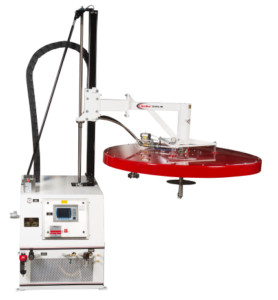
An automated container wash system is built around a wash chamber or station, a spray device that enters or addresses the container, a pump that delivers flow and pressure, a heater for hot wash steps, and a controller that sequences the cycle. The container is positioned — clamped, inverted, or seated over a manifold — and the spray device is inserted through the opening or directed at the container.
The heart of the interior wash is a rotary spray head or rotary jet head lowered through the bung or top opening. As cleaning solution flows through it, the head rotates and indexes, projecting high-impact streams that sweep the entire interior in a programmed pattern. This impingement action mechanically blasts soil off the walls and corners that a simple flooding spray could not reach. Exterior washing, where required, is handled by fixed nozzles or spray bars around the chamber.
- Loading and positioning. The container is placed so the spray device can reach the interior and so spent solution drains freely back out the opening.
- Pre-rinse. Warm or ambient water flushes out the bulk of the residual product before chemistry is introduced, reducing chemical load.
- Hot wash. Heated cleaning solution — caustic for organic and oily soils, acid for mineral scale — recirculates through the spray head to dissolve and lift the soil.
- Rinse. Clean water purges chemistry and loosened soil from the container.
- Final rinse and drain. A final clean-water rinse, sometimes followed by a sanitizing step, leaves the container ready for inspection and refill; the container drains completely before release.
Spray Devices for Containers
The spray device determines whether the wash succeeds. Because containers are relatively small but have tight internal features, high-impact rotary devices are the workhorses of container washing.
| Device | Action | Best For |
|---|---|---|
| Static spray ball | Floods surfaces with sheeting flow from fixed holes | Light water-soluble soils in open, free-draining containers |
| Rotary spray head | Rotating fan sprays for broad, even coverage | Moderate soils, general drum and tote cleaning |
| Rotary jet / impingement head | High-impact indexed jets in a repeating pattern | Tenacious, dried, or oily residues; lower water use |
For dried, viscous, or oily residues, the concentrated jets of a rotary impingement head provide the mechanical energy needed to break the soil loose, and they do so with less water and chemistry than a flooding device because the energy is focused rather than diffuse. The device must be sized so its jets reach the full diameter and depth of the container and overlap across every surface, including behind an IBC discharge valve or the underside of a drum's top.
Heated, Recirculating Operation
Most container wash systems run hot, because heat accelerates chemical reactions and softens fats, oils, and dried residues. A heater — electric, steam, or hot-water — brings the wash solution to set point, commonly well above ambient, while the controller holds temperature through the wash step.
Recirculation is what makes heated washing economical. Rather than sending hot, chemically charged solution to drain after a single pass, the system collects it in a solution tank, filters out loosened soil, replenishes chemistry to strength, and re-uses it across many containers. This dramatically reduces water, chemical, and heating costs. A typical recirculating system reserves fresh water for the final rinse only, which is sometimes recovered to serve as the next container's pre-rinse, capturing most of the savings while protecting the final rinse from carryover.
- Solution tanks. Separate reservoirs hold pre-rinse water, hot caustic, acid, and final rinse so each phase draws from the right source.
- Filtration. Strainers and filters remove suspended soil so it is not redeposited on the next container or sent through the pump and spray head.
- Concentration control. Re-used chemistry is monitored and replenished, because solution that has drifted out of strength leaves soil behind.
Contamination Control and Reuse
The whole point of washing a returnable container is to return it to service without carrying contamination forward. That demands attention to several risks beyond simply removing visible residue.
Cross-contamination between products is the central concern. A container that held one chemistry must be cleaned thoroughly enough that no meaningful residue of the previous product remains before a different product is loaded. Where the previous contents were hazardous, allergenic, or incompatible with the next fill, single-use cleaning of the final steps — sending solution to drain rather than re-using it — avoids carrying trace residue between containers. Verification methods such as conductivity or pH checks on the final rinse, and swab or residue tests on the interior, confirm the container meets the required standard.
Microbial control matters where containers hold food, beverage, or sensitive products. A sanitizing step — chemical sanitizer or hot water — following the wash reduces microbial load, and complete draining prevents residual water from supporting growth during storage. Material compatibility also governs the wash: a poly IBC has temperature limits that a stainless tote does not, so wash temperature and chemistry are matched to the container's construction to avoid damaging it.
Throughput, Safety, and Documentation
Automated systems earn their place by handling volume safely. A programmed cycle runs the same way for every container, freeing labor and removing workers from contact with hot chemistry and from confined-space entry into the container. Enclosed wash chambers contain spray, fumes, and runoff, and they collect spent solution for proper handling rather than letting it escape.
Because the wash replaces visual hand cleaning, it is documented. Controllers log cycle time, temperature, and chemistry concentration for each container or batch, and verification tests confirm the result. For containers that must be recertified for reuse — particularly those that held regulated materials — this documentation is the evidence that the container was cleaned to standard. When the spray device, chemistry, temperature, and cycle are all correct and verified, container washing becomes a fast, safe, repeatable process that protects both the next product and the value of the reusable asset.
Matching the System to the Container and Soil
No single wash configuration suits every container, because the right setup is driven by what the container is made of, what it held, and how many must be processed. A steel drum tolerates higher wash temperatures and more aggressive chemistry than a plastic IBC, whose poly construction sets a ceiling on both. A container that held a light, water-soluble product may need only a warm rinse and a short hot wash, while one that held a dried, polymerized, or oily residue needs the concentrated impact of a rotary jet head and a longer hot caustic step to break the soil free.
Throughput shapes the system as much as the soil does. An operation cleaning a handful of containers a day is well served by a single station with a recirculating tank and a manually loaded spray device. A high-volume operation handling many containers per hour justifies a more automated line: powered handling, indexed positioning, multiple stations, and tighter cycle control. In every case the same fundamentals decide success — the spray device must reach every interior surface, the pump must supply its rated flow and pressure, the chemistry must match the soil, and the result must be verified — but the scale and degree of automation are tailored to the work.
The container's own features also factor in. An IBC with internal baffles, a discharge valve, or a fine-mesh screen creates shadow zones and trap points that a drum does not have, so its wash needs more spray-device coverage and often a longer cycle to clean those features thoroughly. Mapping the container's internal geometry before specifying the system prevents the most common and most expensive surprise: a wash that looks complete but leaves a hidden feature uncleaned.
Frequently asked questions
- What is the difference between cleaning a drum and cleaning an IBC?
- Both rely on a rotary spray device inserted through the top opening, but the geometry differs. A drum has a narrow bung and a simple cylindrical interior, while an IBC or tote has a larger fill opening, internal features, and a discharge valve that creates a shadow zone. The spray device for an IBC must be sized and programmed so its jets reach behind the valve and into every corner, which usually means a higher-impact rotary jet head.
- Why do most container wash systems use hot water?
- Heat accelerates the chemical reactions that dissolve soil and softens fats, oils, and dried residues so they release more readily. Running the wash hot lets the system clean faster and more thoroughly with the same chemistry. The wash temperature is matched to the container material, since plastic IBCs have temperature limits that stainless containers do not.
- Can wash water be reused, or does each container need fresh water?
- Recirculating systems reuse heated cleaning solution across many containers, filtering out soil and replenishing chemistry to strength, which sharply cuts water, chemical, and energy use. The final rinse typically uses fresh water to avoid carryover. Where the previous contents were hazardous, allergenic, or incompatible with the next product, the final steps may be run single-pass to drain to prevent trace carryover between containers.
- How do you confirm a container is clean enough to refill?
- Because automated washing replaces visual hand inspection, it is verified with measurements. A riboflavin coverage test confirms the spray device wetted every surface, conductivity or pH checks on the final rinse confirm chemistry was fully purged, and swab or residue tests confirm no meaningful product residue remains. Controllers also log cycle time, temperature, and concentration as a record that the cycle ran to set point.
Scope your custom build
Send us your volume, service chemistry, dimensions, and finish or code requirements. We return a full engineering package, firm lead time, and a fixed quote — freight quoted separately to your ZIP.
Request a Custom QuoteCall 866-418-1777