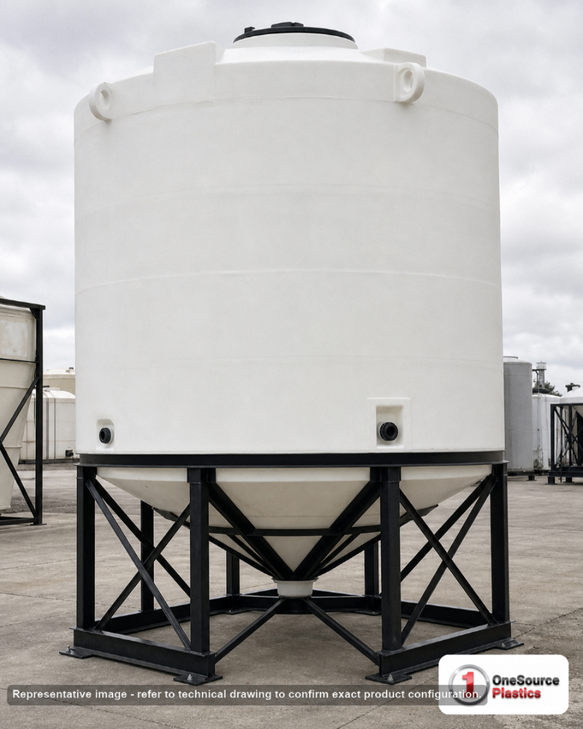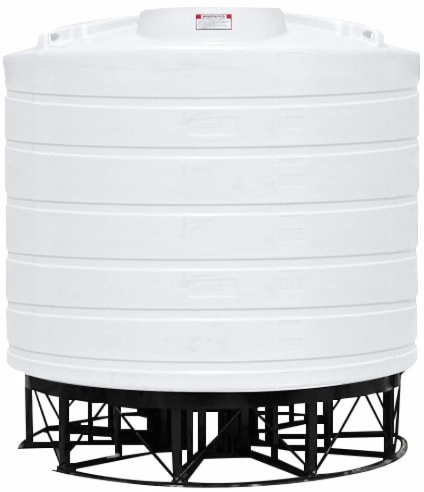
The Enduraplas 7011 Gallon White Cone Bottom Tank with Stand is built for high-volume batching, mixing, and full-drain chemical storage where you need the contents to empty completely through the bottom. Molded from FDA-compliant polyethylene with a natural white wall, it stands 150 inches tall on a 144-inch-diameter footprint and rides on its own integrated stand. Empty tank-and-stand weight is about 1,600 lb, and it ships as a cone-bottom-on-stand assembly with a 16-inch threaded vented manway up top and a 3-inch PP female NPT bulkhead fitting at the cone tip for gravity draw-off.
Will it handle your batch
This tank carries a 1.9 specific-gravity rating, which is what makes it a genuine chem-service vessel rather than a water-only tank. Filled with water the contents alone weigh roughly 58,472 lb; at its full 1.9 SG rating the wall is engineered to hold up to about 111,096 lb of product. That 1.9 is the maximum this poly platform offers, so verify your fluid's actual specific gravity is at or below 1.9 before you fill — if your chemistry runs heavier, this tank is not the answer. Size the pad and anchoring for a loaded 144-inch circular footprint. Our Tank Sizing Calculator and Tank Sizing Guide walk through matching capacity and SG to your process. Because this is a cone-bottom-with-stand rig, the stand choice matters as much as the tank — see our stand selection decision tree and the Norwesco/Snyder/Enduraplas stand compatibility matrix. Reference the technical drawing on this page for exact port and stand geometry.
Chemical compatibility
The resin on this tank is most likely HDLPE but is not yet verified — confirm HDLPE versus XLPE (cross-linked) with us before committing it to chemical service, because that choice changes what it will safely hold. Compatibility below is drawn from a published polyethylene chemical-resistance chart and is concentration- and temperature-specific — verify your exact chemical, concentration, temperature, and fitting and gasket materials before ordering. The headline oxidizers and acids this tank can run all demand the full 1.9 rating, meaning there is no SG headroom, which is exactly why the SG check above is a hard gate: sodium hypochlorite (bleach, <16.5%) with PVC fittings and Viton gaskets; sulfuric acid (98%) with CPVC and Viton; hydrochloric acid (37%), phosphoric acid (85%), hydrofluoric acid (48%), and hydrogen peroxide (50%), all on Viton; plus ferric chloride (50%), ferric sulfate (60%), ethylene glycol (100%), and potassium hydroxide (saturated) on PVC with EPDM; and peracetic acid (30%) on 316SS with Aflas. Lower-SG duties such as DEF (32.5%) and urea solution (50%) call for EPDM gaskets and 316SS or PP hardware. Match the fitting to the chemical: the stock 3-inch PP bulkhead is not the right material for sulfuric acid — spec CPVC there — and DEF or peracetic service want 316SS. The 16-inch manway is vented, which matters because sodium hypochlorite and hydrogen peroxide off-gas in storage. Full chart at our Chemical Compatibility Database.
Freight and ordering
The mistake to avoid on a tank this size is treating the SG rating as optional — fill a 1.9-rated wall with a fluid at or under that rating and it lasts; exceed its rated contents weight and you shorten its life. This 7011-gallon cone-bottom unit ships LTL freight from the nearest Enduraplas plant — Converse, TX or Neche, ND — quoted live to your ZIP. Get a number in seconds with our Freight Cost Estimator, or call 866-418-1777 to confirm resin, fitting materials, and delivery for your application.
Freight and documents
Ships from: Neche, ND; Converse, TX. LTL freight is quoted to your ZIP with the freight cost estimator or by phone at 866-418-1777. The listed price is before freight.
Technical drawing (PDF) for Enduraplas THC07011KW.
See this tank
Product video. Watch the Enduraplas 7011 Gallon White Cone Bottom Tank with Stand video (74 seconds) with dimensions, fittings and shipping notes.
Ready to order?
Add it to your cart at the top of this page, get LTL freight to your ZIP, or call 866-418-1777. The listed price is before freight.