Seven thousand four hundred gallons over a 30 degree cone
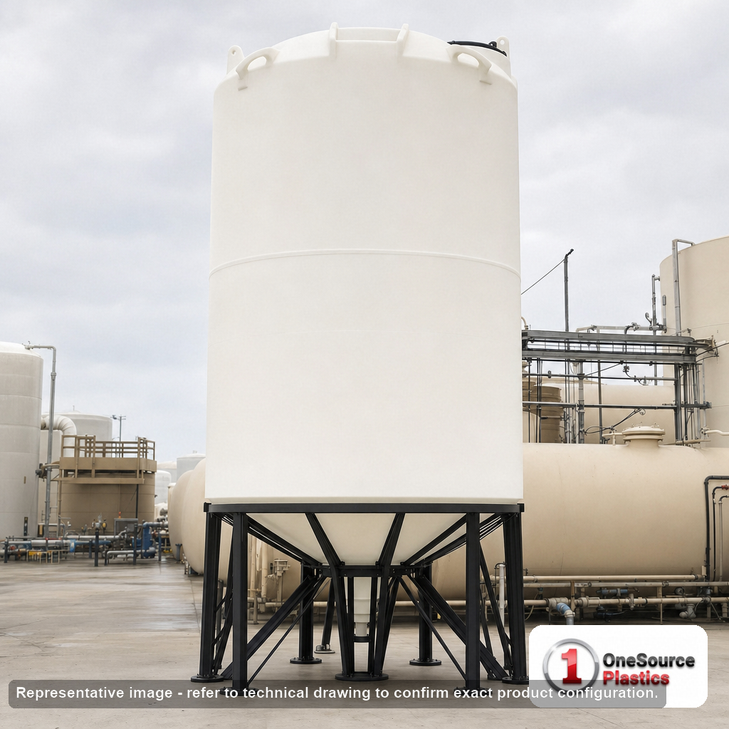
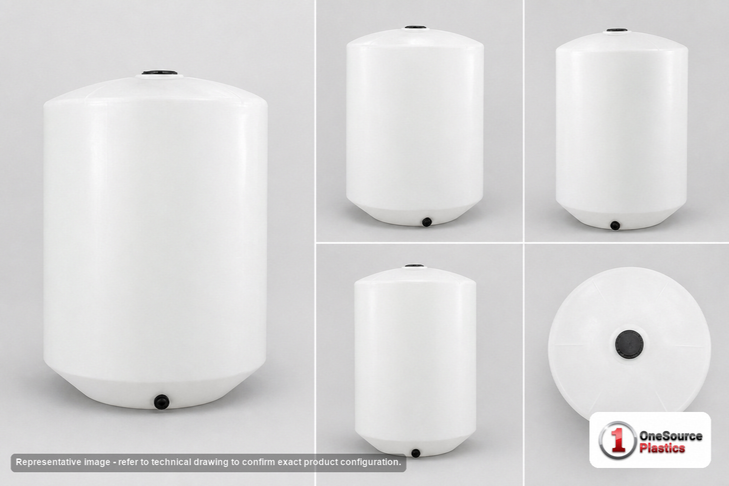
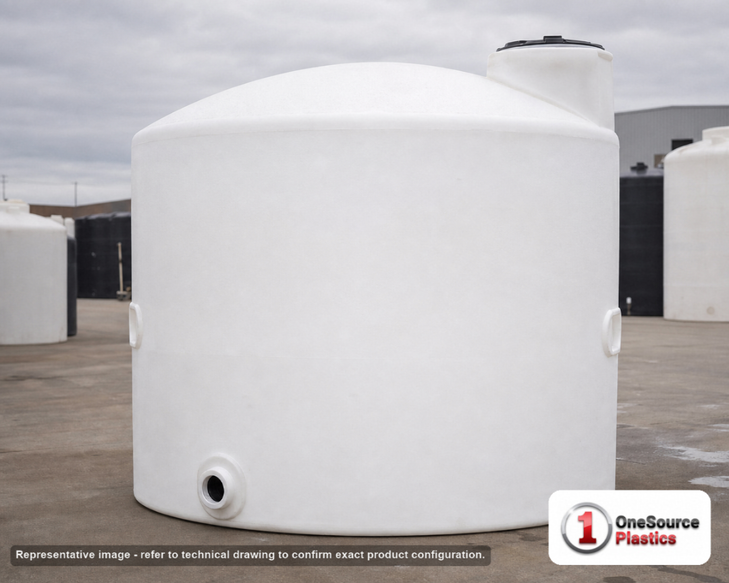
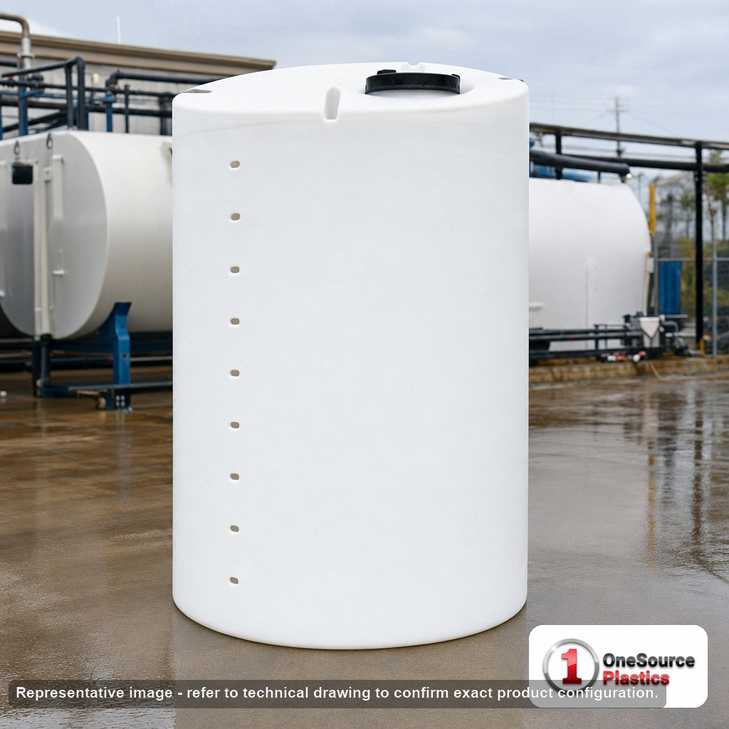
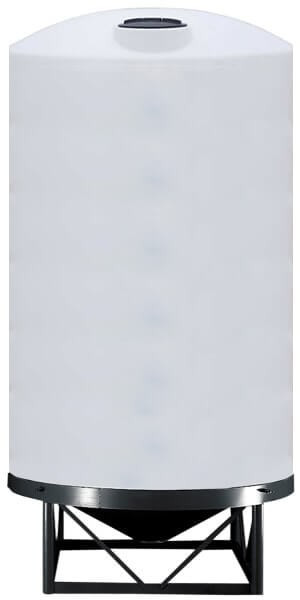
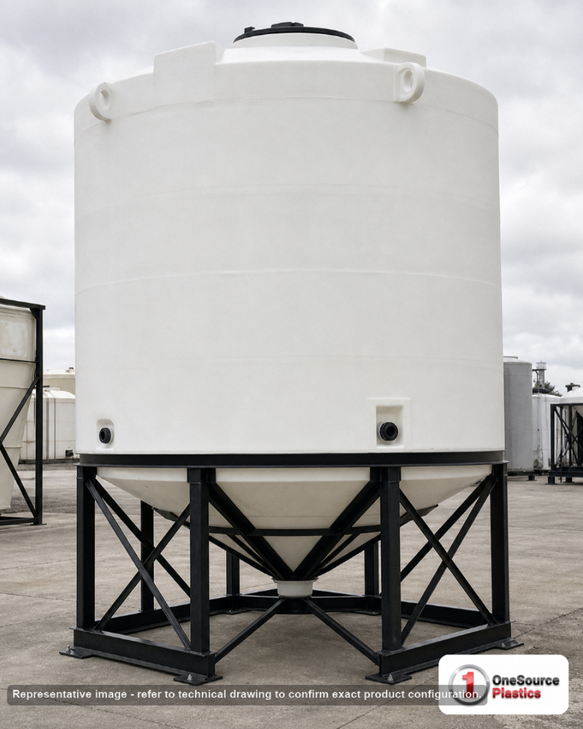
The Snyder SII-5320100N43 is a 7400 gallon 30 degree cone bottom tank in white polyethylene, listed at 142 inches long, 142 inches wide and 160 inches tall, and 1,600 pounds empty. That is a wide, comparatively squat cone: nearly twelve feet across the plan and a little over thirteen feet to the top, which is a different proposition from the tall narrow cones in the same catalogue. The wall is rated at a specific gravity of 1.5, and the sheet gives 61,716 pounds for 7,400 gallons of water at 8.34 pounds per gallon with 92,574 pounds of max contents. The opening on top is an 18 inch threaded vented manway. The service limit is 120 F / 48 C. The sheet publishes no outlet, no inlet, no cone angle field, no stand and no warranty term, so this page claims none of them; the 30 degrees is the angle the product name carries, and the stand is a separate item. Freight is given as OVS under NMFC 156600, out of Lincoln, Nebraska.
Want a second opinion on the size? Call 866-418-1777 with the daily draw and the delivery interval, or price freight to your ZIP and add it to your cart above.
The bulk batching duty that wants a cone under it
Start with the job, because at this volume the job is what justifies the structure. A cone bottom tank is bought by an operation that has to get everything out of the vessel, every time, under gravity: a blender that changes product between batches, a plant that holds a suspension which will settle if it is left alone, a works that thickens and then draws off, a retailer that loads out by the truckload and cannot afford a heel in the bottom of the tank. A flat floor at 7,400 gallons leaves a layer behind at every changeover, and that layer is not a housekeeping problem, it is a disposal ticket and a contamination risk on the next batch. The cone is what removes it. What the cone costs is that the vessel cannot stand on its own bottom. This sheet publishes no stand, no legs, no skirt and no support ring, so nothing here describes what it sits in; that is a separate item, specified before the tank is ordered rather than after it is delivered, and the cone bottom tank stand compatibility matrix is where that gets worked through across makers. What the sheet does give you is the envelope the structure has to live inside, and this one is friendlier than most. At 142 inches across against 160 inches tall, the plan is nearly as wide as the tank is high, which makes it a comparatively stable arrangement and keeps it under a roof that a slender cone of the same volume would never fit beneath. Measure the height to the lowest obstruction and then add the stand, because the stand is the part that surprises people on a site survey. The load is the other half of the design. Empty it is 1,600 pounds; the sheet gives 61,716 pounds full of water and 92,574 pounds at the rating, and all of that arrives through the stand into a small number of bearing points. The foundation under it is an engineered element, not a slab poured to match a drawing. Confirm 7,400 gallons against your real batch size and turnover in the tank sizing calculator before the structure is designed around it, and take the freeboard a warming, gassing or foaming product needs from the tank sizing guide. Where the vessel stands over a floor, a yard or a drain that would have to be recovered after a release, the Captor containment comparison argues the containment question properly instead of assuming it away.
Four 7400s, a 6500 and an 11500 on one sheet
| Part | Gallons | Plan x height | Empty weight |
|---|---|---|---|
| SII-5320100N43 (this tank, rated 1.5) | 7400 | 142 x 142 x 160 in | 1,600 lb |
| SII-5320100N45 (heavy duty name) | 7400 | 160 in tall, plan not given on the sheet | not given on the sheet |
| SII-5320100N49 (cone bottom name) | 7400 | 160 in tall, plan not given on the sheet | not given on the sheet |
| SII-5320100N51 (heavy duty name) | 7400 | 160 in tall, plan not given on the sheet | not given on the sheet |
| 7180000N40 (tall and narrow) | 6500 | 90 x 90 x 273 in | 2,100 lb |
| 5340100N40 (same plan, much taller) | 11500 | 142 x 142 x 215 in | 2,850 lb |
Four listings hold 7,400 gallons and only this one carries a full set of dimensions and a weight. The other three are given at 160 inches tall with no plan and no empty weight on the sheet at all, so the table says so rather than lending them this tank's 142 inch plan or its 1,600 pounds; where a drawing, a spares list or an existing installation names one of those part numbers, order that part number and ask us to confirm the figures against the part before it ships. The two genuinely different tanks are the last two rows, and they show what the shape decision costs. 7180000N40 holds 6,500 gallons, only nine hundred less than this tank, in a 90 inch circle 273 inches tall at 2,100 pounds. That is barely sixty-three percent of this tank's width carrying nearly twenty-three feet of height, which is a slender column that needs a structure, a crane and a building most sites do not have. This tank puts almost the same volume under thirteen and a half feet. Go the other way and 5340100N40 keeps the identical 142 inch plan, stretches to 215 inches tall and holds 11,500 gallons at 2,850 pounds; the footprint, the pad and the stand problem are the same family of problem, and what you buy with the extra height is four thousand more gallons on ground you have already committed. That is the honest way to read this sheet. Buy this tank when the roof or the wind exposure caps your height and the floor is available; buy the taller one on the same plan when the ceiling is generous and the ground is not; buy the narrow 6,500 only when the floor is the binding constraint and you have a structure to tie it into.
Not sure which one? Tell us the liquid, the site and the ceiling height at 866-418-1777, or request a written quote with freight to your ZIP.
The discharge the sheet does not dimension
- The discharge and the pump behind it: the cone ends in a discharge and this sheet publishes no outlet size, no inlet and no bulkhead, so no number appears here. That matters most to whoever is specifying the pump, because the line size sets the drain time and the drain time sets whether a batch changeover takes ten minutes or an hour. Tell us the line size, the valve type, the pump and the product, and we will confirm what this part number carries before anything is ordered.
- Supporting what hangs below: the valve, any reducer and the first length of pipe are carried on their own steelwork off the stand, never off the cone. At 92,574 pounds of max contents, the static head at the bottom of a full vessel is not the place to find out that a valve was hanging on the tank.
- Angle and drain behaviour: the name gives 30 degrees and the sheet gives no cone angle field. A thirty degree cone is the middle of the common range; it moves free-flowing liquid well and holds on to anything that packs or bridges. If your product settles hard, that argues for a steeper cone rather than a bigger one, and the cone bottom buyer's guide on angle selection sets the angles against each other on the terms that decide it.
- Access: an 18 inch threaded vented manway on top of a 160 inch tank, which is a platform, a fixed ladder and a fall protection arrangement designed alongside the stand rather than added afterwards. It is the only opening this sheet publishes.
- The vent: the manway is listed as vented, and that vent path is what protects the wall while a pump draws the column down. Keep it clear, inspect it on a schedule, and never blank it to control an odour.
- Limits: 120 F / 48 C, a specific gravity rating of 1.5, and no warranty term on this sheet. That is the extent of what it publishes.
Name the product when you order. On a cone discharge the gasket, the valve body and the first joint all follow the chemistry, and on a vessel holding this much the cost of getting that generic is never the fitting itself.
Where a wide 7400 gallon cone earns its floor
This size and shape goes into liquid fertiliser and crop input blending at an ag retailer, mixing and batching in a chemical plant, thickened sludge and polymer duty at a treatment works, mineral and slurry handling at a wash plant, fermentation and settling in food and beverage production, and drilling and completion fluid storage where a load-out has to leave the tank clean. The common thread is not the product, it is the changeover: every one of those operations empties the vessel on purpose and then puts something else in it. The wide plan adds a second advantage worth knowing about. A shorter liquid column stratifies less readily than a tall one, so a wide cone at this volume is generally easier to keep homogeneous with a given mixer than a slender cone holding the same gallons. If your product separates, say so when you enquire, because the draw-off arrangement and the mixing arrangement matter more than the tank does.
Chemicals this resin is rated for, with the fitting and gasket to order
These are the chemicals listed for this tank at the concentrations shown. Each links to the full compatibility page; confirm your exact concentration and temperature there or in the chemical compatibility database before ordering.
- Acetic acid
- Aluminum sulfate
- Calcium chloride
- DEF
- Ferrous sulfate
- Magnesium chloride
- Sodium carbonate
- Urea solution
- ethylene glycol
- ferric chloride
- ferric sulfate
- hydrochloric acid
- hydrofluoric acid
- hydrofluosilicic acid
- hydrogen peroxide
- peracetic acid (316SS fittings, Aflas gaskets)
- phosphoric acid
- polyaluminum chloride
- potassium carbonate
- potassium hydroxide
- propylene glycol
- sodium bisulfate
- sodium bisulfite
- sodium hypochlorite
- sodium thiosulfate
- sulfuric acid (CPVC fittings, Viton gaskets), or
- zinc orthophosphate step up to a 1.9 SG tank rather than forcing this one - and call us at 866-418-1777 for the 1.9 SG cone-bottom equivalent.Several of those
Oversize from Lincoln at 1,600 pounds
This tank is moulded at Lincoln, Nebraska, and the sheet lists Nebraska as the state it ships from, which puts the plains and the Midwest on a short lane and everywhere else on a planned one. The freight class reads OVS, an oversize mode rather than a numeric class, under NMFC 156600, and the tank is listed at 142 by 142 by 160 inches. Price the lane to your ZIP with the freight cost estimator; the listed price is before freight. An oversize move is booked rather than ordered: the route, the permits, the delivery window and the unloading equipment are agreed before the tank leaves the plant, and a site that has not decided how a twelve foot wide vessel comes off a trailer is a site that pays for a second visit. Have the lifting equipment standing and the stand set, levelled and anchored before the truck arrives. Set it, restrain it, and only then fill it with clean water and hold that 61,716 pound load long enough to read the manway seal, the discharge joint, the stand feet and the foundation, in that order. Walk the full 142 inch plan with the water still in it, then walk it again the next morning; on a wide cone the thing that moves first is the outside edge of the pad. Chalk the full-water line on the outside after the first fill; it is the level every later reading gets checked against.
Freight and documents
Ships from: Lincoln, NE. LTL freight is quoted to your ZIP with the freight cost estimator or by phone at 866-418-1777. The listed price is before freight.
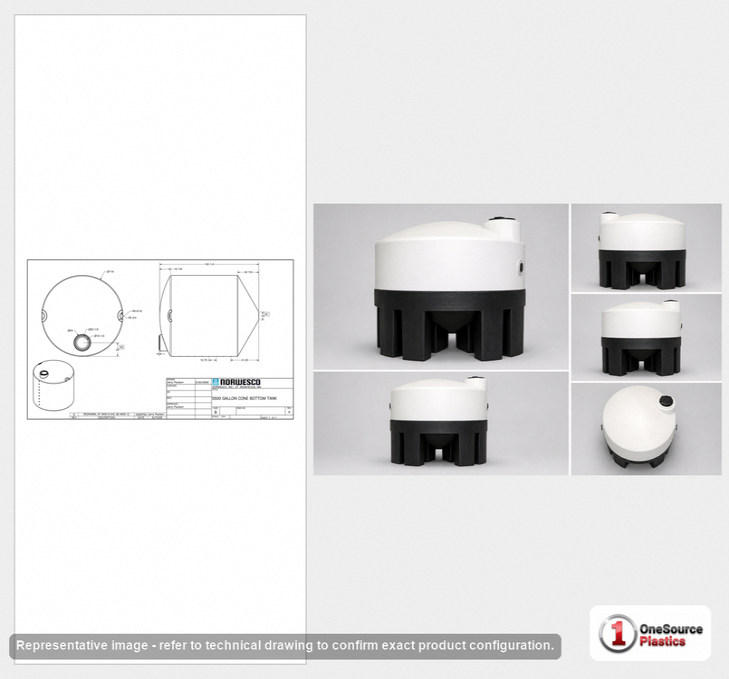
Technical drawing (PDF) for Snyder Industries 5320100N43.
See this tank
Interactive 3D model with live fill. This tank has an interactive 3D model built to its manufacturer dimensions. Rotate it, and set a fill level to see how much liquid it holds at any height. Open the 3D view on the product photo above. Download the 3D model (GLB).
Product video. Watch the Snyder Industries 7400 Gallon 30 Degree Plastic Cone Bottom Tank video (67 seconds) with dimensions, fittings and shipping notes.
Ready to order?
Add it to your cart at the top of this page, get LTL freight to your ZIP, request a written quote, or call 866-418-1777. The listed price is before freight.