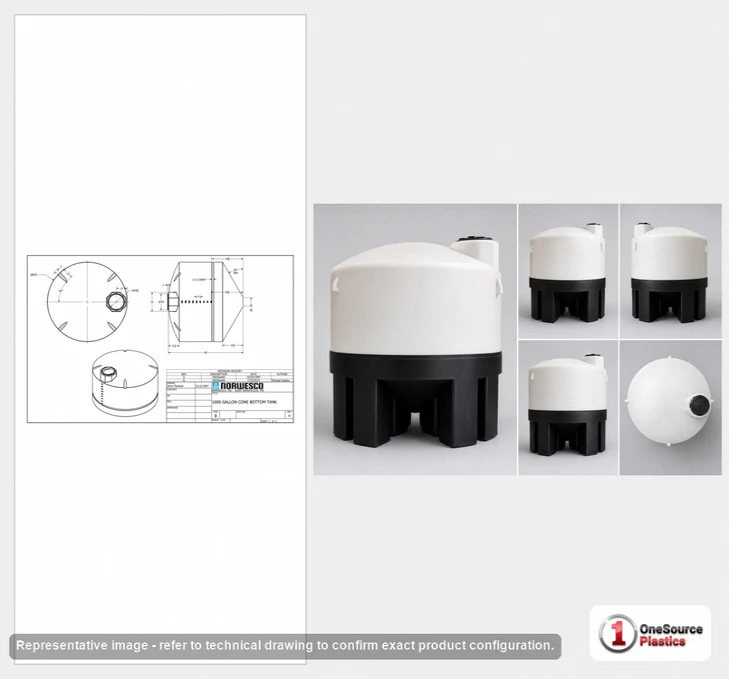
A thousand and fifty gallons over a twenty degree cone
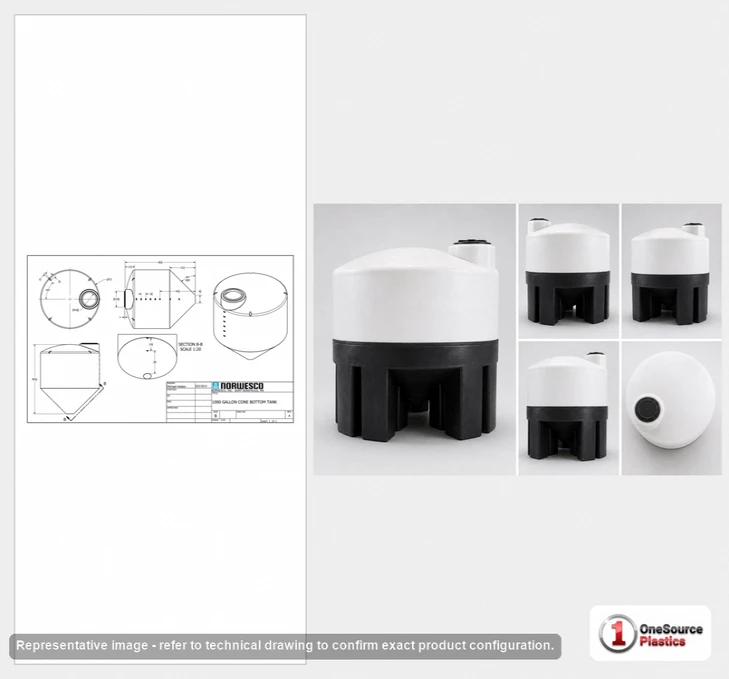
The Norwesco N-40359-C holds 1050 gallons in a white polyethylene shell, and the record's product application field reads Cone Bottom w/Poly Stand. The cone degrees field reads 20. Dimensions are given as 86 inches long, 73 inches wide and 86 inches tall with a diameter field of 73 inches, and the crated ship dimensions read 73 inches by 73 inches by 86 inches high, so the length figure and the crated footprint do not agree; both are printed as the sheet carries them. Empty weight is 354 lb and the ship weight is the same 354 lb. The specific gravity rating field reads 1.5, quoted as a maximum of 12.52 lb per gallon, against a maximum contents figure of 13136 lb; 1050 gallons of water at 8.34 pounds per gallon weighs 8757 lb. The outlet field is a bare 2 inches with no fitting description and the manway field a bare 16 inches with a 16 inch lid size beside it. There is no inlet field. The service limit is 120 F / 48 C, the warranty field reads 3 Year Warranty, the freight class and ship mode fields both read LTL, and the NMFC field is 156600-02.
One tank or a train of them? A single 1050 gallon tank goes straight to the cart above; for several, request a written quote with freight to your ZIP.
Eighty-six inches tall on a seventy-three inch circle
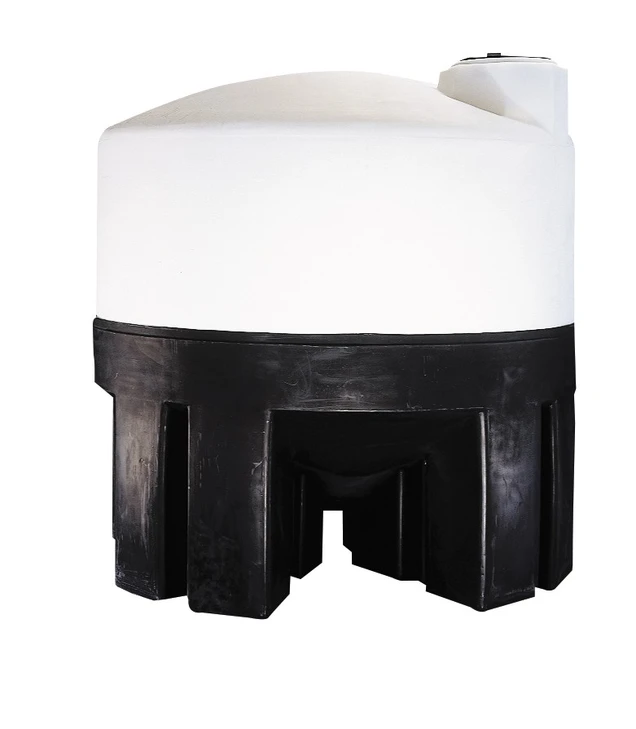
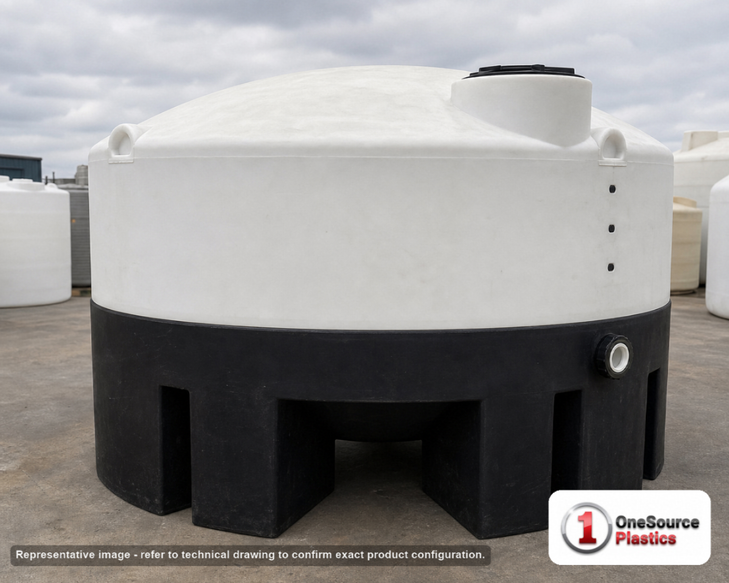
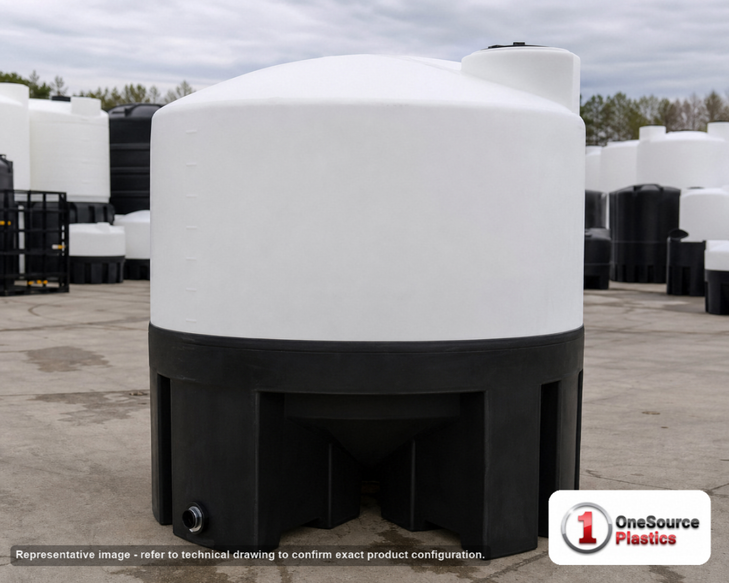
This is the one product in this group that stands up rather than lies down, and where it stands is the first question. The record gives a diameter of 73 inches and a height of 86 inches, and the crated figures are 73 by 73 by 86, so plan for a circle about 73 inches across and a clear height over 86 inches, then add the room a person needs to work round it. The name carries the words with poly stand, and the sheet gives no stand height, no stand material, no leg count, no anchor detail and no load figure of any kind, so nothing about the support under this cone is described here beyond the overall numbers the record itself publishes. Those overall figures already include whatever the tank is standing on, which is exactly why the height is 86 inches on a 1050 gallon body: a cone has to be held clear of the floor for the outlet to be any use. Take the 86 inch figure to the doorway, the roof line and the eaves before anything else. What goes underneath is a flat, level, continuous bearing surface that carries the whole load through whatever the stand's feet are, spread rather than concentrated. Empty the assembly is 354 lb. Full, the maximum contents figure is 13136 lb and the water figure is 8757 lb, and all of that arrives at the floor through a small number of contact points rather than across a wide base. That is the difference between a cone on a stand and a flat-bottomed tank, and it is why the slab under a cone deserves a second look and often an engineer's opinion. Get it plumb, not just level: a tall body out of plumb loads one side of its support for years. The published limits are the service limit, 120 F / 48 C, and the rating field, 1.5 quoted as a maximum of 12.52 lb per gallon with a 13136 lb maximum contents figure. Check your liquid against both before you buy. Then size it against the work with the tank sizing calculator and the tank sizing guide, and read the 1050 gallon 20 degree cone bottom buyer's guide, which walks through this exact configuration in more detail than a product page can.
Three cone bottoms: ten fifty, seven fifty, sixteen hundred
| Part | Gallons | Dimensions | Weight |
|---|---|---|---|
| N-40359-C (this tank, white, 20 degree cone, application field Cone Bottom w/Poly Stand) | 1050 | 86 x 73 x 86 in, 73 in diameter | 354 lb |
| N-40356 (the sheet names it 1050 Gallon 20 Degree Cone Bottom Tank) | 1050 | 73 x 73 x 86 in | 204 lb |
| N-40809 (750 Gallon 20 Degree Cone Bottom Tank with Poly Stand in White) | 750 | 73 x 73 x 67 in | 319 lb |
| 40814 (1600 Gallon 30 Degree HDLPE Cone Bottom Tank with Black Poly Stand and No Fitting) | 1600 | 89 x 89 x 96 in | 524 lb |
The first two rows are the interesting comparison. Both are 1050 gallons, both are 86 inches tall on a 73 inch circle, and they sit at two different weights, 354 lb and 204 lb. The sheet names one with a poly stand in its application field and gives the other the plainer name, and beyond that it explains nothing, so this page prints the two weights and stops. If the shipping weight or the handling weight is what you are planning around, that column is the one to use. Below them the 750 gallon N-40809 keeps the same 73 inch circle and drops to 67 inches tall at 319 lb, which is the row to look at when the clear height is the problem: a shorter body for less volume on the same 73 inch footprint. Above them the 40814 is a different animal, 1600 gallons on an 89 inch square at 96 inches tall and 524 lb, with a 30 degree cone rather than 20 and the words no fitting in its name. A steeper cone and a bigger body change both the headroom and the discharge behaviour, so do not treat it as simply the next size up. Across the four rows, height is the variable that moves most: 67, 86, 86 and 96 inches. Measure the roof, the door and the lifting clearance before you look at the gallons, because on a cone tank the ceiling decides more orders than the capacity does.
Other makers in the running? 866-418-1777 will compare them honestly; Norwesco, Snyder, Chem-Tainer, Enduraplas and Bushman are all here, or price freight on this one.
A two inch outlet at the bottom of a cone
- The outlet field is a bare 2 inches with no fitting description, so the sheet lists the outlet as 2 and this page does not name a thread form, a material or a valve for it. Confirm the fitting on the tank in front of you before you buy the pipe.
- What makes a cone worth its extra height is where that outlet is: at the bottom of a 20 degree slope rather than in a flat floor, so the contents run to the port instead of sitting in a heel around it. If you are buying this shape for that reason, plumb it so the advantage survives the pipework and does not end in a low horizontal run that holds the same heel you were trying to avoid.
- Put a full-bore valve directly under the cone and a union below it. The valve then controls the tank and the union takes every future change without a tool load reaching the shell.
- Support the valve and the line from the stand or the floor, not from the tank. Hanging pipe weight off the lowest point of a cone is the one place on this product where a hard lesson is expensive.
- The manway field is a bare 16 inches and the lid size field also reads 16 inches, so the record names an opening and a size and nothing else. Sixteen inches is a fill line, a light, an arm and a brush handle.
- Because the field does not describe a vent, do not assume there is one. Drawing a tall 1050 gallon body down through a 2 inch port against a sealed top will pull the roof in, so confirm the air path on the tank in front of you and provide one if it has none.
- No inlet field appears on the record, so the fill goes in through the top opening. On a body 86 inches tall that means a fixed fill line and a safe way to reach the lid, planned before the tank arrives rather than improvised on the day.
The limits the record publishes are the service limit, 120 F / 48 C, and the warranty field, which reads 3 Year Warranty. We will get the current written terms from Norwesco for you rather than reading a promise into three words here. On density the sheet gives 1.5, quoted as a maximum of 12.52 lb per gallon, with a maximum contents figure of 13136 lb against 8757 lb of water, and that is the complete density statement on this page.
Why a cone bottom instead of a flat one
People buy a cone for one of two reasons and usually both: they want the tank to empty completely, and they want whatever settles to leave through the outlet rather than build up on a floor. A 20 degree cone at 1050 gallons is the middle of that market, big enough for batch work and small enough to fit under an ordinary industrial roof at 86 inches tall. Typical duty is batching and dosing, mixing where the contents must be discharged clean between products, holding a liquid that will drop solids if it stands, feeding a pump that should never be asked to lift, and any service where rinsing between changes has to be quick and verifiable. The cost of it is height and a support structure, which is why the flat-bottomed shells elsewhere in this range remain the right answer for plain storage. The clean-out advantage is also the reason to plan the pipework properly: a cone that discharges into a long flat run gives back most of what it bought you. Check the liquid against polyethylene in our chemical compatibility reference before ordering, especially if it is a slurry or a blend that settles, and talk to us about the discharge arrangement before you commit to a pump.
Resin compatibility, line by line
Below are the liquids this resin is rated for, the concentration each rating holds to, and the fitting and gasket to specify. Check the exact concentration and temperature you run against the chemical page or the chemical compatibility database before ordering.
- Acetic Acid (60%, PP/PVC fittings)
- Aluminum Sulfate (50%)
- Calcium Chloride (40%)
- DEF (32.5%, 316SS fittings)
- Ferrous Sulfate (20%)
- Magnesium Chloride (30%)
- Sodium Carbonate (30%)
- Urea Solution (50%, PP/PVC fittings), and Ozonated Water (up to 10 PPM).DEF and urea solution only require a 1.5 SG shell, so this 1.5-SG tank carries ma
- Ethylene Glycol
- Ferric Chloride
- Ferric Sulfate
- Hydrochloric Acid
- Hydrofluoric Acid
- Hydrofluosilicic Acid
- Hydrogen Peroxide
- Peracetic Acid
- Phosphoric Acid
- Polyaluminum Chloride
- Potassium Carbonate
- Potassium Hydroxide
- Propylene Glycol
- Sodium Bisulfate
- Sodium Bisulfite
- Sodium Hypochlorite
- Sodium Thiosulfate
- Sulfuric Acid and
- Zinc Orthophosphate .On these, the gasket changes as much as the tank SG: EPDM holds for the salts and glycols, Viton is required on the strong acids and oxidi
Five plants, seven ship-from states, crated seventy-three by seventy-three
Five plants are named: St. Bonifacius, Minnesota; Lancaster, Ohio; Griffin, Georgia; Tooele, Utah; and Hanford, California. The ship-from states are California, Georgia, Iowa, Minnesota, Ohio, Oklahoma and Utah, so Iowa and Oklahoma are origin states with no plant on the record's own list; both lists are printed as the sheet carries them and nothing is added. The freight class field and the ship mode field both read LTL and the NMFC field is 156600-02. The shipping weight is 354 lb against the same 354 lb empty, and the crated figures read 73 inches by 73 inches by 86 inches high, which is the number that matters at the receiving end: this arrives as a tall item, not a long one, and 86 inches of height has to clear a door and a dock before it gets anywhere. The freight cost estimator prices the lane to your ZIP, and the listed price is before freight. Unload it upright and keep it upright. Slings round the body under a spreader, never a chain through the top opening, nothing bearing on the cone or on the outlet, and a flat place to set it down where it will not have to be dragged into position afterwards. Inspect it before the driver leaves: look at the cone all the way round its slope, check the outlet boss from below where damage hides, and put a light through the top opening. Commission it with clean water in its final position, leave it standing full for a day, and watch the base of the cone and the support feet in particular, because that is where a tall tank tells you the truth about the floor you put it on. Put the tank's part number on the maintenance log the day it lands; five years on, nobody remembers which shell it is.
Freight and documents
Ships from: St. Bonifacius, MN; Lancaster, OH; Griffin, GA; Tooele, UT; Hanford, CA. LTL freight is quoted to your ZIP with the freight cost estimator or by phone at 866-418-1777. The listed price is before freight.
Technical drawing (PDF) for Norwesco 40359.
Ready to order?
Add it to your cart at the top of this page, get LTL freight to your ZIP, request a written quote, or call 866-418-1777. The listed price is before freight.