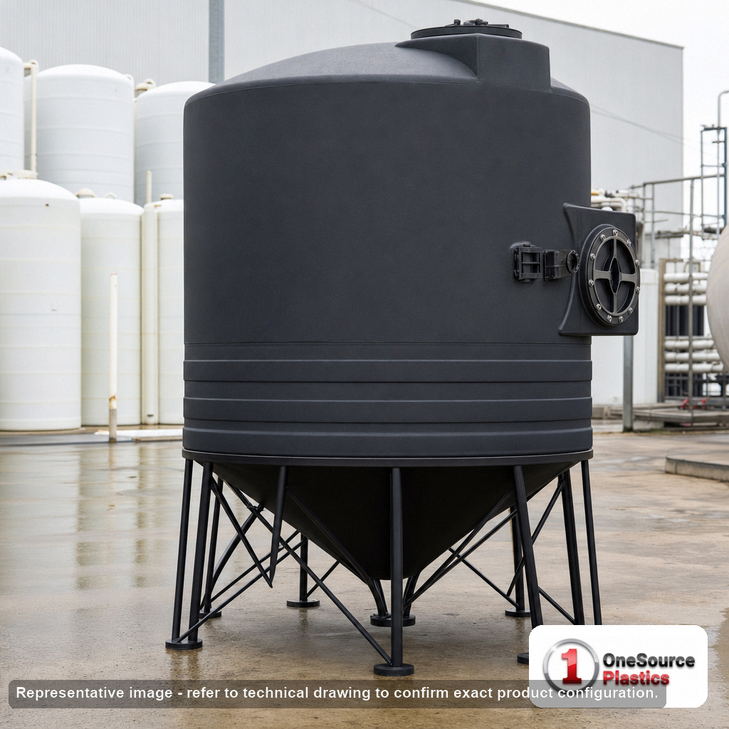
The lighter 2500: three hundred and seventy-five pounds, rated 1.5
Three hundred and seventy-five pounds is the lightest empty weight in this family, and it belongs to the Snyder 5110000N49. The sheet lists it at 2,500 gallons, 90 inches long, 90 inches wide and 125 inches tall, at 375 pounds empty and 375 pounds shipping, with the material field reading Polyethylene and the colour listed as black. The wall is rated at a specific gravity of 1.5, and the sheet gives 31,275 pounds of max contents against 20,850 pounds of water at 8.34 pounds per gallon. The cone angle is published as 30 degrees. The opening on top is an 18 inch threaded vented manway. The outlet field reads 1 Manway / Lid, which names an opening rather than a discharge, and no discharge size is published. The service limit is 100 F / 37 C. The sheet lists 4 tiedown lugs, 8 lifting lugs, ladder lugs and 1 flange line. It publishes no inlet, no stand and no warranty term, and this page claims none of them.
Is this the right 2500 gallon tank? Call 866-418-1777 with the liquid, the site and the ceiling height, or get freight to your ZIP and add it to your cart above.
Nebraska freight on the lightest cone in this family
Take the lane first on this one, because 375 pounds is light enough that the freight is about volume and nothing else. The tank is moulded at Lincoln, Nebraska, and Nebraska is the origin state on the sheet, so the central states are the short haul and either coast is the long one. The shipping size is 90 inches by 90 inches by 125 inches, which is a big, near-empty box on a trailer, and the ticket is priced on the space rather than the scale. For a buyer in the middle of the country that combination is about as favourable as a bulk tank gets. For a coastal buyer it is worth pricing before the specification is fixed, since the freight can be a larger part of the decision than the difference between two capacities. Then plan for the day it arrives, which on a cone bottom tank means planning for the stand. This vessel has no flat bottom and cannot rest on a floor. It has to be carried, and this sheet publishes no stand, no legs, no skirt, no support ring and no bolt pattern, so the support is a separate purchase, on its own drawing and its own lead time, and no stand height, rated load or stand material appears on this page. Specify it with the stand compatibility matrix and ask us to confirm the fit against this part number rather than taking a dimension from a photograph. The pad under it carries 375 pounds of empty tank, 20,850 pounds of water and 31,275 pounds at the rating, concentrated into a few stand feet inside a 90 inch circle, so it is designed ground with a bearing area at each foot. Above it, the finished height is the stand plus 125 inches plus clearance over the manway, measured down from the lowest fixed thing in the room. Size the volume honestly before any of that is drawn with the tank sizing calculator and take the freeboard from the tank sizing guide.
Same shipment, two ratings, and the sizes on either side
| Part | Gallons | Length x width x height | Empty weight |
|---|---|---|---|
| 5110000N49 (this tank, rated 1.5) | 2500 | 90 x 90 x 125 in | 375 lb |
| 5110000N40 (XLPE listing, same weight) | 2500 | 90 x 90 x 125 in | 375 lb |
| 5110000N46 (XLPE listing, same weight) | 2500 | 90 x 90 x 125 in | 375 lb |
| 5110000N48 (XLPE listing, heavier) | 2500 | 90 x 90 x 125 in | 400 lb |
| 5070000N40 (smaller batch, shorter shell) | 2000 | 90 x 90 x 102 in | 325 lb |
| 5100000N40 (bigger batch, taller shell) | 2600 | 90 x 90 x 139 in | 500 lb |
The shipment never changes across the first four rows. Same 2,500 gallons, same 90 inch circle, same 125 inch height, and the sheet separates them by empty weight and by the name printed on each: 375 pounds on this listing and on two XLPE listings, 400 pounds on 5110000N48. No explanation of that accompanies the figures and none is offered here. What this page will say plainly is the rule we would rather follow than sell up. This listing is rated 1.5 and carries 31,275 pounds of max contents, which covers water, treated water and the large family of process liquids no heavier than water. That is most of what a cone bottom tank of this size actually holds. Pay for a heavier rating only when the product genuinely demands it, not as insurance against a hypothetical. The two outer rows shift the height rather than the shape. 5070000N40 holds 2,000 gallons at 102 inches and 325 pounds, which is the answer when the ceiling is tight and the real batch is smaller than the round number on the specification. 5100000N40 holds 2,600 gallons at 139 inches and 500 pounds when the room is there. Since the circle is constant, moving along that ladder does not change the pad, the bund or the aisle you have already drawn. If you are still working the decision, both of these go further than a specification can: the shallower cone buyer's guide at this capacity and the 30 degree guide that covers the poly stand question.
Comparing across brands too? Call 866-418-1777; we carry Norwesco, Snyder, Chem-Tainer, Enduraplas and Bushman and will say which one fits, or price the freight first.
Where the product goes in, and what holds the air path open
- The fill opening: an 18 inch threaded vented manway is the only opening this sheet names. It sits at 125 inches plus the stand, so the fill route is designed around access: a coupling at working level, a line landed into the manway, and a platform or fixed ladder with a fall protection plan drawn alongside the structure rather than added afterwards.
- The vent on that manway: it arrives with the top fitting on this sheet rather than as a separate item. When a pump draws off the bottom of a full tank it pulls hard, and a wall that cannot take air in takes the load instead. Keep it clear, check it every time the tank is opened, and never blank or tape it.
- Inlet: none published on this sheet. No fill fitting, no size and no position, so nothing is claimed. Size the air path to the faster of your fill and draw rates, not to whichever you happen to think about first.
- Outlet: the field reads 1 Manway / Lid, an opening rather than a discharge. That is printed as it reads and nothing more is asserted: no outlet dimension, no thread, no bulkhead, no valve. Tell us the line size you need to land and the product, and we will confirm what this part number carries before it ships.
- The cone: published at 30 degrees. Below it, the valve, any reducer and the first length of pipe are carried on steelwork off the stand, never on the tank, with a flexible connector at the first joint so pump vibration stays out of the wall.
- Ratings and what is blank: 4 tiedown lugs, 8 lifting lugs, ladder lugs and 1 flange line are listed; a specific gravity rating of 1.5, 20,850 pounds of water at 2,500 gallons, 31,275 pounds of max contents and 100 F / 37 C. No warranty term and no NMFC number appear on this sheet.
Where this tank stands over a surface that would have to be recovered after a spill, read the Captor containment comparison before the bund is designed; the contained route sometimes changes the layout rather than adding to it.
Water treatment chemistry and day tank duty
A 1.5 rated cone at 2,500 gallons is the ordinary workhorse of a plant that needs the vessel emptied properly between runs. Polymer and coagulant make-up at a water or wastewater works, day tank duty feeding a dosing pump at a steady rate, liquid fertiliser and crop input blending at an agricultural retailer, batch preparation and intermediate holding in manufacturing, wash and rinse water systems, and process water storage that still has to drain fully. The cone does its work at the changeover, which is the part a flat bottomed tank cannot match: nothing is left standing on a floor to be pumped out, shovelled or explained to somebody. Four chemicals come up constantly in this duty and each deserves its own look before a gasket or a valve is chosen rather than after the first fill: sodium hypochlorite, sulfuric acid, hydrochloric acid and ferric chloride. For anything not on that list, start at our chemical compatibility reference and name the product when you enquire; the fitting answer follows the chemistry and never the catalogue.
Three hundred and seventy-five pounds, and the standing operation at your end
Lincoln, Nebraska is the plant and Nebraska is the origin state on the sheet. The freight class reads 400, a numeric class rather than a mode, and no NMFC number is published. The shipping size measures 90 inches by 90 inches by 125 inches at 375 pounds and travels lying down, which means the real event of the day is not the unloading but the standing up, and that needs a machine, a plan and a nominated person rather than four people and optimism. Price the lane to your own ZIP with the freight cost estimator; the listed price is before freight. The sheet publishes no crane, rigging, permit or escort detail, and none is stated here; settle the offload equipment and the window with us before the truck is booked. The stand has to be set, levelled and anchored before the tank goes vertical, because there is nowhere sensible to park a cone bottom vessel while somebody finishes a foundation. Sling under the body or use the lifting lugs the sheet lists, never the manway, and keep it restrained from the moment it stands, since a light empty shell is exactly the kind that moves in a gust. Then prove the installation with clean water rather than with product: hold the 20,850 pound load, walk the manway seal, the cone joint, the stand feet and the pad edge with a torch, and leave it standing full overnight. Look again in the morning, and once more after the first hard rain. A tank this light is easy to set and just as easy to set slightly off level, and standing water is the only thing that will tell you honestly. Write the fill date on the manway with a paint marker; it answers the first question anyone asks about a tank.
Freight and documents
Ships from: Lincoln, NE. LTL freight is quoted to your ZIP with the freight cost estimator or by phone at 866-418-1777. The listed price is before freight.
Technical drawing (PDF) for Snyder Industries 5110000N49.
See this tank
Interactive 3D model with live fill. This tank has an interactive 3D model built to its manufacturer dimensions. Rotate it, and set a fill level to see how much liquid it holds at any height. Open the 3D view on the product photo above. Download the 3D model (GLB).
Ready to order?
Add it to your cart at the top of this page, get LTL freight to your ZIP, request a written quote, or call 866-418-1777. The listed price is before freight.