Steel framework named for fifteen gallon cone bottom tanks
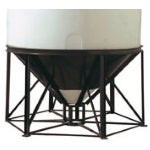
The Snyder SII-48900 is a tank stand, and Snyder's own name for it is Stand for 15 Gallon Cone Bottom Tanks. That gallon figure is a name word describing what the maker names the stand for; it is not a capacity, because a stand holds nothing. The material field reads Steel. The sheet lists the stand at 48 inches long, 40 inches wide and 47 inches tall, at 75 pounds on the bench and 75 pounds to ship, crated at the same 48 by 40 by 47 inches. Snyder files it under cone bottom tank stands. That is the whole of what is published about the object, and it is worth being blunt about what is not. There is no load rating, no leg count, no bolt pattern, no anchor specification and no list of tank part numbers this frame is matched to, so none of those is stated anywhere on this page and no pairing with any specific tank is asserted. Being a structure rather than a vessel, it carries no capacity in gallons, no full-of-water weight, no specific gravity rating, no maximum operating temperature, no warranty and no certification entry either. The freight class field reads LTL rather than a number, with LTL as the ship mode, under NMFC 178717, out of Lincoln, Nebraska, with Nebraska and Oklahoma named as the shipping states.
Need it before the next delivery? Call 866-418-1777 for the ship date, or get freight to your ZIP and add it to your cart above now.
Floor space first: forty-eight by forty inches of footprint
Start with the floor, because that is the measurement people get wrong on a stand and the one that cannot be fixed afterwards. This frame is listed at 48 inches in one direction and 40 inches in the other, which is four feet by a little over three, and that footprint is not square. Mark it out with tape before you order anything. A bay that looks generous from the doorway is often four inches short in the direction nobody measured, and a stand that does not sit flat on its whole footprint is a stand that rocks under load for the rest of its life. Then look at what the floor is. A stand does not spread weight the way a flat bottomed vessel spreads it across a base; it puts the whole load into its feet. On a sound slab that is nothing worth a second thought. On an old floor, a timber platform, a mezzanine, a raised deck or a trailer bed it is an engineering question, and it is asked before the delivery rather than after the first fill. Ask it with the tank, the contents and the floor structure all named, because no load figure of any kind appears on this sheet and it is not a field we will fill by inference. The next measurement is height, and here the stand is the easy half of the sum. The frame is listed at 47 inches tall, a little under four feet. Your finished installation is that height plus whatever vessel goes on top of it plus the clearance a person needs above the opening of that vessel to fill it, open it and look into it. Take that total against the lowest fixed thing over the spot rather than against the ceiling: a light fitting, a duct run, a sprinkler head or a beam is what actually decides this, and it is almost never the thing measured first. Underneath is the other half of the reason a stand exists at all, and it is the half that gets designed last and regretted first. A cone bottom vessel discharges at its lowest point, so the space under that point has to hold whatever the liquid is going into and a person's hand and arm on a valve. Put the real container and the real valve on the floor, hold a tape at the height of the frame, and see whether the arrangement works before the tank is on top of it. Which vessel goes on this frame is a question the sheet does not answer, and we will not answer it from a photograph either. Two longer reads set that question out properly: the cone bottom tank stand compatibility matrix puts the makers side by side, and the steel frame against polyethylene stand decision tree works through the choice this particular record has already made, since the material field here reads Steel.
One part number, and no range printed beneath it
| Part | What the name and sheet give it | Listed size | Weight |
|---|---|---|---|
| SII-48900 (this stand, named for 15 gallon cone bottom tanks, material field Steel) | No load rating, no leg count and no tank part number published | 48 x 40 x 47 in | 75 lb, crated at the same size |
One row, because the sibling list on this sheet is empty. We are not going to reach across to another record, print a part number here and present it as a range Snyder published, because Snyder published none. On a stand that blank matters more than it would on a small fitting, since the obvious question is which vessel goes on top and that is precisely the question the sheet declines to answer beyond the gallon figure in the name. So read this page as a description of an object rather than as a selection chart. Tell us the tank you intend to put on it, by part number if you have one and by measured base size and empty weight if you do not. Tell us the floor it is going on and whether there is a structure under that floor. Tell us what has to live in the space under the discharge, with the actual valve and the actual receiving container in mind rather than a guess at them. We will take all of it to Snyder and come back with the pairing confirmed in writing before an order is placed. That is slower than reading a number off a table and it is the only honest way to do it.
Need a different size? Every tank in the table is in stock programs; ask for a quote on the one that fits, or call 866-418-1777.
The mounting face, and everything the sheet declines to rate
- The mounting face: the top of the frame, over a footprint listed at 48 inches by 40 inches. No ring detail, no cradle dimension, no bolt pattern, no hold-down and no fixing arrangement is published, so none is claimed here.
- The height: 47 inches overall as listed. Check the installed total of frame plus vessel plus working clearance against the lowest obstruction above, not against the ceiling.
- Load: no load rating, no working limit and no capacity of any kind is published for this stand. That is the field buyers most want filled and the one we will not fill by inference. Ask with the tank and the contents named.
- Material: the material field reads Steel, and that is the whole of it. No grade, no section size, no weld detail, no finish and no coating is published, so none is stated.
- Fittings: none. There is no outlet, no inlet, no lid and no valve on this record, because a stand has none. Everything wetted belongs to the vessel that goes on top.
- The floor: a frame concentrates its load at its feet. Continuous, level support under every foot, checked before the vessel goes on and again after the first full load.
Name the tank when you order a stand. On this part the vessel is the specification and every other question follows from it.
Small cone vessels that have to drain into something
A cone bottom vessel is bought because it empties completely, and it can only do that if there is somewhere for the contents to go. Set one on the floor and the whole advantage disappears: the discharge is at ankle height, nothing fits under it, and a shape designed to drain to a point ends up being tipped, siphoned or pumped like any other container. That is the entire argument for a frame, and it is why a stand is not an accessory on a cone bottom tank in the way a lid or a gauge is an accessory. It is half the installation. Lift the vessel and everything changes at once. A pail, a drum, a tote or a pump inlet fits under the discharge. A valve comes to a height somebody can reach and turn without kneeling on a wet floor. A hose leaves without a kink in it. Gravity does work a pump would otherwise have to do, and the last of the batch leaves the vessel instead of sitting in it. The duties this shows up in are the everyday ones: batch mixing and make-up, dosing and metering points, rinse and wash stations, nursery and greenhouse feed, small-scale blending, sampling and decanting, and any bench operation where a measured amount is drawn off by hand rather than piped into a system. The habits that make a stand last are dull and absolute. Set it on flat, level, continuous support and confirm every foot is bearing before the vessel goes on. Check it again after the first full load, because anything that is going to settle settles early. Leave room to walk all the way round, including the side that faces the wall, since the side nobody can see is the side that surprises you. And never correct a rocking foot with whatever is lying about; a packer chosen in a hurry on delivery day is still there, load bearing, five years later.
Seventy-five pounds out of Lincoln, two states on the sheet
This stand is made at Lincoln, Nebraska, and the sheet names two shipping states rather than one, Nebraska and Oklahoma. Both are printed as given. The freight class field reads LTL rather than a number, the ship mode field reads LTL as well, and the NMFC code is 178717. It is listed at 75 pounds on the bench and 75 pounds to ship, the same figure twice, crated at 48 by 40 by 47 inches, which is the frame's own listed size. Price the lane to your ZIP with the freight cost estimator; the listed price is before freight. Practically, that is a bulky package rather than a heavy one: seventy-five pounds is manageable between two people, but four feet by three feet by four feet is awkward through a doorway and worse up a step, so plan the route from the truck to the spot before the truck arrives rather than working it out on the tail lift. Uncrate it where it is going to stand instead of at the dock. Set it down, check it for level in two directions, confirm every foot is taking weight, and only then put the vessel on top of it. A frame that is not level is a vessel that drains to one side of its own discharge, and that is a fault people chase for months without ever looking at the floor. Keep the first delivery's paperwork with the tank; strength and date on day one is the baseline for every batch after.
Freight and documents
LTL freight is quoted to your ZIP with the freight cost estimator or by phone at 866-418-1777. The listed price is before freight.
Technical drawing (PDF) for Snyder Industries 48900.
See this tank
Product video. Watch the Snyder Industries Stand for 15 Gallon Cone Bottom Tanks video (60 seconds) with dimensions, fittings and shipping notes.
Ready to order?
Add it to your cart at the top of this page, get LTL freight to your ZIP, request a written quote, or call 866-418-1777. The listed price is before freight.