A 4,100 gallon white 45 degree cone bottom tank with a 3 year warranty
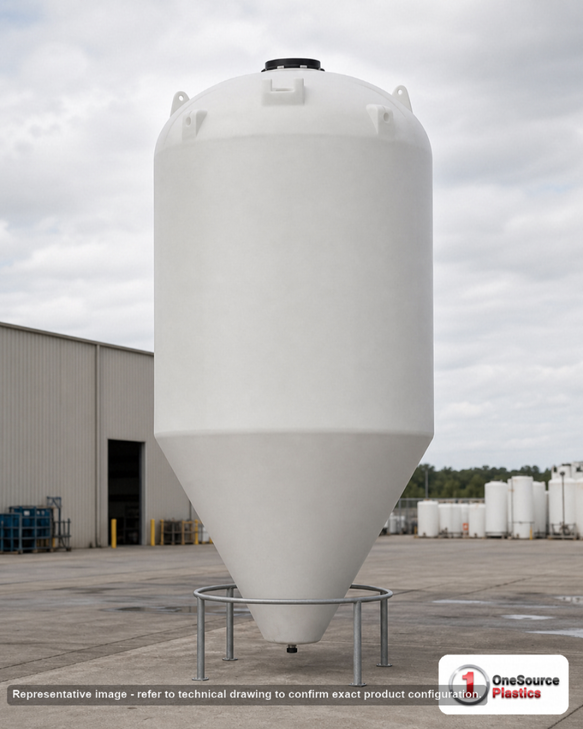
Snyder part number 5180000N43 is a 4,100 gallon cone bottom tank with a steep 45 degree cone, moulded in white high density linear polyethylene. It is 90 inches in diameter, 197 inches tall and 1,000 lb empty. The wall is rated for liquids up to 1.5 specific gravity with a service limit of 100 F (37 C): 4,100 gallons of water weighs 34,194 lb (4,100 x 8.34), and a liquid at the full rating 51,291 lb. Access is an 18 inch threaded vented manway. Snyder backs it with a 3 year warranty. It is made at Snyder's plant in Lincoln, Nebraska.
Draining solids, or just water? Call 866-418-1777 with what goes in it and we will help you choose the angle and rating, or get freight to your ZIP and add it to your cart above.
What this tank does well
The 45 degree cone is the steep one. It moves settled material to the outlet instead of letting it rest on the slope, so it is the cone to pick for liquids that carry solids or drop sediment: wash water with grit, a fertilizer blend that drops crystals in the cold, a batch that leaves a residue, or a holding tank that must be flushed clean between products. The 1.5 rating suits water and the many liquids up to half again as heavy, and the 100 F limit means ambient temperature service, not hot fills. The cost of a steep cone is height. On a 90 inch circle this one is 197 inches tall before a stand, and the stand under a cone is tall on purpose so a valve, a pump or a tote fits beneath the outlet. Add the shell, stand and pad, and check that sum against the lowest obstruction over the site before you order. If you are still choosing an angle, our cone angle guide (15, 30 and 45 degree) compares them.
What to check before you buy
- Weight per gallon. Your liquid's specific gravity times 8.34 gives lb per gallon. Up to 1.5 is within this tank's rating; above it, ask us about a heavier rated cone.
- Temperature. The limit is 100 F (37 C). Mention any heat source near the tank or a warm process liquid when you call.
- The stand and the outlet. The stand is a separate item. No outlet fitting is listed for this part number, so tell us the line size and valve you plan for the low point and we will confirm with Snyder what the tank carries.
- The manway. 18 inch, threaded and vented. The vent must stay open whenever the tank is filled or drained.
- The liquid. Look it up in the chemical compatibility guide; urea solution, DEF, calcium chloride, aluminum sulfate and sodium hypochlorite come up most.
- Drawing. Snyder's drawing for 5180000N43 is linked under Technical Drawing on this page.
Sizes and grades nearby
For crosslinked polyethylene at the same size, see the 4,100 gallon XLPE cone 5180000N40, the XLPE cone 5180000N46 and the XLPE heavy duty cone 5180000N42. One size down, the 3,900 gallon XLPE cone 5440000N40; one size up, the 4,400 gallon XLPE heavy duty cone 5200000N42. Size your volume first with the tank sizing calculator and the tank sizing guide.
Shipping and receiving
The tank ships from Lincoln, Nebraska at 1,000 lb, on its side. The listed price is before freight; the freight cost estimator gives the cost to your ZIP. Standing a 197 inch shell takes a machine and open air above the trailer, so arrange both before the truck is booked, and have the stand level and anchored first. Check 5180000N43 on the bill of lading, sling the body and never the manway, and give it a full water test before the first batch.
Ready to order? Add it to your cart at the top of this page, get LTL freight to your ZIP, or call 866-418-1777. The listed price is before freight.
Freight and documents
Ships from: Lincoln, NE. LTL freight is quoted to your ZIP with the freight cost estimator or by phone at 866-418-1777. The listed price is before freight.
Technical drawing (PDF) for Snyder Industries 5180000N43.
See this tank
Interactive 3D model with live fill. This tank has an interactive 3D model built to its manufacturer dimensions. Rotate it, and set a fill level to see how much liquid it holds at any height. Open the 3D view on the product photo above. Download the 3D model (GLB).
Product video. Watch the 4100 Gallon 45 Degree Plastic Cone Bottom Tank in White video (69 seconds) with dimensions, fittings and shipping notes.
Ready to order?
Add it to your cart at the top of this page, get LTL freight to your ZIP, or call 866-418-1777. The listed price is before freight.