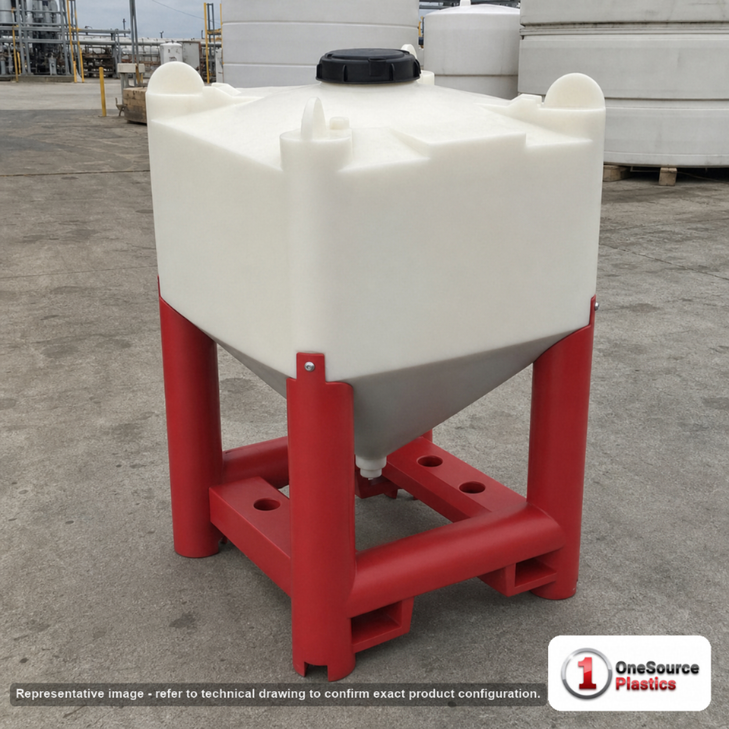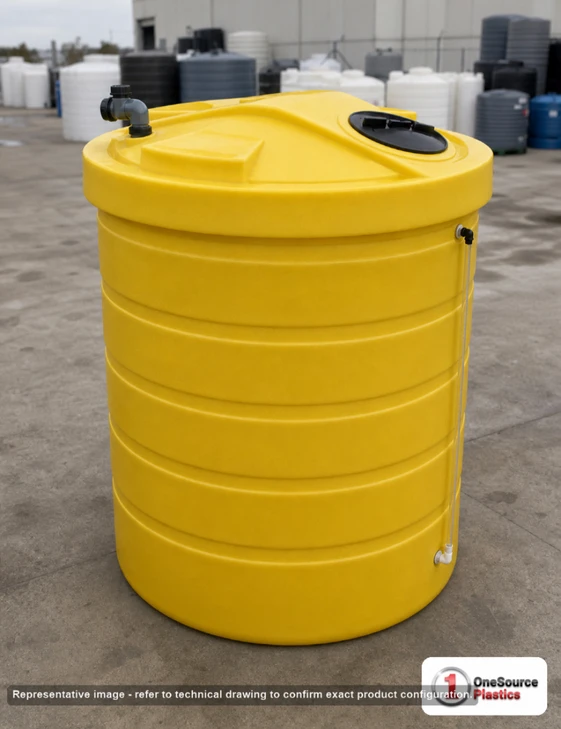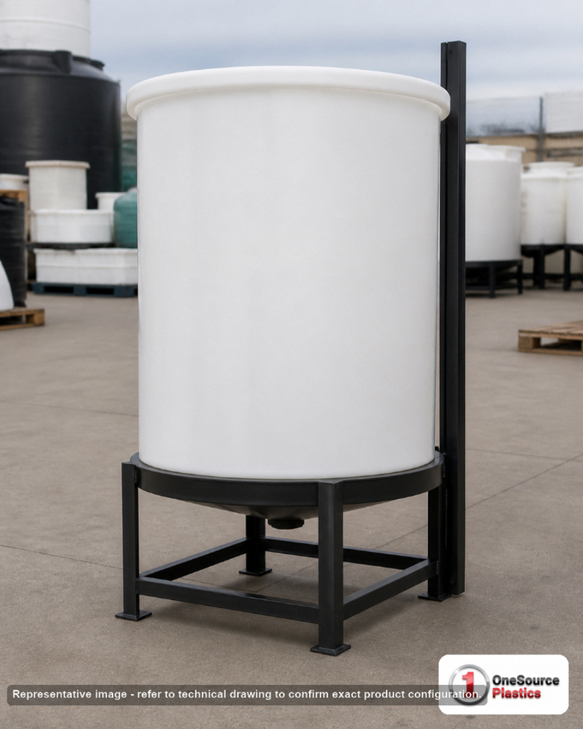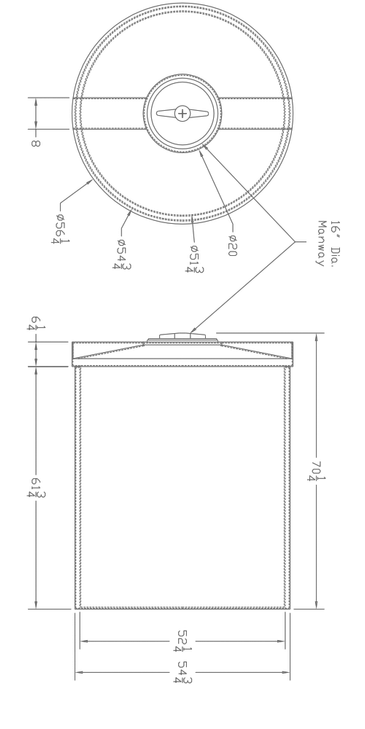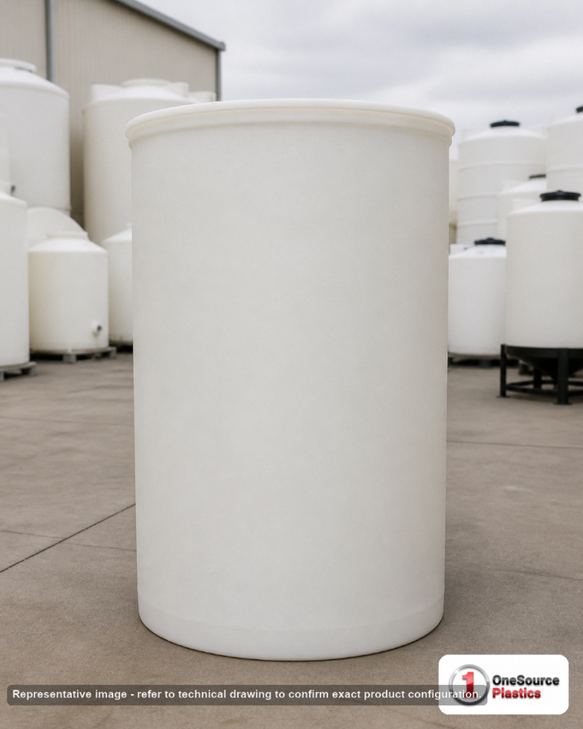
The Chem-Tainer 200 Gallon 20 Degree Open Top Cone Bottom Tank (SKU TC3165CA) is a polyethylene vertical built for chemical batching and full-drain dosing duty, where the cone keeps solids and sludge moving toward the outlet instead of settling on a flat floor. It stands 65 inches tall on a 31 x 31 inch footprint, holds 200 gallons, and carries a 1.9 specific gravity rating - meaning it is rated for liquids up to 1.9 times the weight of water, a heavier band than the 1.5 SG rating common on general water-weight tanks. The 20-degree cone is a shallow-to-moderate angle: it drains more slowly to empty than a 30-degree or 45-degree cone but still clears a smaller residual heel than a flat-bottom tank. The open top gives you full access for manual additions, mixing, and visual level checks, and is a natural fit when you search for an open top tank or cone bottom tank in this size class.
Will this tank handle your job?
At 200 gallons, plan your structure around real loaded weight, not the empty shell. Filled with water this tank carries about 1,668 pounds; loaded to its full 1.9 SG rating it reaches roughly 3,169 pounds. Because it is a cone-bottom design, it must sit in an elevated stand or skirt so the cone hangs free and drains completely - it cannot stand on a flat slab. Size that stand for the loaded weight, not the water figure, if you are storing a dense chemical. Run the numbers for your exact liquid with the Tank Sizing Calculator, and if you are weighing 200 gallons against a larger batch, the Tank Sizing Guide walks through headspace, freeboard, and footprint. Our data does not list confirmed top or cone-outlet fittings for this listing, so confirm the outlet size and any top connections against the technical drawing on this page before you order companion hardware. For where the vent, fill, and drain connections should land so you do not cross fittings during operation, see our tank-top fitting placement guide.
Chemical compatibility
This tank is molded from polyethylene and carries a 1.9 specific gravity rating. The resin code in our data is unconfirmed - confirm the exact polyethylene grade, including HDPE versus XLPE (cross-linked), with the manufacturer before committing to chemical service, because the two resins resist different chemicals and the distinction matters for warranty and longevity. All compatibility below is drawn from the OEM chemical-resistance chart and is concentration- and temperature-specific; verify your operating temperature against the chart, because ratings drop as temperature rises. For diesel exhaust fluid work, this 1.9 SG tank is rated for both DEF (32.5%) and urea solution (50%) batching - note DEF takes 316SS fittings, not PVC.
Chemicals this 1.9 SG tank is rated for, with the recommended fitting and gasket materials, include acetic acid (60%, PP/PVC fittings, EPDM gaskets), aluminum sulfate (50%, PVC, EPDM), calcium chloride (40%, PVC, EPDM), DEF (32.5%, 316SS fittings, EPDM), ethylene glycol (100%, PVC, EPDM), ferric chloride (50%, PVC, EPDM), ferric sulfate (60%, PVC, EPDM), ferrous sulfate (20%, PVC, EPDM), hydrochloric acid (37%, PVC fittings, Viton gaskets), hydrofluoric acid (48%, PP/PVC, Viton), hydrofluosilicic acid (26%, PP/PVC, Viton), hydrogen peroxide (50%, PVC, Viton), magnesium chloride (30%, PVC, EPDM), peracetic acid (30%, 316SS, Aflas), phosphoric acid (85%, PVC, Viton), polyaluminum chloride (PVC, EPDM), potassium carbonate (50%, PVC, EPDM), potassium hydroxide (saturated, PVC, EPDM), propylene glycol (PP/316SS, EPDM), sodium bisulfate (PVC/PP, EPDM), sodium bisulfite (PVC/PP, EPDM), sodium carbonate (30%, PVC, EPDM), sodium hypochlorite (under 16.5%, PVC, Viton), sodium thiosulfate (40%, PVC, EPDM), sulfuric acid (98%, CPVC fittings, Viton), urea solution (50%, PP/PVC, EPDM), zinc orthophosphate (PP/316SS, EPDM), and ozonated water (up to 10 PPM, PVC fittings, EPDM gaskets). Match fitting and gasket materials exactly as listed. Most of the list runs on PVC bulkhead fittings, but four chemicals are the metal-fitting exceptions on this tank - DEF, peracetic acid, propylene glycol, and zinc orthophosphate all call for 316SS (or PP/316SS), not PVC - and defaulting to a PVC fitting there is a costly error. On the gasket side, putting an EPDM gasket on a Viton-rated chemical like sulfuric acid or sodium hypochlorite is the most common and most expensive mistake on a tank like this. Full concentration and temperature detail lives in our Chemical Compatibility Database.
Freight and ordering
This tank ships LTL freight, quoted live to your ZIP from the nearest Chem-Tainer plant - Hanford, CA or West Babylon, NY. As a rule of thumb, if you are west of the Rockies, Hanford ships it; if you are in the Northeast, West Babylon ships it - so coastal deliveries often land at a lower rate than the national average. Get a real number for your address with the Freight Cost Estimator, or call 866-418-1777 and we will quote it by phone. If you are still choosing a drainage geometry, our comparison of 30-degree versus 45-degree cone-bottom tanks and the cone-bottom buyer's guide explain how cone angle changes drainage rate and residual heel.
Freight and documents
Ships from: Merced, CA; West Babylon, NY. LTL freight is quoted to your ZIP with the freight cost estimator or by phone at 866-418-1777. The listed price is before freight.
Technical drawing (PDF) for Chem-Tainer TC3165CA.
See this tank
Interactive 3D model with live fill. This tank has an interactive 3D model built to its manufacturer dimensions. Rotate it, and set a fill level to see how much liquid it holds at any height. Open the 3D view on the product photo above. Download the 3D model (GLB).
Product video. Watch the Chem-Tainer 200 Gallon 20 Degree Plastic Vertical Open Top Cone Bottom Tank video (64 seconds) with dimensions, fittings and shipping notes.
Ready to order?
Add it to your cart at the top of this page, get LTL freight to your ZIP, request a written quote, or call 866-418-1777. The listed price is before freight.