
Manufacturing Clear Protein Beverages at Scale
Manufacturing Clear Protein Beverages at Scale
A clear protein drink looks like flavored water but behaves like a chemistry experiment. Getting it bright at scale is an exercise in pH, heat, and shear control.
Why Clear Protein Is Hard
Conventional protein shakes are opaque emulsions; clarity hides nothing. A clear, refreshing protein beverage must keep its dissolved protein fully soluble and transparent through mixing, heat treatment, packaging, and months on a shelf — without hazing, sedimenting, or gelling. That requires choosing and handling the protein at conditions where it stays in true solution rather than aggregating. The most common approach uses highly hydrolyzed or specially treated whey proteins, often whey protein isolate or hydrolysate, that remain soluble at the low pH where these beverages typically sit.
The central challenge is that protein solubility is exquisitely sensitive to two variables: pH and heat. Proteins have an isoelectric point, the pH at which their net charge is zero and they are most prone to aggregate and fall out of solution. Formulate or drift toward that point and the beverage clouds. Apply heat to an unstable formulation and the protein denatures and gels. Clear protein manufacturing is, at heart, the discipline of keeping the protein away from those failure conditions at every step, and then proving that it stays away through the full life of the product rather than just at the moment it leaves the tank.
Hydration, pH and Clarity
Production begins with proper hydration. Protein powder must be wetted out and fully dissolved without trapping air or forming undispersed lumps, because incompletely hydrated protein leaves haze and grit. This is a controlled mixing operation: enough shear and time to disperse and hydrate the powder, but not so much aggressive, air-incorporating agitation that the protein foams or shears into instability. Powder addition is typically done into a vortex or through an eductor so each particle wets individually rather than clumping into fish-eyes that resist hydration for the rest of the batch.
With the protein hydrated, pH is the master lever for clarity. Clear protein beverages are usually formulated at an acidic pH, deliberately kept on the low-pH side and away from the protein's isoelectric range so the molecules carry enough like charge to repel one another and stay dispersed. Acidulants are added with care, because local pH excursions during acid addition — a pocket of liquid that briefly sees the isoelectric point during mixing — can nucleate haze that never fully clears. Good mixing during acidification, so the acid disperses instantly rather than creating low-pH zones, is part of protecting clarity.
| Variable | Effect on clarity/stability | Control approach |
|---|---|---|
| Hydration | Incomplete hydration leaves haze and grit | Controlled-shear dispersion, eductor or vortex addition |
| pH | Near the isoelectric point protein aggregates and clouds | Formulate away from it; disperse acid evenly |
| Heat | Excess heat denatures and gels protein | Use the gentlest effective thermal process |
| Shear | Too little leaves lumps; too much can destabilize/foam | Match impeller and speed to the step |
| Dissolved oxygen | Oxidation degrades flavor and can affect stability | Deaerate and inert-blanket sensitive steps |
| Minerals/ionic strength | Certain ions can promote aggregation | Control water quality and added salts |
Heat Treatment Without Losing Clarity
A shelf-stable or extended-shelf-life beverage needs a thermal process to ensure safety, but heat is exactly what an unstable protein cannot tolerate. The solution is to make the formulation thermally robust first — correct protein selection, correct pH, correct ionic environment — and then apply the mildest effective process. Acidic beverages can often use less severe thermal treatment than low-acid products, and rapid heat-and-cool processes that minimize time at high temperature help protect both clarity and flavor. The principle is the same as elsewhere in food processing: heat enough for safety, no more, and get the product back to a stable temperature quickly.
Where heat is applied also matters. Indirect heating through a jacket or a heat exchanger gives even, controllable temperature rise and avoids the localized hot surfaces that can denature protein in a thin boundary layer even when the bulk temperature is fine. Gentle, continuous motion at the heated surface — from mild agitation in a jacketed vessel, or from the flow geometry of an exchanger — keeps protein from camping on a hot wall and fouling it, which protects both the product and the equipment.
Mixing, Shear and Filtration
Mixing strategy changes through the process. Dispersing and hydrating powder benefits from higher-shear equipment — a high-speed disperser or rotor-stator device wets out and breaks up agglomerates efficiently. Once the protein is in solution, the goal shifts to gentle, uniform blending of acidulants, sweeteners, and flavors without re-introducing air or excessive shear. The vessel itself supports this: sanitary mix tanks with appropriately selected agitation, jacketing for temperature control, and hygienic tri-clamp fittings designed to 3-A Sanitary Standards. A vessel that can run a high-shear inlet for powder addition and then switch to a slower sweeping agitator for finishing covers both regimes without transferring the batch.
Filtration is the final guarantor of clarity. Even a well-made batch carries some undissolved particulate, and a polishing filtration step — cartridge or membrane filtration sized to the target clarity — removes the last haze-formers and any stray solids before filling. The order matters: filter after the protein is fully dissolved and stable, so the filter is removing genuine particulate rather than fighting protein that is still trying to come out of solution. Filtering an unstable batch simply blinds the filter with aggregated protein and masks a formulation problem that will reappear in the package.
Process Order and the Risk Points
The sequence of operations is itself a design decision, because each step can either set the protein up to survive the next or sabotage it. A typical order begins with hydrating the protein into water of controlled quality, since high mineral content or the wrong ionic strength can nudge the protein toward aggregation before pH is even touched. Acidification follows, performed with vigorous local mixing so the formulation is brought to its target pH without ever passing a portion of the batch through the isoelectric danger zone. Sweeteners, flavors, and any remaining minor ingredients are blended gently once the protein is stable. Only then are deaeration, thermal treatment, and filtration applied, in the order that exposes the now-stable protein to the least cumulative stress.
Two risk points deserve special vigilance. The first is the moment of acidification, where uneven acid dispersion is the classic cause of permanent haze; the cure is mixing intensity and acid-feed location, not more filtration afterward. The second is the thermal step, where an undersized or fouling-prone heater forces longer hold times or higher temperatures than the protein can tolerate. Designing the heat path for fast, even heat transfer — and keeping product moving across hot surfaces — keeps the thermal stress within the window the formulation was built to survive. Mapping these risk points before scale-up, and instrumenting them with pH and temperature monitoring, turns clarity from a hope into a controlled outcome.
Equipment for Commercial Scale
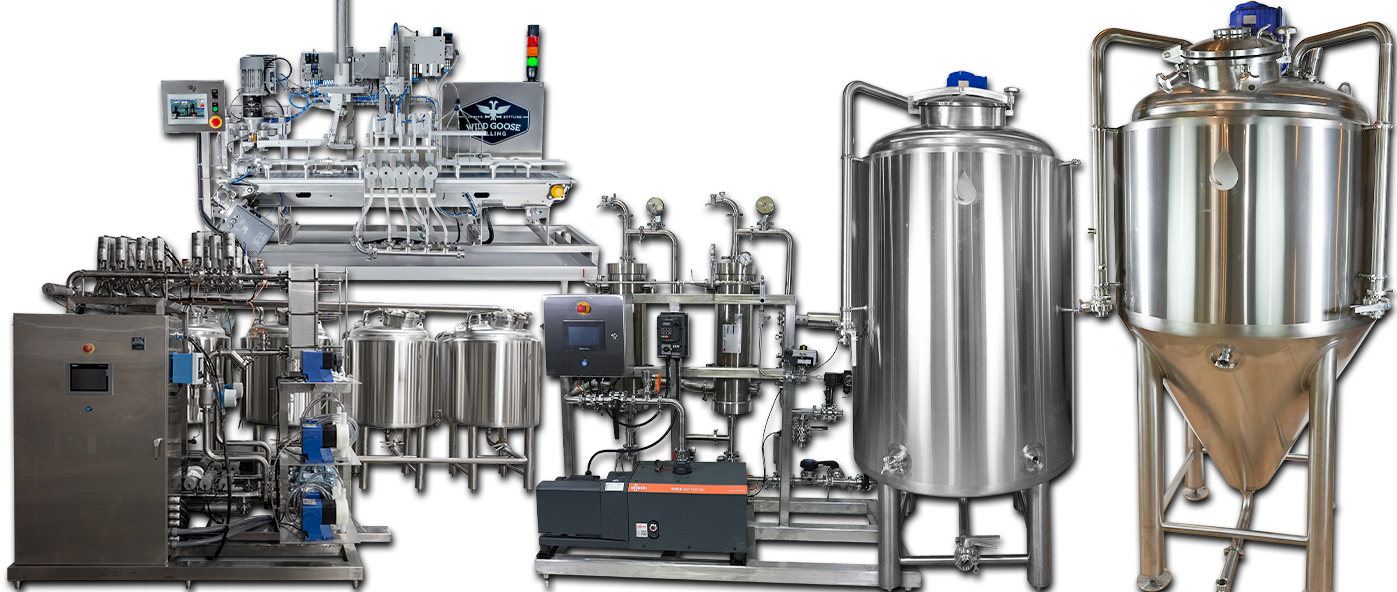
Scaling clear protein from bench to plant assembles a recognizable train of sanitary equipment, each piece protecting one of the failure modes above:
- High-shear dispersion: for fast, complete powder wet-out and hydration.
- Sanitary, jacketed mix/blend tanks: with controlled agitation and temperature for pH adjustment and ingredient blending.
- Deaeration and inert blanketing: to control dissolved oxygen and foam.
- Mild thermal processing: sized to deliver safety with the least heat exposure.
- Polishing filtration: to deliver bright, sediment-free product to the filler.
The recurring lesson is that clarity is a system property. No single piece of equipment makes a protein beverage clear; the formulation, the hydration, the pH control, the thermal process, the shear history, and the filtration all have to agree. Bench-scale success does not guarantee plant-scale success, because larger vessels mix differently, heat and cool more slowly, and impose a different shear and time history on the protein. Designing the line so each step holds the protein within its stable window — and verifying clarity and stability under real production conditions, including accelerated shelf-life testing, rather than assuming a bench recipe transfers — is what turns a promising formulation into a manufacturable product. Pilot-scale trials that mimic the full-scale shear, thermal, and hold profile are the bridge between the two, surfacing the haze and stability problems that only appear at volume while there is still time and budget to correct them.
Frequently asked questions
- What makes a protein beverage clear instead of opaque?
- Clarity requires keeping the protein in true solution rather than as suspended particles or an emulsion. That means selecting highly soluble protein, typically a hydrolyzed or isolate whey, and holding the formulation at a pH well away from the protein's isoelectric point so the molecules repel each other and stay dispersed. Complete hydration and a polishing filtration step then remove any remaining haze-formers.
- Why is pH so important in clear protein manufacturing?
- Proteins are least soluble at their isoelectric point, the pH where they carry no net charge and tend to aggregate and cloud the liquid. Clear protein beverages are formulated on the acidic side, away from that point, so the protein stays dispersed and can survive heat treatment. Even brief local pH excursions during acid addition can nucleate permanent haze, so even acid dispersion during mixing is critical.
- How is a clear protein beverage heat-treated without gelling?
- The formulation is made thermally robust first, through correct protein choice, pH, and ionic environment, so that the mildest effective thermal process can be used. Acidic beverages generally tolerate less severe heat treatment than low-acid products, and rapid heat-and-cool cycles that minimize time at high temperature protect both clarity and flavor while still ensuring safety.
- What equipment is needed to make clear protein RTDs at scale?
- A typical line uses high-shear dispersion for fast, lump-free powder hydration; sanitary jacketed mix tanks with controlled agitation for pH adjustment and blending; deaeration and inert-gas blanketing to manage oxygen and foam; a mild thermal process for safety; and polishing filtration to deliver bright product to the filler. Each piece protects a specific clarity or stability failure mode.
Scope your custom build
Send us your volume, service chemistry, dimensions, and finish or code requirements. We return a full engineering package, firm lead time, and a fixed quote — freight quoted separately to your ZIP.
Request a Custom QuoteCall 866-418-1777