
Cold-Brew Extraction Vessels
Cold-Brew Extraction Vessels
Cold brew is deceptively simple chemistry done at scale: time and surface area instead of heat. The vessel is where consistency is won or lost.
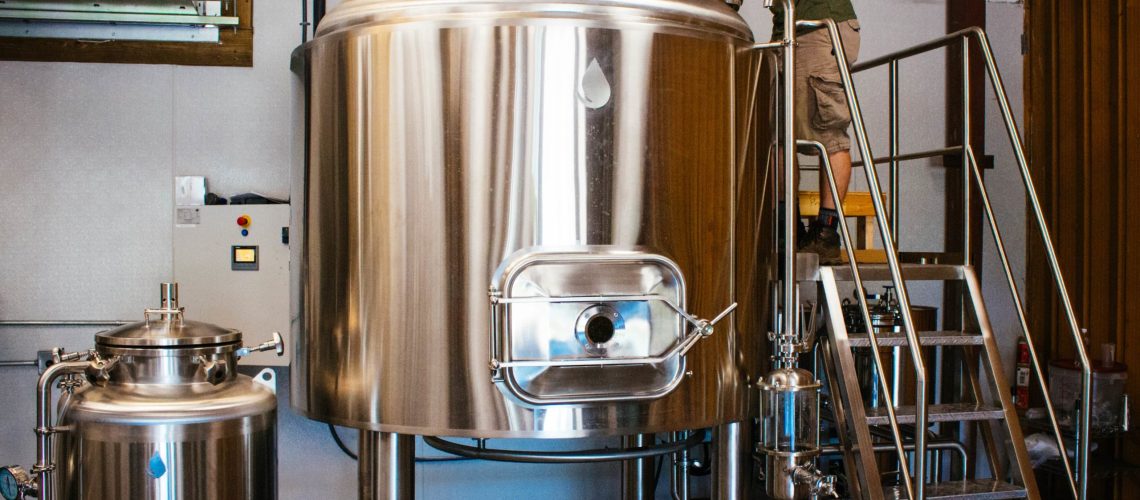
What Cold-Brew Extraction Actually Is
Cold brew extracts soluble coffee solids using extended contact time at ambient or refrigerated temperature rather than the rapid thermal extraction of hot brewing. Because heat is removed from the equation, the dominant variables become contact time, grind particle size, the coffee-to-water ratio, agitation, and temperature stability. The vessel's job is to hold those variables steady across a batch that may steep for 12 to 24 hours, then to separate the spent grounds cleanly from the finished extract.
The chemistry favors a different flavor outcome. Slow, cool extraction pulls fewer of the acidic and bitter compounds that high temperatures liberate, yielding a smoother, lower-perceived-acidity concentrate. That same gentleness means the process is sensitive to drift: a few degrees of temperature variation or uneven wetting of the grounds shows up directly in cup quality and in extraction yield, the percentage of available solids actually dissolved into solution. Producers commonly verify yield with a refractometer reading of total dissolved solids, then back-calculate extraction so that recipes are tracked by number rather than by feel.
It helps to think of cold brew as a mass-transfer problem. Soluble compounds migrate from inside each coffee particle, through its wetted surface, into the surrounding water until the concentration gradient that drives them flattens out. Everything the vessel does — wetting the grounds evenly, holding a stable temperature, gently renewing the water at the particle surface — either accelerates or smooths that migration. A well-designed vessel makes the gradient act uniformly on every particle in the batch; a poor one lets some grounds sit in stagnant, already-saturated water while others over-extract.
Immersion vs Continuous Extraction
Two broad architectures dominate commercial cold brew. Immersion is the batch approach: grounds and water are combined in a single vessel, held for the steep, then separated. Continuous (sometimes called percolation or column extraction) passes water through a packed bed of grounds, more like a slow drip column. Each has a distinct equipment profile.
| Attribute | Immersion (batch) | Continuous (column) |
|---|---|---|
| Vessel form | Jacketed tank with steep and drain stages | Tall packed column or cartridge |
| Contact time | Long (12–24 hr typical) | Shorter per pass, flow-controlled |
| Batch consistency | High; whole batch sees same conditions | Depends on bed packing and channeling |
| Yield control | Ratio and time | Flow rate and bed depth |
| Liquid inventory | Full batch held at once | Smaller working volume |
| Cleanability | Straightforward CIP of a single vessel | More complex; packed media handling |
For most producers scaling from kitchen to plant, jacketed immersion vessels are the workhorse because they decouple the steep from the separation step and keep every liter of a batch under identical conditions. Continuous systems can offer throughput and a smaller liquid inventory, but they demand careful control of bed packing to avoid channeling, where water finds a low-resistance path and under-extracts much of the bed. A hybrid arrangement — immersion steeping followed by a recirculation loop that gently moves liquid through the grounds — is sometimes used to get more even contact without committing fully to a packed column.
Vessel Construction and Hygienic Design
Cold brew is a low-acid, nutrient-rich liquid held for long periods, which makes it microbiologically vulnerable. The vessel must therefore be built to food-contact and hygienic standards. Type 304 stainless steel is the common baseline for the wetted surfaces; 316/316L is specified where chloride exposure or aggressive cleaning chemistry warrants the extra pitting resistance. Interior surfaces are typically polished to a smooth finish (commonly a #4 mechanical polish, with surface roughness expressed as an Ra value) so that residues and biofilm cannot anchor in microscopic crevices.
Hygienic design principles drawn from 3-A Sanitary Standards and FDA food-contact guidance govern the details: full drainability with no liquid-holding pockets, crevice-free internal welds done with an inert argon purge, sanitary tri-clamp connections instead of threaded fittings, and a clean-in-place (CIP) spray device for interior coverage. A sloped or coned bottom with a flush sanitary outlet valve ensures complete drainage of both extract and rinse water. The CIP device — a static spray ball or rotary head — must be sized to fully wet the vessel's interior diameter, including the underside of the lid and any internal fittings, because any surface the cleaning solution misses becomes a sanitation risk on a product this perishable.
Filtration and Clarification
Separating spent grounds from extract is a multi-stage problem. The bulk solids come out first — either by draining the extract away from a settled or contained grounds bed, or by transferring through a coarse screen. Fines and colloidal haze require finer polishing: bag or cartridge filtration, plate-and-frame filters, or in higher-clarity applications, depth media. The target clarity depends on the end product. A rustic concentrate tolerates more body and sediment; a bottled ready-to-drink (RTD) product or a nitro draught system demands a cleaner, more consistent filtrate to prevent sediment in the package and clogging downstream.
- Coarse separation: drain or screen to remove the grounds bed.
- Clarification: bag, cartridge, or plate filtration to remove fines and haze.
- Polish (optional): finer media or filtration for bright, sediment-free RTD product.
Grind selection and filtration are coupled decisions. A finer grind raises extraction yield by exposing more surface area, but it also generates more fines that load the filters and slow throughput. A coarser grind filters cleanly and quickly but leaves yield on the table. The vessel design influences this balance too: a basket or false-bottom that contains the grounds lets a finer grind be used without overwhelming downstream filtration, while a free-grounds steep typically pushes producers toward a coarser grind to keep the spent bed manageable.
Yield, Consistency and Scaling Up
The economics of cold brew live in yield. Because the process is slow and uses a high mass of coffee relative to the finished beverage, small gains in extraction efficiency translate directly into cost. The controllable levers are well established:
- Coffee-to-water ratio: the single biggest determinant of concentration and yield.
- Grind size: finer grind increases surface area and extraction but raises fines and filtration load.
- Contact time: longer steeps extract more, up to a plateau where additional time adds little but cost.
- Temperature: warmer extracts faster but trades away the cold-brew flavor profile and shortens the safe window.
- Agitation: gentle, periodic mixing wets the grounds evenly and prevents under-extracted clumps.
Scaling up is largely a matter of holding those variables constant as batch size grows. The pitfalls are predictable: a deep, unagitated grounds bed extracts unevenly; a long transfer line warms the cold extract; an undersized CIP system leaves a vessel that cannot be cleaned reliably between batches. Designing the vessel with adequate jacket capacity, a CIP spray device sized for the tank diameter, gentle agitation to keep wetting uniform, and a separation strategy that scales with volume is what allows a recipe proven at five gallons to behave the same at five hundred.
Geometry deserves attention as the batch grows. As a tank gets larger, its volume rises faster than its surface area, so a jacket that cooled a small vessel adequately may struggle to hold a deep batch cold at scale — an argument for jacket zoning or a higher heat-transfer area on large vessels. Likewise, the depth of the grounds bed changes the path water must travel and the tendency to compact, which is why agitation and bed management become more important, not less, at production volumes. The recurring theme across every successful scale-up is that consistency is engineered into the vessel, not chased afterward in the cup.
Finally, the path the finished extract takes after the steep deserves the same care as the steep itself. Cold brew leaving a chilled vessel can warm and pick up oxygen in a long, partially full transfer line, and the smooth, low-acid character that defines the product is exactly the kind of flavor that oxidation dulls. Keeping transfers short, cold, and liquid-full — and chilling or pasteurizing and packaging promptly — protects the quality built during extraction. For producers moving cold brew into bottled or nitro formats, the same low-oxygen handling discipline used elsewhere in beverage processing applies here, so that the freshness achieved in the tank survives all the way to the package.
Frequently asked questions
- How long should cold brew steep in a commercial extraction vessel?
- Most commercial immersion processes steep between 12 and 24 hours, with the exact time chosen to hit a target extraction yield without over-extracting. The right duration depends on grind size, temperature, and the coffee-to-water ratio, so producers typically dial it in with cupping and refractometer measurements rather than copying a fixed number.
- Why use stainless steel instead of plastic for cold-brew extraction?
- Cold brew is a low-acid, nutrient-rich liquid held for many hours, which makes hygiene critical. Food-grade stainless (typically 304 or 316/316L) can be polished crevice-free, withstands repeated clean-in-place cycles with caustic and acid, and does not absorb flavors or harbor biofilm the way porous or scratched plastic surfaces can.
- What is the difference between immersion and continuous cold brew?
- Immersion is a batch method: grounds and water steep together in one vessel, then separate. Continuous extraction passes water through a packed bed of grounds like a slow column. Immersion gives every part of a batch identical conditions and is easier to clean, while continuous systems can offer higher throughput but require careful control of the grounds bed to avoid channeling.
- How is finished cold-brew concentrate clarified before packaging?
- Clarification is staged: the bulk grounds are drained or screened off, then fines and haze are removed with bag, cartridge, or plate-and-frame filtration. Bottled RTD and nitro products usually need a finer polishing step to deliver a bright, sediment-free liquid that will not settle in the package or clog downstream equipment.
Scope your custom build
Send us your volume, service chemistry, dimensions, and finish or code requirements. We return a full engineering package, firm lead time, and a fixed quote — freight quoted separately to your ZIP.
Request a Custom QuoteCall 866-418-1777