
RTD Beverage Deaeration & Oxygen Control
RTD Beverage Deaeration & Oxygen Control
Oxygen is the invisible saboteur of bottled beverages. Strip it out before packaging and flavor, color, and shelf life all hold longer.
Why Dissolved Oxygen Matters
Every liquid in contact with air carries dissolved gases, and the most damaging of these for a beverage is oxygen. Dissolved oxygen (DO) drives a cascade of oxidative reactions that degrade ready-to-drink (RTD) products from the moment they are filled. Oxidation dulls and stales flavor, fades or browns color, breaks down sensitive nutrients such as vitamin C, and in some products promotes the growth of spoilage organisms that need oxygen to thrive. For coffee, tea, and protein-based RTDs in particular, the difference between a product that tastes fresh at end of shelf life and one that tastes flat and cardboard-like often comes down to how much oxygen was left in the liquid and headspace at the moment of sealing.
DO is measured in parts per million (ppm) or milligrams per liter, and water in equilibrium with air at room temperature holds roughly 8 to 9 ppm. Many oxygen-sensitive beverages target total package oxygen well below 1 ppm. Hitting that target means controlling oxygen at two points: the oxygen dissolved in the liquid itself, and the oxygen in the headspace above it in the container. The two together are usually expressed as total package oxygen, and it is that combined figure — not liquid DO alone — that ultimately governs how the product ages.
Deaeration: Removing Oxygen From the Liquid
Deaeration is the unit operation that strips dissolved gases out of the beverage before it reaches the filler. The underlying physics is governed by Henry's Law: the amount of a gas that stays dissolved in a liquid is proportional to that gas's partial pressure above the liquid. Reduce the partial pressure of oxygen at the surface, and dissolved oxygen leaves solution to re-establish equilibrium. Deaerators exploit this in two main ways.
| Method | How it works | Best suited to |
|---|---|---|
| Vacuum deaeration | Spray or thin-film the liquid into a vacuum chamber, lowering oxygen partial pressure so DO flashes off | Water and clear, low-foaming streams |
| Inert gas (nitrogen) stripping | Sparge nitrogen through or over the liquid; oxygen migrates into the nitrogen and is carried away | A wide range of beverages, including viscous ones |
| Combined vacuum + gas | Vacuum plus a nitrogen sweep for very low residual DO | Highly oxygen-sensitive products |
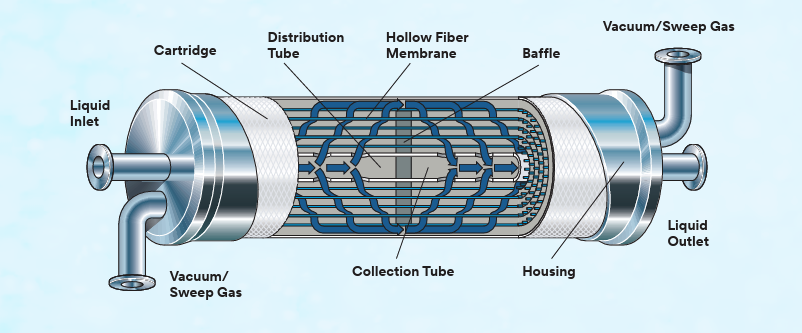
| Membrane contactors | Liquid and strip gas/vacuum separated by a hydrophobic membrane; gas transfers, liquid does not | Continuous lines needing tight, repeatable DO control |
Vacuum deaeration increases the surface area of the liquid — by spraying it as a fine mist or spreading it as a thin film — while a vacuum lowers the surrounding pressure so that dissolved gas readily escapes. Nitrogen stripping works on the partial-pressure principle differently: introducing nitrogen, which contains essentially no oxygen, drives the oxygen out of solution and into the gas stream, which is then vented. Membrane contactors achieve the same separation across a hydrophobic membrane wall, offering precise, continuous control without direct gas-liquid mixing. The choice among them turns on the product: a thin, clear stream deaerates readily under vacuum, while a viscous or foam-prone beverage often does better with gas stripping or a membrane system that avoids violent gas-liquid contact.
Protecting the Liquid Downstream of the Deaerator
Stripping oxygen out is only worthwhile if the beverage does not re-absorb it on the way to the package. A deaerated liquid is thirsty for oxygen and will pull it back from any air it contacts. Effective lines therefore protect the deaerated stream end to end:
- Nitrogen blanketing: holding tanks and surge vessels are kept under a low-pressure inert-gas blanket so the liquid surface never sees air.
- Closed, full transfers: piping is run liquid-full with minimal turbulence and no air entrainment; pumps and valves are selected to avoid drawing in air.
- Filler atmosphere control: fillers may operate under nitrogen, and the headspace is purged or dosed so the sealed container starts with minimal oxygen.
The vessels and piping that carry a deaerated beverage are part of the oxygen control system, not just plumbing. Tanks designed for inert blanketing — gas-tight, with sanitary gasketed connections and a pressure/vacuum control that maintains the blanket as level rises and falls — are what let the gains made in the deaerator survive all the way to the cap. A single leaking valve on the suction side of a transfer pump can undo an otherwise excellent deaeration step by aspirating air into the stream, which is why the integrity of the whole path matters as much as the deaerator itself.
Where Deaeration Fits in the Process
Position in the line affects how well deaeration holds. Deaerating as late as practical — close to the filler, after the major mixing and transfer steps that would otherwise re-introduce air — minimizes the opportunity for re-oxygenation. Some processes deaerate the water before it is even used to make up the beverage, so that high-shear mixing of powders or syrups does not start from an oxygen-saturated base. Many lines do both: deaerate the makeup water early, then give the finished beverage a final deaeration and inert handling just upstream of filling.
Carbonated and nitrogenated products add a wrinkle, because gas is deliberately put back into the liquid after oxygen is removed. There, deaeration is doubly valuable: removing oxygen first means the carbonation or nitrogenation step is not competing with dissolved air, giving more stable, predictable gas pickup and a cleaner finished product.
Matching the Deaerator to the Beverage
No single deaerator suits every product, and the selection is driven as much by the beverage's physical behavior as by the target oxygen number. Viscosity is a primary factor: a thin, water-like RTD releases dissolved gas readily under vacuum, whereas a thicker, protein- or pulp-bearing beverage resists gas escape and may foam violently when sprayed into a vacuum chamber. Foaming products often favor gentle gas stripping or a membrane contactor, which separates the gas without the turbulent spray that whips up foam. Pulp or particulate content argues against fine membranes that would blind quickly, pointing instead toward vacuum or sparge methods that tolerate solids.
Throughput and operating mode matter too. A batch operation can deaerate a tank and hold it under blanket until needed, while a high-speed continuous line needs a deaerator that delivers a steady, repeatable low-oxygen stream in line with the filler's demand. Temperature is a quieter variable: gases are less soluble in warm liquid, so deaeration can be more effective at slightly elevated temperature, but heat also stresses delicate flavors and proteins, so the choice balances oxygen removal against product protection. The practical result is that deaerator selection is a product-specific engineering decision, not a catalog default, and it is best made alongside the formulation rather than bolted on afterward.
Shelf Life, Quality and Verification
The payoff for controlling DO is measured in weeks or months of additional shelf life and, just as importantly, in flavor and color that hold up across that life. Reducing total package oxygen slows oxidative staling, protects added nutrients, preserves the bright character of coffee and tea, and reduces the risk of oxygen-dependent spoilage. The effect compounds over distribution: a product that leaves the plant near-zero in oxygen has a far larger margin against the slow oxygen ingress that occurs through closures and packaging over time.
Because oxygen is invisible, verification is essential. Inline DO probes monitor the liquid stream, and total-package-oxygen testing on finished, sealed containers confirms that both liquid and headspace oxygen are under control. Producers typically set a DO target for the deaerated liquid and a separate total-package-oxygen specification for the finished product, then validate that the line consistently meets both. Treating oxygen as a measured, specified parameter — rather than an afterthought — is what separates a beverage that ages gracefully from one that does not. The most reliable producers fold these measurements into routine quality control, trending DO and total package oxygen over time so that a slow upward creep — the signature of a wearing seal or a relaxing gasket — is caught and corrected before it ever reaches a customer's glass. In this way deaeration stops being a single piece of equipment and becomes a controlled, documented quality parameter that runs from the makeup water all the way to the sealed package, with the deaerator as its anchor and the measurement program as its proof.
Frequently asked questions
- What dissolved oxygen level should an RTD beverage target?
- Many oxygen-sensitive ready-to-drink beverages target dissolved oxygen and total package oxygen well below 1 ppm, compared with roughly 8 to 9 ppm for water in equilibrium with air. The exact specification depends on the product's sensitivity and required shelf life, so producers set a measured DO target for the deaerated liquid and a separate total-package-oxygen limit for the sealed container.
- What is the difference between vacuum and nitrogen deaeration?
- Vacuum deaeration sprays or thin-films the liquid into a low-pressure chamber so dissolved gas flashes off, which works well for water and clear streams. Nitrogen stripping sparges oxygen-free gas through or over the liquid so oxygen migrates into the gas and is vented, handling a wider range of beverages including more viscous ones. The two are often combined for very low residual oxygen.
- Why does dissolved oxygen shorten beverage shelf life?
- Oxygen drives oxidation reactions that stale flavor, fade or brown color, and degrade sensitive nutrients, and it can support oxygen-dependent spoilage organisms. Because these reactions begin the moment the product is filled, lowering dissolved and headspace oxygen slows the entire degradation cascade and extends usable shelf life.
- How is a beverage kept low in oxygen after deaeration?
- A deaerated liquid readily re-absorbs oxygen, so the line must protect it downstream. That means nitrogen-blanketing holding tanks, running closed liquid-full transfers without air entrainment, and controlling the filler atmosphere so the sealed container starts with minimal headspace oxygen. The tanks and piping are part of the oxygen-control system, not just conveyance.
Scope your custom build
Send us your volume, service chemistry, dimensions, and finish or code requirements. We return a full engineering package, firm lead time, and a fixed quote — freight quoted separately to your ZIP.
Request a Custom QuoteCall 866-418-1777