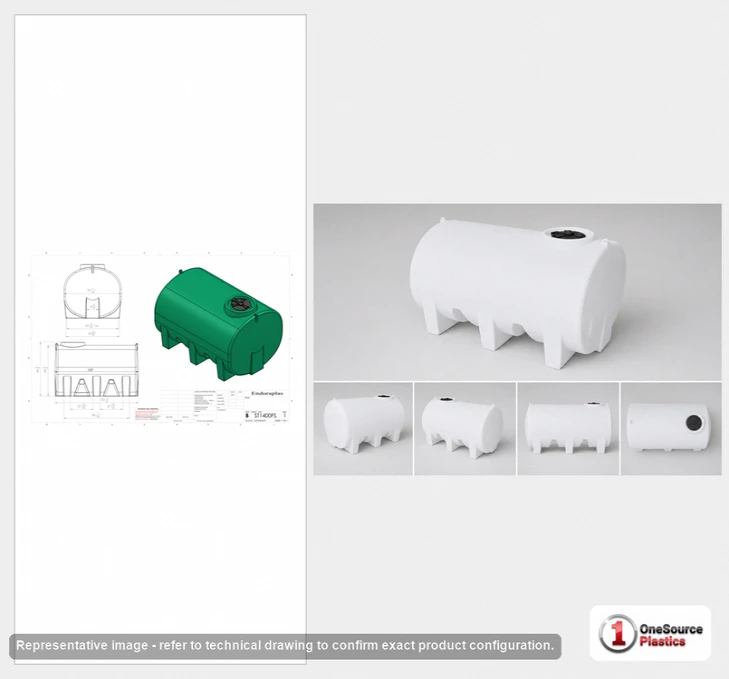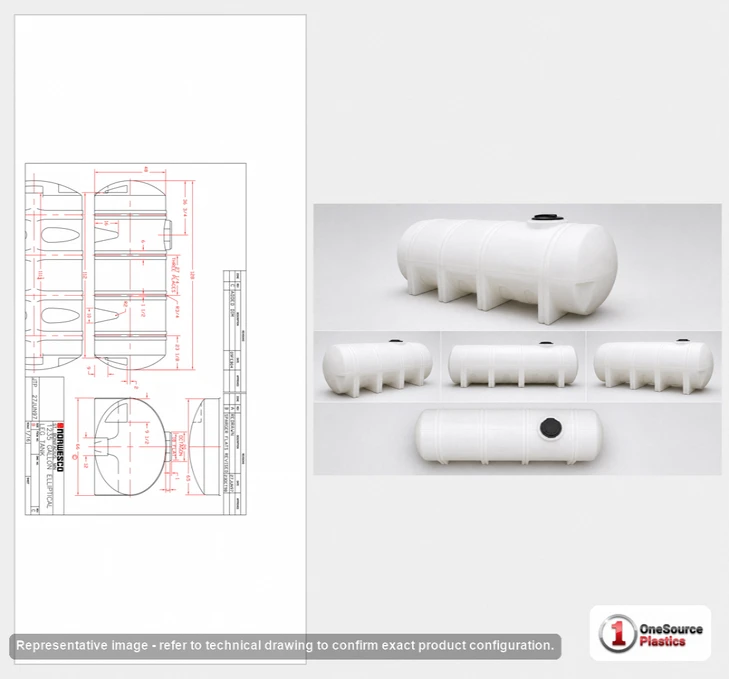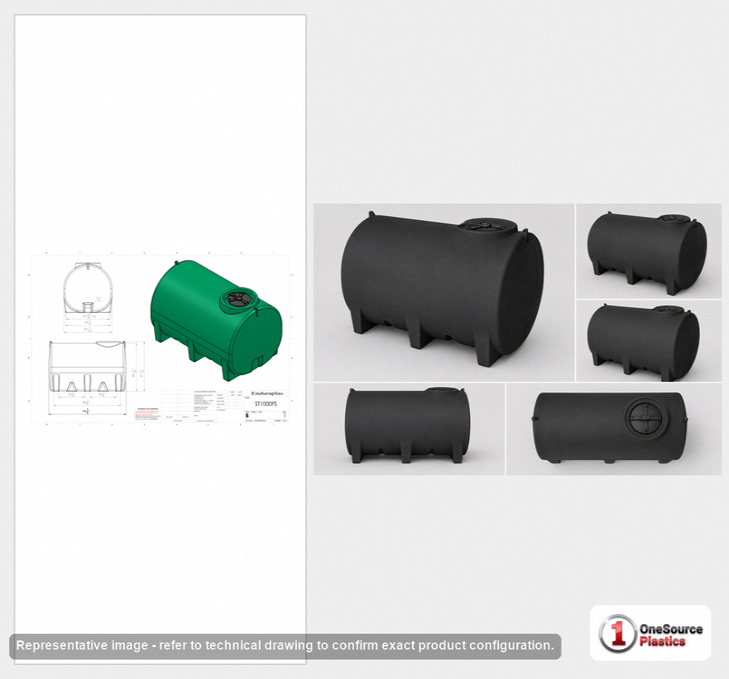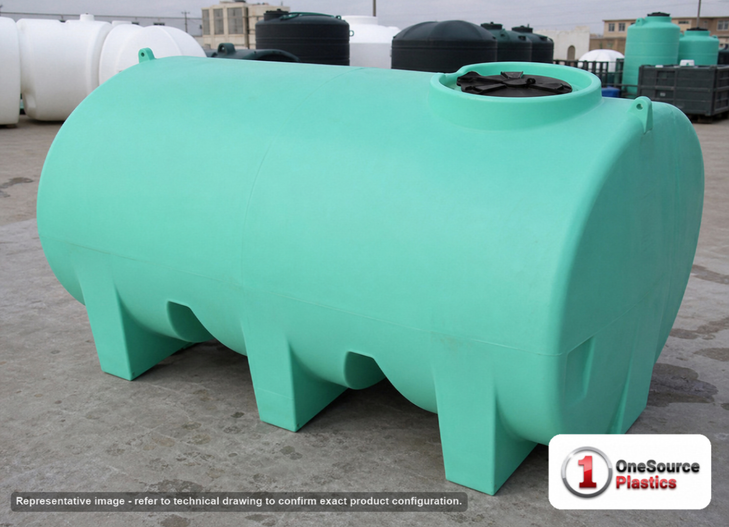
The Enduraplas 1200 Gallon Green Horizontal Sump Bottom Leg Tank (SKU THD01200G) is a polyethylene horizontal leg tank built for the haul and applicator role: the cradle-style legs hold the tank stable on a transport trailer, and the sump bottom drains the load to a single low point so you can empty it cleanly between fills. It measures 102 inches long by 70 inches wide and stands 63 inches tall, holding 1,200 gallons of green-pigmented polyethylene rated to a 1.9 specific gravity. That horizontal footprint of 70 x 102 inches keeps the center of gravity low for road and field use as a horizontal leg tank.
Will this tank work for your job?
This is a horizontal leg tank, not a stationary storage tank, so size it by the weight it will carry, not just the gallon count. Filled with plain water (SG 1.0), the contents weigh about 10,008 pounds. At its full 1.9 specific-gravity rating, the maximum rated contents weight climbs to 19,015 pounds. Here is the practical inverse: at 1.9 SG a heavy chemical reaches that 10,008 lb water-equivalent at only about 526 gallons, so a dense liquid fills your weight budget long before it fills the gallon budget. Check your trailer rating, axle capacity, and tongue weight against the heavier figure, and do not chase the full 1,200 gallons with a high-density load. Use the Tank Sizing Calculator and the Tank Sizing Guide to confirm the contents weight for your specific liquid and density. At 1.9 SG this is already the heaviest-rated polyethylene option for this size, so there is no higher-density tank to step up to; if your contents exceed 1.9 SG, polyethylene is not the right material.
Chemical compatibility
This tank is polyethylene rated to a 1.9 specific gravity. The resin type is not confirmed in our data, so call 866-418-1777 to confirm linear versus crosslinked polyethylene before chemical service, since the two differ in chemical resistance. The single low-point sump matters here too: it lets you fully drain the load between chemical changes, which is important for the oxidizers in this list, where a leftover heel of one liquid degrades the next batch. The chemicals below are matched to recommended fitting and gasket materials per the OEM chemical-resistance chart, which is concentration- and temperature-specific. Verify your exact concentration and operating temperature against that chart before committing to a chemical.
- Acetic Acid at 60% with PP/PVC fittings and EPDM gaskets
- Aluminum Sulfate at 50% with PVC fittings and EPDM gaskets
- Calcium Chloride at 40% with PVC fittings and EPDM gaskets
- DEF at 32.5% with 316SS fittings and EPDM gaskets
- Ethylene Glycol at 100% with PVC fittings and EPDM gaskets
- Ferric Chloride at 50% with PVC fittings and EPDM gaskets
- Ferric Sulfate at 60% with PVC fittings and EPDM gaskets
- Ferrous Sulfate at 20% with PVC fittings and EPDM gaskets
- Hydrochloric Acid at 37% with PVC fittings and Viton gaskets
- Hydrofluoric Acid at 48% with PP/PVC fittings and Viton gaskets
- Hydrofluosilicic Acid at 26% with PP/PVC fittings and Viton gaskets
- Hydrogen Peroxide at 50% with PVC fittings and Viton gaskets
- Magnesium Chloride at 30% with PVC fittings and EPDM gaskets
- Peracetic Acid at 30% with 316SS fittings and Aflas gaskets
- Phosphoric Acid at 85% with PVC fittings and Viton gaskets
- Polyaluminum Chloride with PVC fittings and EPDM gaskets
- Potassium Carbonate at 50% with PVC fittings and EPDM gaskets
- Potassium Hydroxide saturated with PVC fittings and EPDM gaskets
- Propylene Glycol with PP/316SS fittings and EPDM gaskets
- Sodium Bisulfate with PVC/PP fittings and EPDM gaskets
- Sodium Bisulfite with PVC/PP fittings and EPDM gaskets
- Sodium Carbonate at 30% with PVC fittings and EPDM gaskets
- Sodium Hypochlorite at under 16.5% with PVC fittings and Viton gaskets
- Sodium Thiosulfate at 40% with PVC fittings and EPDM gaskets
- Sulfuric Acid at 98% with CPVC fittings and Viton gaskets
- Urea Solution at 50% with PP/PVC fittings and EPDM gaskets
- Zinc Orthophosphate with PP/316SS fittings and EPDM gaskets
- Ozonated Water up to 10 PPM with PVC fittings and EPDM gaskets
For the full picture across these liquids, see our chemical compatibility resource.
The mistake to avoid
The costliest error on a 1.9 SG haul tank is matching the fittings and gaskets to the tank instead of to the chemical. The polyethylene shell tolerates a wide range of liquids, but the wetted hardware does not: sodium hypochlorite, hydrogen peroxide, phosphoric acid, and sulfuric acid call for Viton or CPVC, peracetic acid needs Aflas, and DEF and propylene glycol want stainless. Install EPDM where the chart specifies Viton and you will see early seal failure on an oxidizer. Confirm your resin type, then match every gasket and fitting to the chemical and concentration you are actually running. The fertilizer-blend physics behind heavy ag loads are covered in our guide to tank stratification and mixing protocol, and the DOT scope for fertilizer leg and applicator tanks is explained in our applicator and leg tank guide.
This tank ships LTL freight from the manufacturing plant in Neche, North Dakota, with cost quoted live to your ZIP code through our Freight Cost Estimator. The loaded weight, between 10,008 and 19,015 pounds on a 70 x 102 inch footprint, dictates your offload equipment far more than the empty tank does, so confirm you can receive an LTL delivery and have the gear to handle a full load. Even as a non-roadable leg tank, verify your trailer and axle capacity before you fill it. See the technical drawing on this page for fitting layout and dimensional detail, and call 866-418-1777 to confirm specifications, lead time, and the best configuration for your haul.
Freight and documents
Ships from: Neche, ND. LTL freight is quoted to your ZIP with the freight cost estimator or by phone at 866-418-1777. The listed price is before freight.
See this tank
Interactive 3D model with live fill. This tank has an interactive 3D model built to its manufacturer dimensions. Rotate it, and set a fill level to see how much liquid it holds at any height. Open the 3D view on the product photo above. Download the 3D model (GLB).
Product video. Watch the Enduraplas 1200 Gallon Green Horizontal Sump Bottom Leg Tank video (66 seconds) with dimensions, fittings and shipping notes.
Ready to order?
Add it to your cart at the top of this page, get LTL freight to your ZIP, request a written quote, or call 866-418-1777. The listed price is before freight.