The 1.5 rated wide 2500, four hundred and seventy pounds
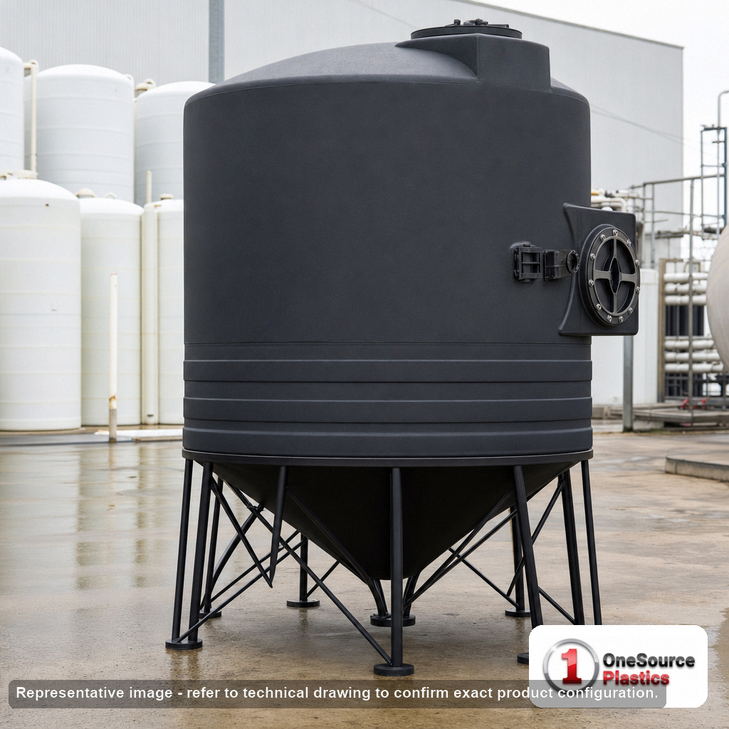
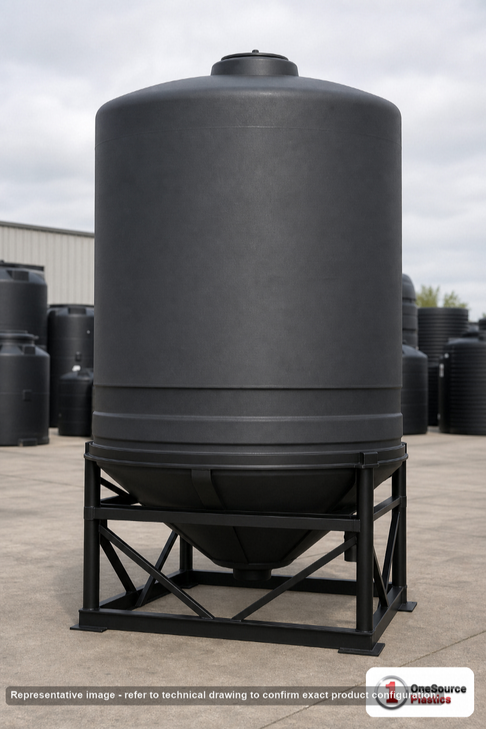
The Snyder 8350000N49 holds 2,500 gallons in a shell only 104 inches tall. The sheet lists it 95 inches long, 95 inches wide and 104 inches tall, at 470 pounds empty and 470 pounds shipping, with the colour given as black and the material field reading Polyethylene. The wall is rated at a specific gravity of 1.5, and the sheet gives 31,275 pounds of max contents against 20,850 pounds of water at 8.34 pounds per gallon. The opening on top is an 18 inch threaded vented manway. The outlet field reads 1 Manway / Lid, which names an opening rather than a discharge, and no discharge size is published on this sheet. The service limit is 100 F / 37 C. There is no cone angle field, no inlet, no stand, no warranty term, no structural lug detail and no NMFC number on this sheet, and this page claims none of them.
Talk to a person first? 866-418-1777 reaches a tank specialist, not a call center; or see freight to your ZIP and add the 2500 gallon tank to your cart above.
What a western plant means for a load headed east
Start with the origin, because it is the fact most likely to change the arithmetic. This tank is moulded at Chowchilla, California, and the sheet gives California as the state it ships from. In the west that is the short lane and a genuine advantage over the Nebraska-built tanks in the same family. Headed east it is a long haul, and on a shipment that is 95 inches by 95 inches by 104 inches at 470 pounds, what you are paying for is trailer space rather than weight. Get that number early with a real ZIP, because on bulk polyethylene the lane occasionally decides between two perfectly good tanks. The shape helps on the route in a way people notice on the day: at 104 inches the shipment is shorter than the taller listings in this family, which makes it easier through a gate, easier to turn in a yard and easier for whatever machine stands it up. What holds it up afterwards is not on this sheet at all. A cone bottom vessel has no flat bottom, cannot rest on a floor and must be carried by a stand, and this sheet publishes no stand, no legs, no skirt, no support ring and no bolt pattern. That makes the stand a separate purchase with its own drawing and lead time, and it is why no stand height, rated load or stand material appears anywhere on this page. Work it through with the stand compatibility matrix and confirm the fit with us against this part number. Under the stand, the pad takes 470 pounds of empty tank, 20,850 pounds of water and 31,275 pounds at the rating, concentrated into stand feet inside a 95 inch circle rather than spread over a slab, which is why cone foundations are designed rather than poured to suit. Settle the volume before the structure with the tank sizing calculator and take the freeboard from the tank sizing guide.
Ninety-five inches across instead of ninety, and what it buys
| Part | Gallons | Length x width x height | Empty weight |
|---|---|---|---|
| 8350000N49 (this tank, rated 1.5) | 2500 | 95 x 95 x 104 in | 470 lb |
| 5110000N40 (narrower circle, taller) | 2500 | 90 x 90 x 125 in | 375 lb |
| 5110000N46 (narrower circle, taller) | 2500 | 90 x 90 x 125 in | 375 lb |
| 5110000N48 (narrower circle, heavier listing) | 2500 | 90 x 90 x 125 in | 400 lb |
| 5070000N40 (step down in capacity) | 2000 | 90 x 90 x 102 in | 325 lb |
| 5100000N40 (step up in capacity) | 2600 | 90 x 90 x 139 in | 500 lb |
Five inches of extra width is what this listing sells, and what it buys is height. The same 2,500 gallons that need 125 inches on a 90 inch circle fit inside 104 inches on a 95 inch one, and in a low bay, under a mezzanine or beneath a duct run that nobody is going to move, those inches are the whole purchase. What they cost is floor: a wider circle means a wider pad, a wider bund and a wider aisle, and on a congested plant floor that is a real price rather than a rounding error. Measure both before you choose, because there is no general answer. On the rating, this listing is the 1.5 one, with 31,275 pounds of max contents, and it is the right buy for water, treated water and the broad family of process liquids no denser than water. Take a higher rating only when the product genuinely is heavier, not as a hedge. The three 5110000 rows carry their own weights on the sheet, 375 pounds on two and 400 pounds on the third, with no explanation published and none invented here. The last two rows are the capacity ladder on the narrow circle, 2,000 gallons at 102 inches and 2,600 gallons at 139 inches, for when the batch size rather than the room is what you are solving. Two longer reads take the decision further than a spec table can: the shallower cone buyer's guide at this capacity and the 30 degree guide that covers the poly stand question.
Neighboring size a better fit? Every row links to its own page; freight to your ZIP is quoted on each, or call 866-418-1777.
One manway, one lid field, and the blanks between them
- The fill opening: an 18 inch threaded vented manway, the only opening this sheet names. It sits at 104 inches plus the height of the stand, which is lower than most tanks in this family but still above head height once a stand is under it, so a platform or fixed ladder and a fall protection plan belong in the same drawing as the structure. Land the fill line at a coupling at working level.
- The vent: it arrives with the manway on this sheet rather than as a separate item. A tank being drawn down by pump needs that air path more than it needs anything else on the roof, so keep it clear and never blank, tape or paint it.
- The outlet field: it reads 1 Manway / Lid. That names an opening, not a discharge, and we print the field as it reads without turning it into a pipe size. No outlet dimension, no thread, no bulkhead and no valve is published or claimed. Give us the line size and the product and we will confirm what this part number carries before anything ships.
- Inlet: none published on this sheet. No fill fitting, no size, no position, so the arrangement is designed rather than assumed, and the air path is sized to the faster of the fill rate and the draw rate.
- Cone angle: no field on this sheet and no angle in the product name, so none is stated here. Ask and we will confirm the geometry against the part number rather than describing it from a picture.
- Ratings and blanks: a specific gravity rating of 1.5, 20,850 pounds of water at 2,500 gallons, 31,275 pounds of max contents and a service limit of 100 F / 37 C. No warranty term, no structural lug detail and no NMFC number appear.
Where this vessel stands over a surface that would have to be recovered after a release, the containment question is separate from the tank question and worth starting properly: the Captor containment comparison sets the contained polyethylene route against the alternatives.
Rinse-out batch work where the ceiling is low
This is the tank for a plant that changes product often and has a roof it cannot argue with. Polymer and coagulant make-up at a water or wastewater works, batch preparation and intermediate holding in manufacturing, liquid fertiliser and crop input blending at an agricultural retailer, food and beverage duty where the vessel is washed between products, wash and rinse water systems, and day tank duty feeding a pump at a steady rate. The cone is what makes a frequent changeover cheap: the vessel drains toward one low point, so a product change is a rinse rather than a recovery operation, and nothing sits on a flat floor waiting to contaminate the next batch. The wide shallow shape helps a second way, because a blend that wants to separate stays honest better here than in a tall slender column, which matters when the tank is mixed rather than merely stored. And at 470 pounds empty it is a manageable vessel to handle on installation day, which is worth more than it sounds when a machine has to be hired. Check your liquid in our chemical compatibility reference before the fittings are chosen rather than after the first fill.
Which liquids, at what concentration, with which fitting
Each entry pairs a rated liquid with its concentration limit and the fitting and gasket to order alongside the tank. The full rating sits on the linked page and in the chemical compatibility database before ordering.
- Acetic Acid at 60%, with PP/PVC fittings and EPDM gaskets
- Aluminum Sulfate at 50%, PVC fittings, EPDM gaskets
- Calcium Chloride at 40%, PVC fittings, EPDM gaskets
- DEF (diesel exhaust fluid) at 32.5%, 316SS fittings, EPDM gaskets
- Ferrous Sulfate at 20%, PVC fittings, EPDM gaskets
- Magnesium Chloride at 30%, PVC fittings, EPDM gaskets
- Sodium Carbonate at 30%, PVC fittings, EPDM gaskets
- Urea Solution at 50%, PP/PVC fittings, EPDM gaskets
- Ethylene Glycol
- Ferric Chloride
- Ferric Sulfate
- Hydrochloric Acid
- Hydrofluoric Acid
- Hydrofluosilicic Acid
- Hydrogen Peroxide
- Peracetic Acid
- Phosphoric Acid
- Polyaluminum Chloride
- Potassium Carbonate
- Potassium Hydroxide
- Propylene Glycol
- Sodium Bisulfate
- Sodium Bisulfite
- Sodium Hypochlorite
- Sodium Thiosulfate
- Sulfuric Acid and
- Zinc Orthophosphate. Note that several of these (hydrochloric acid, hydrofluoric acid, hydrogen peroxide, phosphoric acid, sulfuric acid, sodium hypochlorite)
Four hundred and seventy pounds on the long lane
Chowchilla, California is the plant and California is the origin state on the sheet, so everything east of the mountains is the long lane for this one. The freight class reads 400, a numeric class rather than a mode, and no NMFC number is published. The shipping size is 95 inches by 95 inches by 104 inches at 470 pounds, a large light package priced on the trailer space it occupies rather than on the scale. Run the lane to your ZIP through the freight cost estimator; the listed price is before freight. It travels lying down and is stood up at your site, and a wide shipment wants a clear circle of ground to be turned in. The sheet publishes no crane, no rigging, no permit and no escort detail, and this page states none; agree the offload equipment and the window with us before the truck is booked, rather than assuming a forklift will do it. Set, level and anchor the stand first, because a cone bottom tank has nowhere sensible to wait. Lift under the body with slings, never by the manway, and keep the tank restrained the moment it is upright, since an empty shell this size catches wind long before anybody expects it to. Fill it with clean water before any product goes near it, hold the 20,850 pound load, and read the manway seal, the cone joint, the stand feet and the pad edge in daylight. Leave it standing full overnight and look again in the morning. Take one photograph of it standing full on the first day and file it with the paperwork; every later argument about whether something has moved starts from that picture. Once it is full and holding, leave it alone for a day before the plumbing goes on; a settled tank is a quiet one.
Freight and documents
Ships from: Chowchilla, CA. LTL freight is quoted to your ZIP with the freight cost estimator or by phone at 866-418-1777. The listed price is before freight.
Technical drawing (PDF) for Snyder Industries 8350000N49.
See this tank
Interactive 3D model with live fill. This tank has an interactive 3D model built to its manufacturer dimensions. Rotate it, and set a fill level to see how much liquid it holds at any height. Open the 3D view on the product photo above. Download the 3D model (GLB).
Ready to order?
Add it to your cart at the top of this page, get LTL freight to your ZIP, request a written quote, or call 866-418-1777. The listed price is before freight.