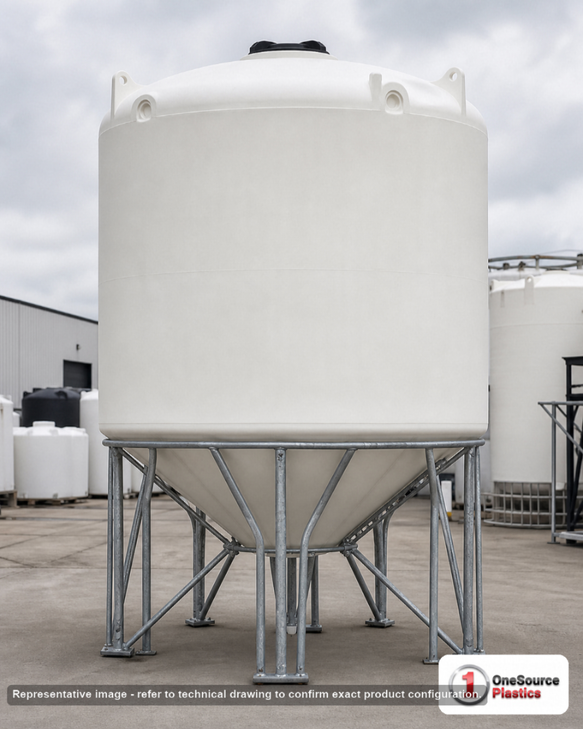
Thirty-nine thousand six hundred and fifteen pounds of allowed contents
That figure is what separates the Snyder SII-5110000N45 from the other 2,500 gallon listings on this sheet. The tank is 90 inches long, 90 inches wide and 125 inches tall, at 400 pounds empty and 400 pounds shipping, with the material field reading Polyethylene and the colour field reading White. Plastic and 30 Degree are the maker's own name words; the sheet publishes no cone angle field, so no measured angle is stated below. The wall carries a specific gravity rating of 1.9, and the sheet gives 39,615 pounds of max contents against 20,850 pounds of water at 8.34 pounds per gallon in the same 2,500 gallons. Access is an 18 inch threaded vented manway and the lid size field reads 18 inches. The freight class reads 500 beside an OVS ship mode. This sheet publishes no outlet, no inlet, no service temperature limit, no warranty term, no NMFC number, no lug or flange count and no stand, and none of those is asserted on this page.
Replacing a tank that failed? Call 866-418-1777 with what it held and how long it lasted; or check freight to your ZIP and put the 2500 gallon tank in your cart above.
The heavy rating on the tall shell, and who needs it
The family sets this decision, and the family here is one shell listed several ways. Every 2,500 gallon row on this sheet is 90 inches across and 125 inches tall; the sheet separates them by empty weight and by the rating that goes with it. This is the 400 pound row at 1.9. It allows 39,615 pounds of contents where the same 2,500 gallons of water weighs 20,850 pounds at 8.34 pounds per gallon, and that gap is the entire reason the part number exists. If your product is meaningfully heavier than water, this is the row that lets you fill the vessel with product rather than leave the top third empty to stay inside a lighter rating. If your product is water, treated water or anything at or below the weight of water, a lighter row on this same shell does the identical job and the difference stays in your pocket. There is no third consideration and the sheet offers none, so none is manufactured here. Get the specific gravity of your liquid in front of you before you compare part numbers; it moves this decision further than anything else on the page. The colour field reads White, so daylight reaches the contents and an operator gets a rough level by eye from the floor. On a dense product that is genuinely useful, because a heavy liquid is the one you least want to guess about, and it is a drawback outdoors on anything that should be kept out of the light. Then the support, which on a dense fill is the part that deserves the most attention. A cone bottom tank has no flat floor and cannot stand on its own bottom. This sheet publishes no stand, no legs, no skirt, no support ring and no bolt pattern, so the support is a separate item with its own drawing and its own lead time, and no stand height, rated load or material is stated here. What it has to carry is on the sheet: 400 pounds of empty tank, 20,850 pounds of water and up to 39,615 pounds at the rating, concentrated on a few feet inside a 90 inch circle with 125 inches of shell standing above them. Fix the volume with the tank sizing calculator and take the freeboard from the tank sizing guide before the support is drawn, not after.
Same circle, same height, a different rating
| Part | Gallons | Length x width x height | Empty weight |
|---|---|---|---|
| SII-5110000N45 (this tank, white, rated 1.9) | 2500 | 90 x 90 x 125 in | 400 lb |
| 5110000N48 (heavy duty on this shell, same listed weight) | 2500 | 90 x 90 x 125 in | 400 lb |
| 5110000N40 (same shell, lighter listing) | 2500 | 90 x 90 x 125 in | 375 lb |
| 5110000N46 (same shell, lighter listing) | 2500 | 90 x 90 x 125 in | 375 lb |
| 5070000N40 (two thousand gallons, same circle) | 2000 | 90 x 90 x 102 in | 325 lb |
| 5100000N40 (twenty-six hundred gallons, same circle) | 2600 | 90 x 90 x 139 in | 500 lb |
Every row in the top four holds 2,500 gallons in a 90 inch circle at 125 inches, so the table is not really about shape at all. It is a weight column: 400 pounds on two rows and 375 pounds on the other two, with the names the sheet prints beside them. The sheet does not explain what the extra pounds buy beyond the rating that travels with them, so this page does not either; the rating is the specification you order against and the weight is the number the carrier cares about. The bottom two rows are the ladder, and they are the interesting half of this table because the circle never changes: 2,000 gallons at 102 inches, 2,500 gallons at 125 inches, 2,600 gallons at 139 inches, all on the same 90 inch footprint. If your building has the height, the step up costs no floor at all; if it does not, the step down hands height back without redrawing the pad. That is a rare thing in tank selection and it is worth building the civils around, because it keeps the capacity decision open long after the concrete has set. For the whole selection at this capacity, the complete buyer's guide to a twenty-five hundred gallon thirty degree cone bottom tank is the long read, and where the bottom angle rather than the volume is what you are weighing, the cone angle selection guide compares the shallow, middle and steep options against how real product drains.
Want the certified one or the plain one? Call 866-418-1777 and say what the inspector asks for; or request a quote on the row you need.
One opening, and the blanks the sheet leaves under it
- The vent is the first fitting to get right, and on this sheet it arrives as part of the 18 inch threaded vented manway rather than as a separate line. The lid size field also reads 18 inches. That air path is what protects the wall while a pump draws a heavy liquid down, and a dense product makes the vacuum it can pull worse, not better. Keep it clear, inspect it whenever the tank is open, and never blank or tape it.
- Reaching the lid: it sits at the top of 125 inches of shell plus the stand. No ladder lugs and no structural attachments are counted on this sheet, so the access belongs to the structure and the fill line belongs at a coupling at working level rather than in somebody's hands at the top.
- The outlet: this sheet publishes no outlet and no inlet, so no discharge size, thread, bulkhead or valve is stated or implied. Give us the line size you need to land, the valve type and the product, and we will confirm what this part number carries before it ships.
- Under the cone, and this matters more here than on any other row in the family: everything hung at the low point holds up the column above it, and the sheet allows that column to reach 39,615 pounds. Carry the valve, any reducer and the first run of pipe on steelwork off the stand and never on the tank, with a flexible connector at the first joint so pump vibration stops there.
- The angle: 30 Degree is the maker's name word on this listing and the sheet carries no cone angle field, so none is stated here and none should be read off a photograph. If the way your product drains is the deciding factor, ask and we will confirm the geometry against the part number.
- Not on this sheet: a service temperature limit, a warranty term, an NMFC number, a lug count, a flange count and any stand detail. Nothing is claimed for them. Published: a rating of 1.9, 20,850 pounds of water at 2,500 gallons and 39,615 pounds of max contents.
Because no service temperature figure is published here, treat a warm or heated fill as a question for us rather than an assumption, and send the temperature with the product name.
Heavy concentrate at twenty-five hundred gallons
A 1.9 rated shell gets bought for one reason: the product weighs more than water and the buyer wants the tank full. Concentrated mineral and salt solutions in a process building, liquid fertiliser and crop input concentrate at an agricultural retailer, treatment chemistry held at working strength rather than diluted for storage, brines, spent liquor and pickling solution in a metals plant, and process intermediates carrying solids in suspension that still have to drain clean at the end of a run. Against 20,850 pounds of water in the same 2,500 gallons, the 39,615 pound allowance is what turns those loads from marginal into ordinary. The cone is the second argument and at high specific gravity it is the stronger one, because dense product left in the last inches of a flat floor is heavier, worth more and harder to dispose of than a light one; a full-drain bottom is simply worth more per gallon of residue avoided. The third consideration is the one people skip, and it is the ground. A heavy fill on a tall shell puts a very concentrated load through a small number of feet inside a 90 inch circle, so the pad, the support and the anchors deserve the same attention as the tank, and the first full product fill should be watched rather than assumed. The honest limits: no service temperature figure is published on this sheet, no outlet is published, and a tall column of dense liquid stratifies more readily than a shallow one. Check the liquid in our chemical compatibility reference before the trim is chosen, and send us the specific gravity and the temperature at fill with the enquiry.
Listed chemical service for this shell
The maker's list for this resin: each liquid, the concentration it is rated to, and the fitting and gasket that go on the order. Verify your own service on the linked page or in the chemical compatibility database before ordering.
- Acetic Acid (60%) - PP/PVC fittings, EPDM gaskets
- Aluminum Sulfate (50%) - PVC fittings, EPDM gaskets
- Calcium Chloride (40%) - PVC fittings, EPDM gaskets
- DEF (32.5%) - 316SS fittings, EPDM gaskets
- Ethylene Glycol (100%) - PVC fittings, EPDM gaskets
- Ferric Chloride (50%) - PVC fittings, EPDM gaskets
- Ferric Sulfate (60%) - PVC fittings, EPDM gaskets
- Ferrous Sulfate (20%) - PVC fittings, EPDM gaskets
- Hydrochloric Acid (37%) - PVC fittings, Viton gaskets
- Hydrofluoric Acid (48%) - PP/PVC fittings, Viton gaskets
- Hydrofluosilicic Acid (26%) - PP/PVC fittings, Viton gaskets
- Hydrogen Peroxide (50%) - PVC fittings, Viton gaskets
- Magnesium Chloride (30%) - PVC fittings, EPDM gaskets
- Peracetic Acid (30%) - 316SS fittings, Aflas gaskets
- Phosphoric Acid (85%) - PVC fittings, Viton gaskets
- Polyaluminum Chloride - PVC fittings, EPDM gaskets
- Potassium Carbonate (50%) - PVC fittings, EPDM gaskets
- Potassium Hydroxide (saturated) - PVC fittings, EPDM gaskets
- Propylene Glycol - PP/316SS fittings, EPDM gaskets
- Sodium Bisulfate - PVC/PP fittings, EPDM gaskets
- Sodium Bisulfite - PVC/PP fittings, EPDM gaskets
- Sodium Carbonate (30%) - PVC fittings, EPDM gaskets
- Sodium Hypochlorite (
- Sodium Thiosulfate (40%) - PVC fittings, EPDM gaskets
- Sulfuric Acid (98%) - CPVC fittings, Viton gaskets
- Urea Solution (50%) - PP/PVC fittings, EPDM gaskets
- Zinc Orthophosphate - PP/316SS fittings, EPDM gaskets
Four hundred pounds, ninety inches square, class five hundred
Lincoln, Nebraska is where this one is moulded and Nebraska is the origin state on the sheet, so the short lanes run across the plains and the Midwest and the long ones run to both coasts. The freight class reads 500 beside an OVS ship mode, and no NMFC number is published. The package is 90 inches by 90 inches by 125 inches at 400 pounds, a tall and very light ticket for its size, and that is the shape that prices on trailer space rather than on weight. Price your own lane with the freight cost estimator before the order goes in; the listed price is before freight. The tank travels lying down and is stood up at your end, so agree who does that, with what machine, and on what ground, before the truck is booked. The sheet publishes no crane, no rigging, no permit and no escort detail, and none is described here; settle the offload equipment and the window with us in advance. Have the support set, levelled and anchored first. No lifting lugs are counted on this sheet, so lift under the body, never off the manway, and restrain the shell the moment it stands. Then commission it properly, because this row will hold something heavier than water and the structure has never seen that load: fill with clean water first, hold the 20,850 pound load, read the manway seal, the cone joint, the stand feet and the pad edge, and leave it standing full overnight. On the first product fill, watch the stand feet and the pad edge again from the start of the fill rather than at the end of it. Walk the base once more after the first hard rain; a pad that has shifted shows it at the edge before it shows it anywhere else. Keep one spare gasket for the outlet fitting on the shelf; it is the part that fails on a holiday.
Freight and documents
Ships from: Lincoln, NE. LTL freight is quoted to your ZIP with the freight cost estimator or by phone at 866-418-1777. The listed price is before freight.
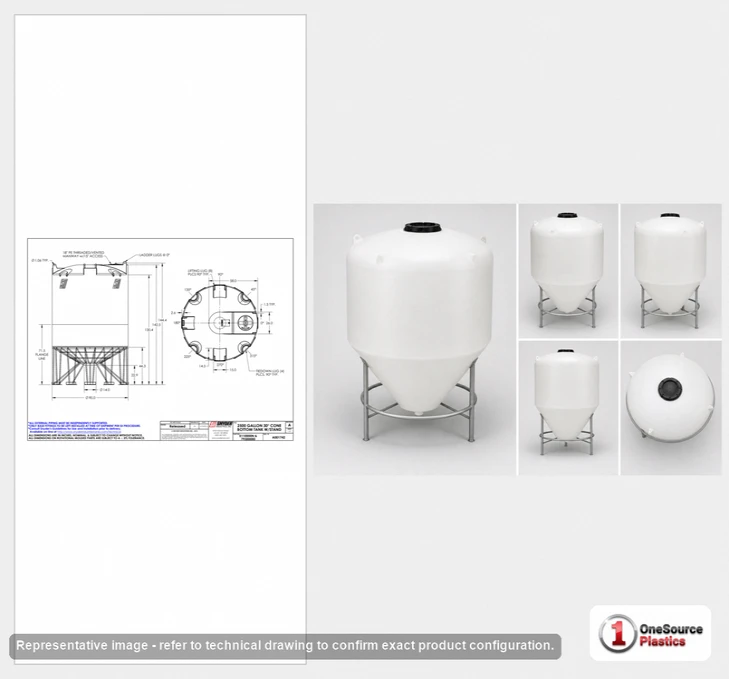
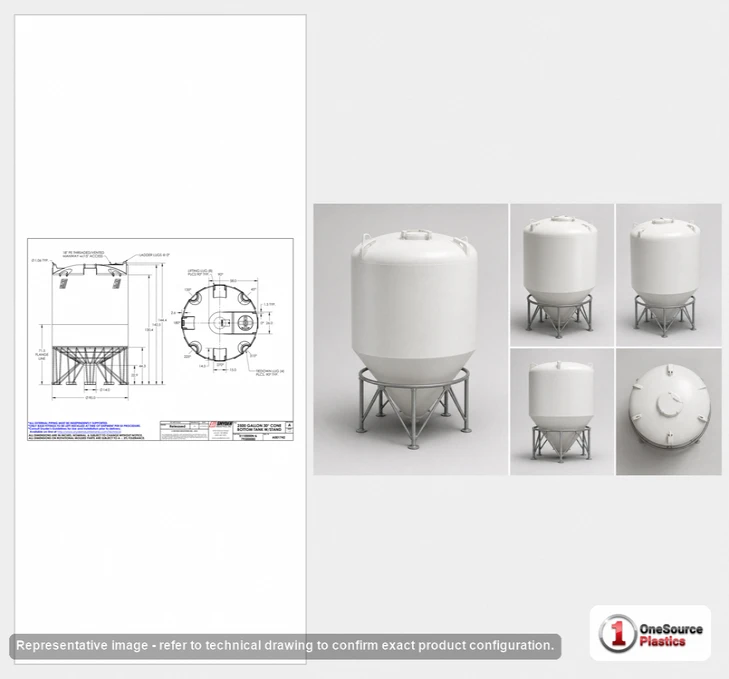
Technical drawing (PDF) for Snyder Industries 5110000N45.
See this tank
Interactive 3D model with live fill. This tank has an interactive 3D model built to its manufacturer dimensions. Rotate it, and set a fill level to see how much liquid it holds at any height. Open the 3D view on the product photo above. Download the 3D model (GLB).
Product video. Watch the 2500 Gallon 30 Degree Plastic Cone Bottom Tank video (65 seconds) with dimensions, fittings and shipping notes.
Ready to order?
Add it to your cart at the top of this page, get LTL freight to your ZIP, request a written quote, or call 866-418-1777. The listed price is before freight.