Twenty-five hundred gallons, rated 1.5, a hundred and twenty-five inches tall
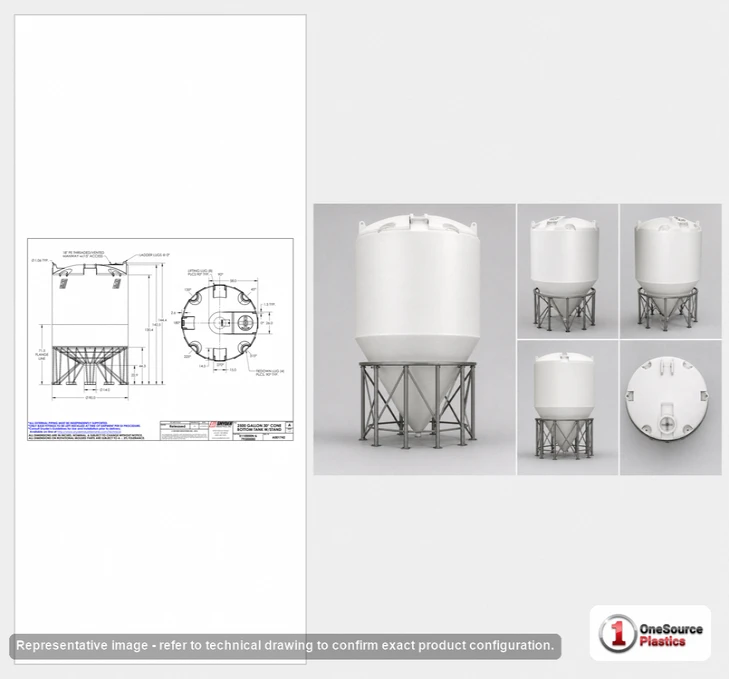
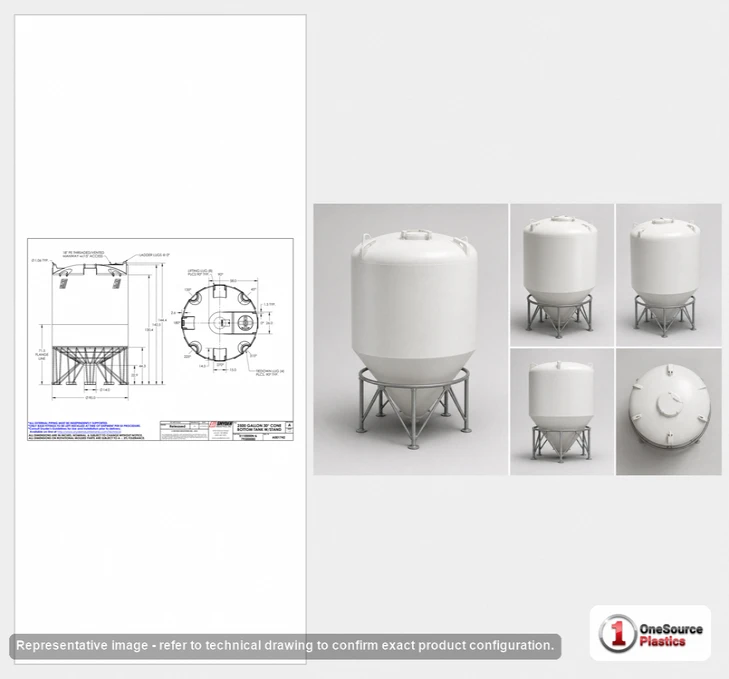
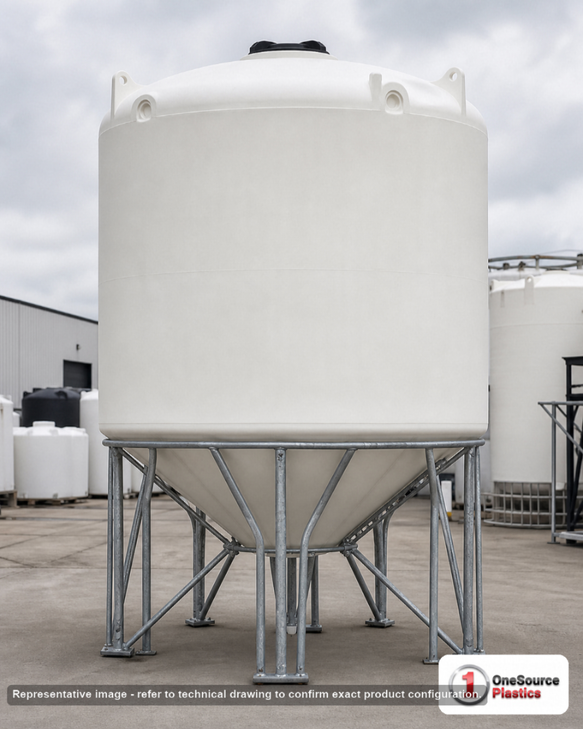
The Snyder SII-5110000N43 is a 2,500 gallon cone bottom tank listed 90 inches long, 90 inches wide and 125 inches tall, at 375 pounds empty and 375 pounds shipping. The material field reads Polyethylene and the colour field reads White. Plastic and 30 Degree are the maker's own name words on this listing; the sheet carries no cone angle field, so no measured angle is stated below. The wall carries a specific gravity rating of 1.5, and the sheet gives 31,275 pounds of max contents against 20,850 pounds of water at 8.34 pounds per gallon. The opening is an 18 inch threaded vented manway and the lid size field reads 18 inches. The service limit is 100 F / 37 C. The freight class reads 500 beside an OVS ship mode. This sheet publishes no outlet, no inlet, no warranty term, no NMFC number, no lug or flange count and no stand detail, and this page claims none of them.
Have the liquid and the ZIP? That is all 866-418-1777 needs to confirm the fit; or price freight to your ZIP and add it to your cart above.
Reading this row against the heavier listing on the same shell
The family decides this purchase, so start there. One 90 by 90 by 125 inch shell carries several 2,500 gallon listings and the sheet separates them by empty weight and by the specific gravity rating that travels with it. This is the 375 pound row at 1.5, with 31,275 pounds of max contents against 20,850 pounds of water in the same 2,500 gallons. On the same shell sits a heavier listing at 400 pounds for genuinely dense product. The sheet explains that weight difference no further than the figure, so neither does this page, and the practical rule is simple: find what your liquid weighs per gallon, match it to a rating, and stop. Above your duty you are buying wall you will never load; below it you are not saving anything. For water, treated water, rinse water and the broad run of process liquid at or under the weight of water, this is the row. The colour field reads White, which puts a rough level in an operator's eye from the floor in daylight, with no ladder and nothing opened, and costs you light control on anything that should be kept dark. That is the full published difference between this row and the ones beside it; nothing else is invented for it. The rest of the decision is the building. At 125 inches of shell plus whatever stand carries it, this is a tall vessel, and the height is what buys you 2,500 gallons on a 90 inch circle rather than a wider footprint. Measure the roof line, the door and the route in before the part number is fixed. Then the structure itself, which is not optional and is not on this sheet: a cone bottom tank has no flat floor and cannot stand on its own bottom, and this sheet publishes no stand, no legs, no skirt, no support ring and no bolt pattern, so the support is a separate item and no stand height, rated load or material appears here. It has to answer 375 pounds of empty tank, 20,850 pounds of water and up to 31,275 pounds at the rating, arriving through a few stand feet inside a 90 inch circle rather than spreading across a slab. Size the volume with the tank sizing calculator, take the freeboard from the tank sizing guide, and leave real clearance under the cone for whatever the discharge feeds.
The fifty-one ten group, and the sizes either side of it
| Part | Gallons | Length x width x height | Empty weight |
|---|---|---|---|
| SII-5110000N43 (this tank, white, rated 1.5) | 2500 | 90 x 90 x 125 in | 375 lb |
| 5110000N40 (same shell, same listed weight) | 2500 | 90 x 90 x 125 in | 375 lb |
| 5110000N46 (same shell, same listed weight) | 2500 | 90 x 90 x 125 in | 375 lb |
| 5110000N48 (the heavy duty listing on this shell) | 2500 | 90 x 90 x 125 in | 400 lb |
| 5070000N40 (a size down, same circle) | 2000 | 90 x 90 x 102 in | 325 lb |
| 5100000N40 (a size up, same circle) | 2600 | 90 x 90 x 139 in | 500 lb |
Four rows in this table say 2,500 gallons and the dimensions never move: 90 inches across, 125 inches tall, on every one. What moves is the weight column and the name the sheet prints on each row, 375 pounds on three of them and 400 pounds on the fourth. That is all the sheet gives and this page will not manufacture more. The rows worth studying are the last two, because they are the only places the geometry changes and they change it in one direction only. The 2,000 gallon listing is 102 inches tall on this same 90 inch circle; the 2,600 gallon listing is 139 inches tall on it. Three capacities, one footprint. If you are drawing a pad, a bund or a stand line for this family, draw it for the circle and decide the gallons against the roof, because the civils do not care which of the three you end up with and the building does. That also means an upgrade later is a drawing exercise rather than a demolition one, which is worth an hour of measurement now. Two long reads cover this size properly: the complete buyer's guide to a twenty-five hundred gallon thirty degree cone bottom tank takes the whole selection, and the buyer's guide to the shallower angle at the same capacity is the one to read if you are still deciding how steep the bottom needs to be for what you are draining.
Found the 2500 gallon tank in the table? Freight to your ZIP is one click; add it to your cart above, or call 866-418-1777 to check the grade.
What the sheet dimensions, and what it leaves blank
- The manway and its vent, first: an 18 inch threaded vented manway is what the sheet gives, with the lid size field also reading 18 inches, and the vent comes as part of it rather than as a separate item. That is the tank's air path, and on a vessel being pumped out it is doing structural work; a shell that cannot take air in takes the load in its wall instead. Keep it clear, check it every time the tank is opened, and never blank, paint or tape it.
- Working at height: the lid sits at the top of 125 inches of shell plus the stand, which makes access a designed item rather than an improvised one. No ladder lugs and no structural attachments are counted on this sheet, so the ladder or platform belongs to the structure, and the fill should land at a coupling at working level.
- The service limit: 100 F / 37 C is published here. It is the figure a hot make-up line or a summer fill will test first, so give us the fill temperature with the product rather than after the tank is standing.
- The outlet: no outlet and no inlet is published on this sheet, so no size, thread, bulkhead or valve is stated. Tell us the line size you need to land and the product, and we will confirm what this part number carries before anything is ordered.
- Under the cone: 30 Degree is the maker's name word and no cone angle field is published, so none is stated. Everything hung at the low point carries the column above it, up to 31,275 pounds at the rating, so put the valve, any reducer and the first run of pipe on steelwork off the stand, never on the tank, with a flexible connector at the first joint.
- Blank on this sheet: warranty term, NMFC number, lug count, flange count and stand detail. Nothing is claimed for any of them. Published: a rating of 1.5, 20,850 pounds of water at 2,500 gallons, 31,275 pounds of max contents and a limit of 100 F / 37 C.
On a tall shell the ladder and the lid are the two things people improvise and then live with for a decade, so draw them once, properly, with the support.
Blending and holding where the batch is the whole tank
Twenty-five hundred gallons is a useful number because it takes a full bulk drop without splitting it between vessels, and the cone means the vessel gives all of it back at the end. Liquid fertiliser and crop input blending at an agricultural retailer, polymer and coagulant preparation at a water or wastewater works, batch make-up and intermediate holding in manufacturing, wash and rinse water emptied between runs, recovered process liquid waiting on a decision, and buffer volume between two stages that run at different rates. The common thread is the changeover, and the changeover is where a full-drain bottom pays: a product change becomes a rinse rather than a recovery job, and nobody is climbing in with a pump to clear the last layer off a floor. The 1.5 rating is the honest match for that work, since almost everything on the list weighs what water weighs or less, and 31,275 pounds of max contents against 20,850 pounds of water leaves margin without paying for capability you cannot use. The white wall is the small daily gain, a rough level by eye between batches. The limits belong in the same paragraph as the benefits: the published service limit is 100 F / 37 C, daylight reaches the contents through a translucent wall, and 125 inches of liquid on a 90 inch circle will stratify more readily than a wide shallow vessel would, so if your blend wants to separate, specify the draw point and the mixing arrangement with the tank rather than a season later. Name the liquid when you enquire and start in our chemical compatibility reference; the gasket and valve selection follows the chemistry and not the shell.
Chemical ratings on record for this resin
What the manufacturer lists for this resin, liquid by liquid, with the concentration ceiling and the fitting and gasket material. Your concentration and temperature get checked on the linked page or in the chemical compatibility database before ordering.
- Acetic Acid (60%, PP/PVC fittings, EPDM gaskets)
- Aluminum Sulfate (50%, PVC, EPDM)
- Calcium Chloride (40%, PVC, EPDM)
- DEF (32.5%, 316SS, EPDM)
- Ferrous Sulfate (20%, PVC, EPDM)
- Magnesium Chloride (30%, PVC, EPDM)
- Sodium Carbonate (30%, PVC, EPDM)
- Urea Solution (50%, PP/PVC, EPDM), and Ozonated Water (up to 10 PPM, PVC, EPDM). Match the fitting and gasket material to the chemical, since the right p
- Ethylene Glycol
- Ferric Chloride
- Ferric Sulfate
- Hydrochloric Acid
- Hydrofluoric Acid
- Hydrofluosilicic Acid
- Hydrogen Peroxide
- Peracetic Acid
- Phosphoric Acid
- Polyaluminum Chloride
- Potassium Carbonate
- Potassium Hydroxide
- Propylene Glycol
- Sodium Bisulfate
- Sodium Bisulfite
- Sodium Hypochlorite
- Sodium Thiosulfate
- Sulfuric Acid and
- Zinc Orthophosphate. Gasket choice matters as much as the tank rating: hydrochloric, hydrofluoric, hydrofluosilicic, phosphoric, sulfuric acid, hydrogen perox
An oversize package at three hundred and seventy-five pounds
Lincoln, Nebraska is the plant, and Nebraska is the state the sheet gives for shipping, which puts the plains and the Midwest on the short lane and both coasts on the long one. The freight class reads 500 beside an OVS ship mode and the sheet publishes no NMFC number. The package is 90 inches by 90 inches by 125 inches at 375 pounds, a tall, light load that prices on the trailer space it occupies rather than on the scale ticket, which is exactly why the quote surprises people who budgeted by weight. Get the lane figure for your own ZIP from the freight cost estimator before you commit; the listed price is before freight. It travels lying down and is stood up at your site, and at 125 inches that is the longest lift in this family, so nominate the machine and the person for it in advance. The sheet publishes no crane, no rigging, no permit and no escort detail, and none is described here; settle the offload arrangement and the delivery window with us before the truck is booked. Set, level and anchor the support first, because concrete curing while a tank lies in the yard is time nobody planned for. No lifting lugs are counted on this sheet, so sling under the body and never off the manway, and restrain the shell the moment it is upright. Commission with clean water rather than product: hold the 20,850 pound water load, then read the manway seal, the cone joint, the stand feet and the pad edge in that order and leave it standing full overnight. Note the pad height and the discharge height on the site plan while the tape is out; the next pipe run will need both and nobody will want to climb back up for them. Check the strap tension a week after the first fill; a tank settles a little, and the strap that was tight is loose.
Freight and documents
Ships from: Lincoln, NE. LTL freight is quoted to your ZIP with the freight cost estimator or by phone at 866-418-1777. The listed price is before freight.
Technical drawing (PDF) for Snyder Industries 5110000N43.
See this tank
Interactive 3D model with live fill. This tank has an interactive 3D model built to its manufacturer dimensions. Rotate it, and set a fill level to see how much liquid it holds at any height. Open the 3D view on the product photo above. Download the 3D model (GLB).
Product video. Watch the 2500 Gallon 30 Degree Plastic Cone Bottom Tank video (65 seconds) with dimensions, fittings and shipping notes.
Ready to order?
Add it to your cart at the top of this page, get LTL freight to your ZIP, request a written quote, or call 866-418-1777. The listed price is before freight.