3000 gallons rated 1.9 on an eight foot base
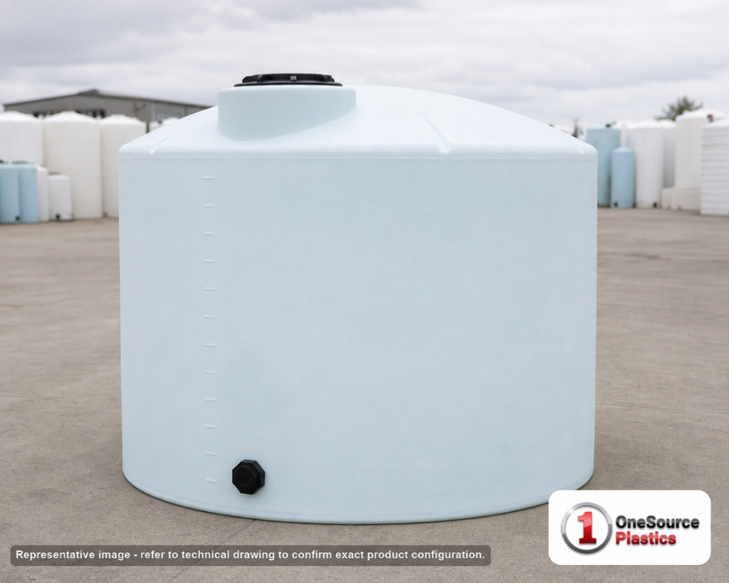
The Snyder SII-32273 is the heavy-rated 3000: a white high density linear polyethylene vertical tank 96 inches across and 109 inches tall, 654 pounds empty, molded at Albertville, Alabama. Its sheet rates the wall at a specific gravity of 1.9, which is the top rating on any sheet in this group. The arithmetic the sheet publishes with it is worth reading twice: 3000 gallons of water is 25,020 pounds at 8.34 pounds per gallon, and the contents figure against this wall is 47,538 pounds. It is fitted with a 20 inch threaded vented manway, a lid size given as 20 inches, and a 2 inch polypropylene female NPT bulkhead outlet with a siphon tube. Freight is class 400 and it moves as an oversize load. No temperature limit and no warranty term are published on this sheet, so none is stated here; ask us and we will get Snyder's current terms in writing.
Want a second opinion on the size? Call 866-418-1777 with the daily draw and the delivery interval, or price freight to your ZIP and add it to your cart above.
Who pays for a 1.9 wall: the plants that store the heavy liquids
The duty that sells this tank is density. A buyer takes the 1.9 rating because the liquid is heavier than water and the tank has to be sized for the liquid rather than for the gallons, and that buyer is usually a plant: a water or wastewater treatment works holding a dense treatment chemical in bulk, a mining or minerals operation with a heavy solution, a metal finishing or plating shop with a concentrated bath chemistry, a fertilizer blender or co-op with a dense nutrient solution, a pulp, paper or textile plant with a process liquor, an oilfield or industrial service yard storing a weighted fluid. What the delivery looks like follows from that. This is a tanker or a tote-fleet tank, not a drum tank: liquid arrives under pressure through a hose into the top, 3000 gallons at a time or in partial loads, and somebody has to be standing at the tank while it happens because there is no gauge on a polyethylene wall that reads itself. The shape suits that work. At 109 inches, nine feet one inch, the manway is high enough to need a step or a short platform and low enough to sit inside a great many process buildings and under most single-storey eaves. The 96 inch base, eight feet, is what carries the load, and the load is the number that deserves the engineering: 25,020 pounds of water, and more than that if the liquid is what the rating is for, all of it standing on an eight foot circle through a rotationally molded floor that bears on the whole surface it touches and nothing else. A low corner, a hollow or a seam under the base becomes the bearing point. Engineer the slab to the framework in the concrete pad sizing framework for above-ground polyethylene tanks, level, in full contact and poured wider than the tank, inside containment sized to the tank where the liquid is regulated. At 654 pounds empty it is light enough for wind to move before it is filled, so band or strap it while it is empty. Then check the volume against the duty rather than the budget: 3000 gallons against your real draw and delivery interval in the tank sizing calculator, with the reserve and the thermal freeboard from the tank sizing guide.
One capacity, three shells: 96 by 109 against 90 by 127
| Part | Gallons | Diameter x height | Empty weight |
|---|---|---|---|
| SII-32273 (this tank, white, wide and low) | 3000 | 96 x 109 in | 654 lb |
| 5130000C34 (black, narrower, taller) | 3000 | 90 x 127 in | 575 lb |
| 5130000C37-BLACK (black, narrower, taller) | 3000 | 90 x 127 in | 575 lb |
| 5130000N33 (black, cross-linked, rated 1.35 in its own name) | 3000 | 90 x 127 in | 510 lb |
| 8390000C26 (smaller, widest, lowest) | 2650 | 102 x 97 in | 510 lb |
| SII-32288 (larger, same base, taller) | 3500 | 96 x 125 in | 550 lb |
Three shells on this sheet hold 3000 gallons and the argument between them is rating and silhouette together. The 5130000 tanks put the same volume on a 90 inch base and stand 127 inches, eighteen inches taller than this one, in black walls; the N33 among them carries 1.35 in its own product name where this tank's sheet says 1.9, so if the liquid is dense enough to need the heavier figure, the narrow black shells are not a substitute and this tank is the buy. It is also the lower of the two silhouettes by a foot and a half, which decides more installations in an existing building than any rating does. Beside them the 8390000C26 is the extreme wide-and-low option, 2650 gallons on a 102 inch base at only 97 inches, for a genuinely tight roof, and the SII-32288 keeps this tank's own 96 inch base and adds volume by going up to 125 inches at 3500 gallons. Read that one carefully before you swap: it is the taller tank at the larger volume and its own sheet publishes its own rating, which this page does not assert for it.
Not sure which one? Tell us the liquid, the site and the ceiling height at 866-418-1777, or request a written quote with freight to your ZIP.
Suction first: a siphon tube under nine feet of liquid
- The pump: 109 inches of shell puts nine feet of liquid over the base, which is real suction head and the reason a transfer or feed pump on this tank can be made to run flooded for practically the whole draw. Keep it that way by mounting the pump below the outlet on its own base, with a short suction run that falls continuously toward the pump. Lift the pump to bench height beside the tank and you have paid for nine feet of head and thrown it away, and the symptom is a pump that loses prime on the tail of every batch.
- Prime and protection: a cleanable strainer ahead of the pump, a check valve where the discharge lifts, and a low level float, probe or run-dry cut-out that stops the pump with liquid still over the fitting. On a dense liquid a dry-run event is not just a pump repair, it is a line full of the wrong thing at the wrong time.
- Outlet: a 2 inch polypropylene female NPT bulkhead fitting with a siphon tube, as the sheet lists it. The siphon tube draws from inside the shell rather than straight through the wall. Make the thread up once with the right sealant for the liquid, and put a union or a flange a short way downstream so valves get changed there and never at the tank.
- Access: a 20 inch threaded vented manway on top, 109 inches up, with the lid size also given as 20 inches. That means a step or a short platform with something to hold. Fill down a dip tube rather than free-falling onto the surface, vent outdoors on anything that fumes, and size the vent to the delivery pump, not to the tank.
Everything else here is the discipline a heavy liquid demands of the pipework. The first joint off the bulkhead is a flexible connector, the first valve rides on its own support off the pad, and nothing rigid is clamped between the tank wall and a building. Where machinery turns near the pad, put a kerb or a bollard between the traffic and the fitting, because the fitting is the only fragile thing on the tank. Where the site freezes, trace or insulate the valve and the exposed run and leave the body to ice from the top down. And tell us the liquid at order: the fitting, the gasket and the bolting are specified against the liquid, and on a wall rated at 1.9 the fitting is usually the part that decides the service life.
Dense process liquids and the tanker that delivers them
The work is bulk storage of liquids heavier than water: treatment chemical at a water or wastewater plant, process solution at a plating or metal finishing shop, a dense nutrient or fertilizer solution at a blender or co-op, a process liquor at a paper, pulp or textile mill, a weighted or brine fluid at an industrial service yard, mine or minerals solution storage, and general plant bulk where a full tanker arrives on a schedule. On every one of those the specification question is the liquid and not the gallons, so check the compatibility data against the resin and against the fittings before you order, and remember that the specific gravity rating on this sheet speaks to the weight the wall is built for and nothing else. The shape-by-shape argument across the tanks at this capacity, including which base suits which building, is set out in the complete buyers guide to the white vertical tank at this capacity.
Albertville, Alabama, an oversize load at class 400
The SII-32273 is molded at Albertville, Alabama and ships at class 400 as the sheet lists it, moving as an oversize load rather than as ordinary freight. Eight feet across is wider than a trailer is meant to carry, so the route is part of the purchase: confirm the gate, the turn, the overhead lines and where the truck can stop and be unloaded, because a load this shape does not reverse out of a bad approach. The freight cost estimator prices the lane to your ZIP, and the listed price is before freight. Take it off the deck with a forklift or telehandler and slings under the body, never a hook through the manway, and set it straight onto the finished pad rather than beside it, because 654 pounds is easy to move now and impossible once the tank has liquid in it. Then hydrostatic test it with clean water before the real liquid: fill to the manway, hold, and watch the pad edge, the base and the outlet thread through the hold. Get the tank straight on the pad while a machine is still on site; a tank set a few degrees off plumb will be off plumb for its whole life. Chalk the full-water line on the outside after the first fill; it is the level every later reading gets checked against.
Freight and documents
Ships from: Albertville, AL. LTL freight is quoted to your ZIP with the freight cost estimator or by phone at 866-418-1777. The listed price is before freight.
See this tank
Interactive 3D model with live fill. This tank has an interactive 3D model built to its manufacturer dimensions. Rotate it, and set a fill level to see how much liquid it holds at any height. Open the 3D view on the product photo above. Download the 3D model (GLB).
Ready to order?
Add it to your cart at the top of this page, get LTL freight to your ZIP, request a written quote, or call 866-418-1777. The listed price is before freight.