The lighter forty-four hundred: eleven hundred pounds and a published limit
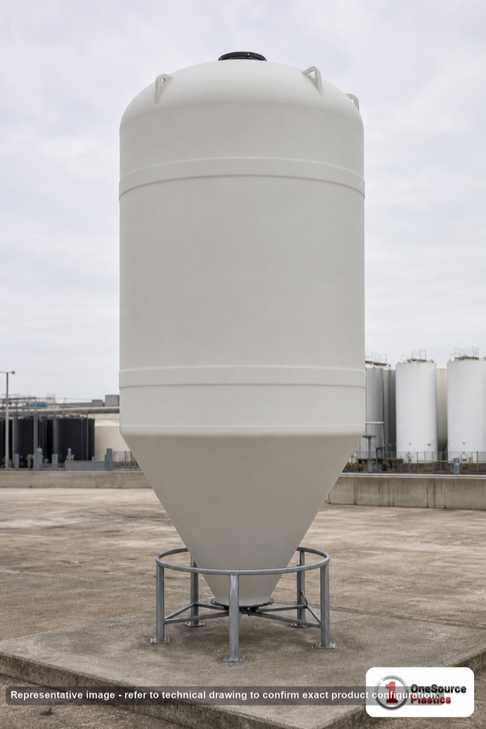
Eleven hundred pounds is the figure that places the Snyder 5200000N43 in this family. The sheet gives it as 4,400 gallons, 90 inches long, 90 inches wide and 199.5 inches tall on a 90 inch diameter, at 1,100 pounds empty and 1,100 pounds shipping, with the colour field reading White and the material field reading Polyethylene. The wall carries a specific gravity rating of 1.5, and the sheet gives 55,044 pounds of max contents against 36,696 pounds of water at 4,400 gallons and 8.34 pounds per gallon. This row publishes what several of its shellmates do not: a service limit of 100 F / 37 C and a 3 year warranty. Thirty degrees is the maker's name word for the listing and the cone degrees field is empty, so no measured angle appears here. Access is an 18 inch threaded vented manway with a lid size field of 18 inches; the outlet and inlet fields are both empty. It is moulded at Lincoln, Nebraska, ships from Nebraska, and the freight class reads 400 beside an oversize ship mode. No NMFC number, no stand and no lug count is published.
Ready to price it? The listed price is before freight; quote freight to your ZIP in a few seconds, then add to cart above or call 866-418-1777.
Where it is moulded, and why that reaches the quote before the specification does
Lincoln, Nebraska is where this tank is made, and Nebraska is the origin state on the sheet. Start there, because on a shell 199.5 inches tall the distance from that plant to your gate shapes the total figure more than most of the choices further down the page. The class reads 400 beside an oversize ship mode, and the shipping size is listed at 90 by 90 by 200 inches carrying 1,100 pounds; that is an enormous envelope around a modest weight, and it prices on the trailer space it occupies rather than on the scale ticket. So the first thing worth doing with this listing is not reading the rest of the specification. It is putting the site's own ZIP into the estimator and seeing what the lane looks like from the plains, because the answer tends to reorder people's shortlist. Two consequences follow. One is timing: an oversize move books further ahead than a pallet does, so the pad, the stand, the anchors and the pipework want to be ready to a date rather than ready in principle. The other is the receiving end, where the tank arrives lying down and is stood up by you. That needs ground clear enough to turn sixteen feet of shell, air above the trailer, and named equipment and people rather than whoever is free that afternoon. The sheet publishes no crane, no rigging, no permit and no escort detail, and none is stated on this page. Under all of that is the structure, and on a cone it is half the installation rather than an accessory. This tank has no flat floor and cannot stand on its own bottom, and this sheet publishes no stand, no legs, no skirt, no support ring and no bolt pattern, so no stand height, rated load, leg count or material is given here. The loads the structure has to answer are published and should go to whoever pours the pad: 1,100 pounds of empty tank, 36,696 pounds full of water and up to 55,044 pounds of contents at the rating, gathered onto a handful of feet inside a 90 inch circle rather than spread over a slab. This row also publishes a service limit of 100 F / 37 C, which puts shade and fill temperature into the siting conversation rather than leaving them to chance. Size the volume with the tank sizing calculator and take the freeboard discipline from the tank sizing guide before the concrete is specified.
Four capacities around one ninety inch circle
| Part | Gallons | Length x width x height | Empty weight |
|---|---|---|---|
| 5200000N43 (this tank, white, rated 1.5) | 4400 | 90 x 90 x 199.5 in | 1100 lb |
| 5200000N46 (same shell, heavier) | 4400 | 90 x 90 x 200 in | 1400 lb |
| 5200000N42 (same shell, heavy duty listing) | 4400 | 90 x 90 x 200 in | 1700 lb |
| 5200000N48 (same shell, heavy duty listing) | 4400 | 90 x 90 x 200 in | 1700 lb |
| 5180000N40 (a size down, same circle) | 4100 | 90 x 90 x 197 in | 1000 lb |
| 8050100C75501 (more gallons on a wider, shorter shell) | 4600 | 102 x 102 x 154 in | 1200 lb |
Read the height column and this table tells a straight story about buildings. Four rows stand about sixteen and a half feet tall on a 90 inch circle, one stands a little under sixteen and a half feet at 4,100 gallons, and the last stands under thirteen feet at 154 inches while holding more liquid than any of them. That last row, 8050100C75501 at 4,600 gallons on a 102 inch circle, is the answer when the roof is fixed and the floor is not; it wants a wider pad and a wider bund and it gives back nearly four feet of height. Everything else here shares the 90 inch circle, so moving between those rows leaves the pad drawing, the bund and the aisle alone. This listing's height reads 199.5 inches where its shellmates read 200; both figures are on the sheet and both are printed as given rather than rounded into agreement. Inside the 4,400 gallon group the sheet separates the rows by empty weight, 1,100 pounds here against 1,400 and 1,700 pounds, and it explains that spread nowhere, so neither does this page. The rating is what a buyer should actually be matching, and this is the 1.5 row with 55,044 pounds of max contents. That covers water, treated water and the ordinary run of process liquid no heavier than water, which is the majority of real cone bottom duty; if your product is genuinely denser, a heavier row on this shell exists for it and carries its own figures. Write down what your liquid weighs per gallon before you compare part numbers, and this decision takes a minute rather than a meeting.
Want us to check the fit? Send the site dimensions to 866-418-1777 or through a written quote request and we will confirm the tank, the pad and the freight.
The opening you fill through, and the blanks beneath it
- The fill opening: an 18 inch threaded vented manway, with the lid size field also reading 18 inches. It is the only opening this sheet dimensions, and at eighteen inches it is a working opening rather than a port, which matters when a hose end, a dip tape or an inspection light has to pass through it.
- Its vent: the vent arrives with the manway rather than as a separate specification. It is the cheapest fitting on the vessel and the one whose failure costs the most, because a sealed shell being pumped down takes the load in its wall. Keep it clear, check it whenever the tank is opened, and never blank it to control a smell.
- Reaching the opening: 199.5 inches of shell plus the stand puts it well above head height, and this sheet counts no ladder lugs and no structural attachments, so the ladder or platform goes with the structure. Land the fill at a coupling at working level rather than sending anyone up with a hose.
- Underneath: the outlet field and the inlet field are both empty on this sheet, so no discharge dimension, thread, bulkhead, drain or valve is claimed here. Give us the line size you need to land, the valve type and the product, and we will confirm what this part number carries before it is ordered.
- Whatever you do hang at the low point: it carries the column above it, and the sheet allows that column to reach 55,044 pounds. Take the weight of the valve, any reducer and the first pipe run on steelwork off the stand, never on the tank, with a flexible connector at the first joint.
- Published limits: a specific gravity rating of 1.5, 36,696 pounds of water at 4,400 gallons, 55,044 pounds of max contents, a service limit of 100 F / 37 C and a 3 year warranty. The limit and the term are on this row and not on every row of the family, which is worth knowing when two part numbers look interchangeable at a glance.
A white wall gives an operator only a rough sense of level in daylight, so the level instrument belongs in the same order as the tank rather than in next year's budget.
Water and water-weight process liquid at forty-four hundred gallons
This is the everyday row of a large family, and the rating is why. A specific gravity rating of 1.5 with 55,044 pounds of max contents covers water, treated water and the broad run of process liquid that weighs about what water weighs, and that is most of what cone bottom tanks are actually asked to hold. Process and treated water holding that still has to drain fully, liquid fertiliser and crop input blending at an agricultural retailer, polymer and coagulant make-up at a water or wastewater works, batch preparation and intermediate holding in manufacturing, wash and rinse systems emptied between runs, and buffer volume between two stages that run at different rates. At 4,400 gallons a full bulk drop lands in one vessel, and the cone means the vessel gives all of it back rather than keeping a layer on a floor that somebody has to recover before the next product goes in. The service limit is the constraint to hold on to on this row. It publishes 100 F / 37 C, and that becomes real on a hot wash, on a recovered stream that arrives warm, and on a shell standing in full southern sun through a long summer, so plan the fill temperature rather than discovering it. The other honest caution is shape rather than tank: a tall narrow column stratifies more readily than a wide shallow vessel, so if your blend wants to separate, decide the draw point and the mixing arrangement when you decide the tank. Check the liquid in our chemical compatibility reference before the gaskets and valves are chosen, because the chemistry decides the trim and the vessel does not.
Resin compatibility, line by line
Below are the liquids this resin is rated for, the concentration each rating holds to, and the fitting and gasket to specify. Check the exact concentration and temperature you run against the chemical page or the chemical compatibility database before ordering.
- Acetic Acid at 60%
- Aluminum Sulfate at 50%
- Calcium Chloride at 40%
- DEF at 32.5%
- Ferrous Sulfate at 20%
- Magnesium Chloride at 30%
- Sodium Carbonate at 30%
- Urea Solution at 50%, and Ozonated Water up to 10 PPM. Most of these call for PVC fittings with EPDM gaskets; Acetic Acid and Urea Solution accept PP or
- Ethylene Glycol
- Ferric Chloride
- Ferric Sulfate
- Hydrochloric Acid
- Hydrofluoric Acid
- Hydrofluosilicic Acid
- Hydrogen Peroxide
- Peracetic Acid
- Phosphoric Acid
- Polyaluminum Chloride
- Potassium Carbonate
- Potassium Hydroxide
- Propylene Glycol
- Sodium Bisulfate
- Sodium Bisulfite
- Sodium Hypochlorite
- Sodium Thiosulfate
- Sulfuric Acid and
- Zinc Orthophosphate. Note that Sodium Hypochlorite, Hydrochloric Acid, Hydrofluoric Acid, Hydrofluosilicic Acid, Phosphoric Acid, Sulfuric Acid, and Hydrogen
Class 400 on an oversize move, and the first fill
The freight class on this sheet reads 400 beside an oversize ship mode, and the sheet publishes no NMFC number. The shipping size is listed at 90 by 90 by 200 inches, the tank lying down, at 1,100 pounds. Run the site's own ZIP through the freight cost estimator before you commit; the listed price is before freight. Have the stand set, levelled and anchored before the trailer is due, because there is nowhere sensible to park a cone bottom tank while concrete cures and nothing about this shape leans against a wall. The sheet publishes no crane, no rigging, no permit and no escort detail, so none is described here; settle the offload equipment and the delivery window with us in advance rather than on the day. No lifting lugs are counted on this sheet, so sling under the body and never off the manway, and restrain the shell as soon as it is vertical. Then give the first fill the attention it deserves, because it is the only time you get to see the installation behave before it matters. Use clean water rather than product, hold the 36,696 pound water load, and walk the manway seal, the cone joint, the stand feet and the pad edge in that order with a torch. Leave it standing full overnight and read it again in the morning, since slow movement shows up over hours rather than minutes. Chalk the full-water line on the outside while the tape is out, and note the outlet height on the site plan at the same time; the next pipe run will want both figures and nobody will want to climb up for them twice. A photo of the tank on its pad, full, on day one is worth keeping; it is the baseline every later inspection is compared against.
Freight and documents
Ships from: Lincoln, NE. LTL freight is quoted to your ZIP with the freight cost estimator or by phone at 866-418-1777. The listed price is before freight.
Technical drawing (PDF) for Snyder Industries 5200000N43.
See this tank
Interactive 3D model with live fill. This tank has an interactive 3D model built to its manufacturer dimensions. Rotate it, and set a fill level to see how much liquid it holds at any height. Open the 3D view on the product photo above. Download the 3D model (GLB).
Product video. Watch the 4400 Gallon 30 Degree Plastic Cone Bottom Tank in White video (69 seconds) with dimensions, fittings and shipping notes.
Ready to order?
Add it to your cart at the top of this page, get LTL freight to your ZIP, request a written quote, or call 866-418-1777. The listed price is before freight.