
Brite Tanks & Carbonation
Brite Tanks & Carbonation
After fermentation does the biology, the brite tank does the polish: clarity, carbonation, and a steady supply ready to package or serve.
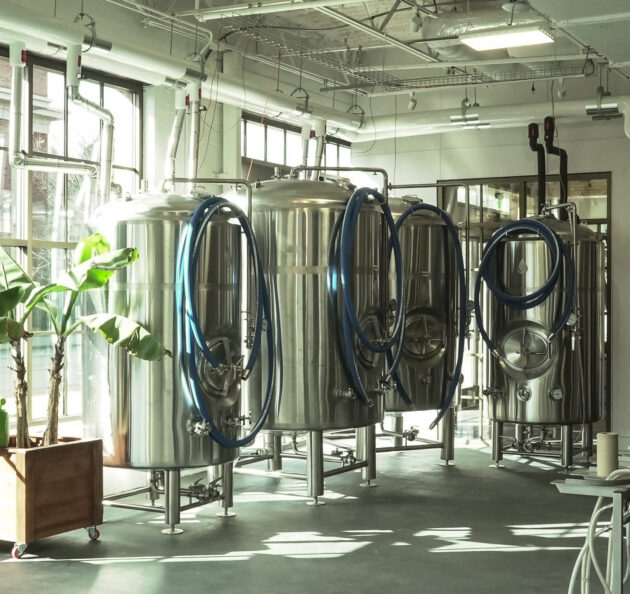
What a Brite Tank Is For
A brite tank — short for bright beer tank, sometimes called a serving or conditioning tank — receives finished, fermented product and prepares it for packaging or dispense. The name comes from the goal: brilliantly clear (bright) liquid. By the time product reaches the brite tank, fermentation is essentially complete; the brite tank's jobs are to clarify, carbonate to the target level, hold the product cold and stable, and supply a steady, pressurized source for filling kegs, cans, bottles, or serving lines.
Separating conditioning into a dedicated brite tank frees the fermenter to start its next batch. In a high-turn cellar, that hand-off is a capacity multiplier: the fermenter does fermentation, the brite tank does finishing, and neither bottlenecks the other.
Brite Tank vs Fermenter
Brite tanks and fermenters look similar — both are jacketed stainless vessels — but their designs reflect different jobs. The most important difference is the bottom. Fermenters use a steep cone to collect and harvest yeast. Brite tanks often use a shallow dish or slightly sloped bottom, because there is little yeast to harvest and a low-profile bottom maximizes usable volume and lowers tank height for a given capacity.
| Feature | Fermenter | Brite tank |
|---|---|---|
| Primary job | Active fermentation and yeast harvest | Conditioning, carbonation, and supply |
| Bottom shape | Steep cone for yeast collection | Dished or shallow-sloped for volume |
| Headspace | Generous, to contain krausen foam | Minimal, since fermentation is done |
| Carbonation | Optional via spunding | Designed for precise carbonation |
| Pressure focus | Modest, mostly for spunding | Central to function; rated for serving pressure |
The other difference is headspace. A fermenter is overbuilt with room for foam; a brite tank can be filled much closer to capacity because there is no active fermentation throwing krausen. That makes a brite tank more volume-efficient for its footprint.
Carbonation Methods
Carbonation is the brite tank's signature function: dissolving CO2 into the product to a precise, repeatable level. There are two principal approaches.
Carbonation Stone (Diffusion)
A carbonation stone is a porous sintered-metal diffuser, usually mounted low in the tank. CO2 is fed through the stone, breaking the gas into very fine bubbles that dissolve into the cold liquid as they rise. Smaller bubbles mean more gas-liquid surface area and more efficient absorption. Stone carbonation is gentle and well suited to in-tank carbonation, but it takes time and benefits from cold temperature and patience — CO2 dissolves far more readily in cold liquid.
In-Line Carbonation
In-line (flow-through) carbonation injects and dissolves CO2 as the product moves through a contact device on the way to packaging, rather than in the tank. It is fast and continuous, well suited to high-throughput packaging where carbonating a full tank by stone would be too slow. The trade is added equipment and the need for tight control of flow, pressure, and temperature to hit the target consistently.
Pressure Rating and Carbonation Safety
Because a brite tank holds carbonated product under pressure and supplies it under pressure, it is fundamentally a pressure-bearing vessel. Brite tanks carry a rated maximum allowable working pressure — commonly higher than a typical fermenter, often in the range of around 15 to 45 psi depending on design — and must include vacuum protection so they are not crushed when emptied or chilled. Vessels operating above the regulatory pressure-vessel threshold fall under ASME BPVC Section VIII and require code design and stamping.
The pressure rating is also a quality tool. Holding the product under controlled CO2 head-pressure keeps carbonation in solution during storage and dispense, so the last keg or can off the tank matches the first.
Clarity and Conditioning
Conditioning in the brite tank lets remaining haze-forming material settle out under cold, stable conditions. Time, cold temperature, and stillness do most of the work; some operations also use filtration or fining upstream to accelerate clarity. The dished bottom and side-mounted racking or outlet are positioned to draw the clear product while leaving any settled sediment behind. Hygienic design — smooth welds, tri-clamp fittings, a CIP spray ball, and full drainability — applies just as it does to a fermenter, because the brite tank is the last stainless vessel the product sees before it is packaged or served.
Where the Brite Tank Fits in the Cellar
- Finished product is transferred cold from the fermenter into the brite tank.
- Remaining haze settles under cold, stable conditions for clarity.
- CO2 is dissolved to the target level by carbonation stone or in-line carbonation.
- The tank holds the carbonated product under controlled head-pressure.
- Product is supplied under pressure to fill kegs, cans, bottles, or serving lines.
Specified well, the brite tank is the cellar's finishing station: a volume-efficient, pressure-rated, jacketed vessel that turns a fermented batch into a clear, precisely carbonated, ready-to-serve product — while keeping the fermenters free to do what only they can do.
Frequently asked questions
- What is the difference between a brite tank and a fermenter?
- A fermenter is built for active fermentation and yeast harvest, with a steep cone bottom and generous headspace for foam. A brite tank receives the finished product to condition, clarify, and carbonate it, so it typically has a shallow dished bottom for volume efficiency, minimal headspace, and a higher pressure rating for carbonation and serving. Separating the two lets the fermenter start its next batch while the brite tank finishes the last one.
- How does a carbonation stone work?
- A carbonation stone is a porous sintered-metal diffuser mounted low in the tank that breaks injected CO2 into very fine bubbles. The small bubbles create a large gas-liquid surface area so the CO2 dissolves efficiently into the cold product as it rises. Stone carbonation is gentle and well suited to in-tank carbonation, and it works best when the liquid is cold and held under pressure.
- When is in-line carbonation better than a stone?
- In-line carbonation injects and dissolves CO2 as the product flows toward packaging rather than carbonating a full tank in place, making it fast and continuous. It suits high-throughput packaging where stone-carbonating an entire tank would be too slow. The trade is additional equipment and the need for tight control of flow, pressure, and temperature to hit the carbonation target consistently.
- Does a brite tank need to be a rated pressure vessel?
- Yes. A brite tank holds and dispenses carbonated product under pressure, so it carries a rated maximum allowable working pressure and must include vacuum protection and a correctly sized pressure-relief valve. If it operates above the regulatory pressure-vessel threshold it falls under ASME BPVC Section VIII and requires code design and stamping, so always confirm the rated working pressure before applying any pressure.
Scope your custom build
Send us your volume, service chemistry, dimensions, and finish or code requirements. We return a full engineering package, firm lead time, and a fixed quote — freight quoted separately to your ZIP.
Request a Custom QuoteCall 866-418-1777