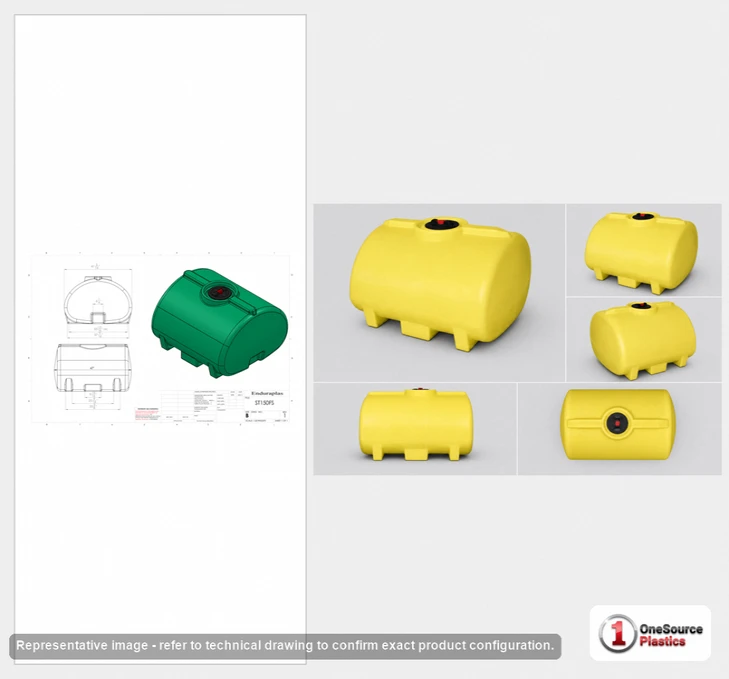
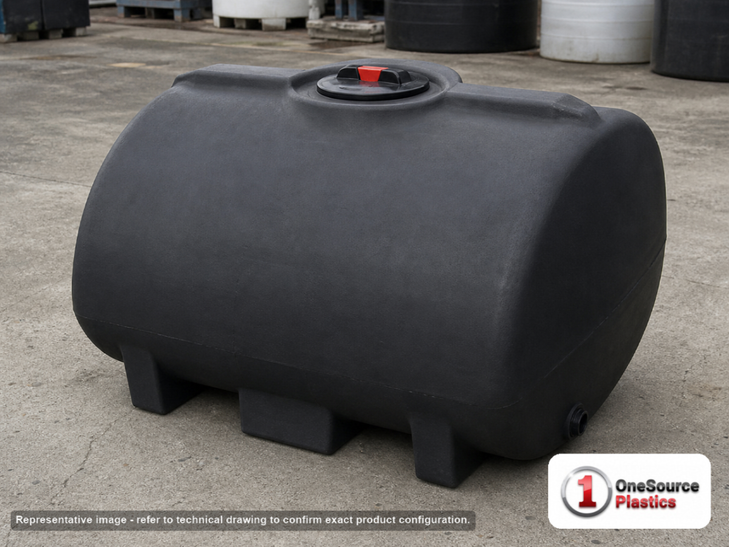
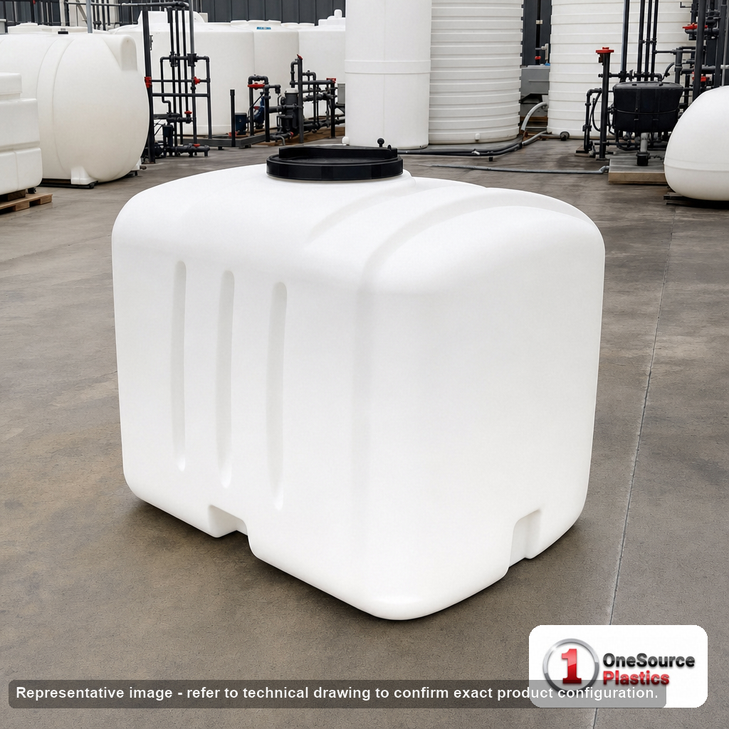
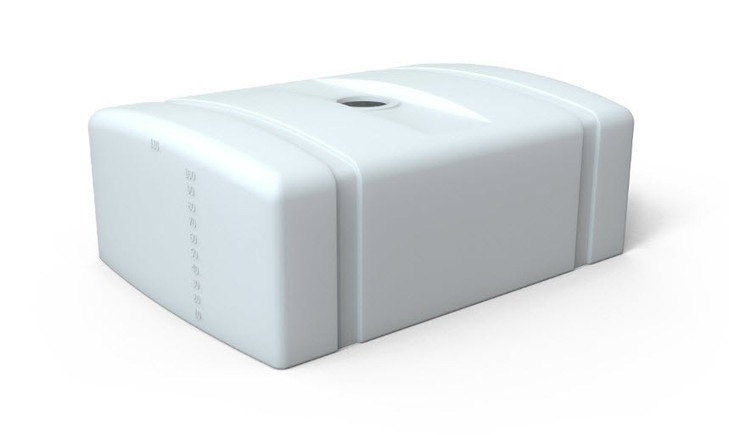
The Enduraplas 150 Gallon White Horizontal Sump Bottom Leg Tank is a 150-gallon polyethylene leg tank built for hauling liquid fertilizer, water, and a wide range of process chemicals on a trailer, skid, or pickup bed. It measures 46 inches long by 41 inches wide by 33 inches tall, with a 41.0 x 46.0 inch footprint and integral support legs that keep the load low and stable in transit. The sump bottom drains toward a single low point for near-complete drain-down between products, which matters when you are switching loads or rinsing out. The tank is molded in Natural White polyethylene.
Will this Enduraplas horizontal leg tank work for your load?
The tank carries a 1.9 specific gravity rating, so it is engineered for heavy liquids well beyond plain water. Filled with water (SG 1.0), the 150 gallons weigh roughly 1,251 pounds; at the full 1.9 SG rating the tank is built to support contents up to about 2,377 pounds. That works out to roughly 9.0 pounds per gallon at the 1.9 rating versus water's 8.34, so on any dense fertilizer or chemical load you should size your trailer axles, tongue weight, and tie-down points against the 2,377-pound figure, not the water number. If you are not sure how a denser product changes the math, run your liquid through the Tank Sizing Calculator and review the Tank Sizing Guide. The horizontal leg design lowers the center of gravity compared with a vertical tank of the same volume, which is why this style is a favorite for field fertilizer and applicator setups.
Chemical compatibility
This tank is a heavy-wall 1.9 specific gravity polyethylene vessel. Our resin records list it as HDLPE, but the resin designation still carries a question mark, so confirm HDLPE versus XLPE with us at 866-418-1777 before putting it into chemical service, especially with oxidizers. The tank ships without fittings, bulkheads, or gaskets, so the hardware below is spec'd separately to your chemical, not included with the tank. The chemicals listed are drawn from the OEM chemical-resistance chart and call out the fitting and gasket materials proven for each. Always verify against the chart for your exact concentration and operating temperature.
- Acetic Acid 60% — PP/PVC fittings, EPDM gaskets
- Aluminum Sulfate 50% — PVC fittings, EPDM gaskets
- Calcium Chloride 40% — PVC fittings, EPDM gaskets
- DEF 32.5% — 316SS fittings, EPDM gaskets
- Ethylene Glycol 100% — PVC fittings, EPDM gaskets
- Ferric Chloride 50% — PVC fittings, EPDM gaskets
- Ferric Sulfate 60% — PVC fittings, EPDM gaskets
- Ferrous Sulfate 20% — PVC fittings, EPDM gaskets
- Hydrochloric Acid 37% — PVC fittings, Viton gaskets
- Hydrofluoric Acid 48% — PP/PVC fittings, Viton gaskets
- Hydrofluosilicic Acid 26% — PP/PVC fittings, Viton gaskets
- Hydrogen Peroxide 50% — PVC fittings, Viton gaskets
- Magnesium Chloride 30% — PVC fittings, EPDM gaskets
- Peracetic Acid 30% — 316SS fittings, Aflas gaskets
- Phosphoric Acid 85% — PVC fittings, Viton gaskets
- Polyaluminum Chloride — PVC fittings, EPDM gaskets
- Potassium Carbonate 50% — PVC fittings, EPDM gaskets
- Potassium Hydroxide (saturated) — PVC fittings, EPDM gaskets
- Propylene Glycol — PP/316SS fittings, EPDM gaskets
- Sodium Bisulfate — PVC/PP fittings, EPDM gaskets
- Sodium Bisulfite — PVC/PP fittings, EPDM gaskets
- Sodium Carbonate 30% — PVC fittings, EPDM gaskets
- Sodium Hypochlorite (under 16.5%) — PVC fittings, Viton gaskets
- Sodium Thiosulfate 40% — PVC fittings, EPDM gaskets
- Sulfuric Acid 98% — CPVC fittings, Viton gaskets
- Urea Solution 50% — PP/PVC fittings, EPDM gaskets
- Zinc Orthophosphate — PP/316SS fittings, EPDM gaskets
- Ozonated Water (up to 10 PPM) — PVC fittings, EPDM gaskets
For the full picture, see our chemical compatibility resource. A working rule for this tank: EPDM gaskets cover most of the salts and bases on the list, Viton is required for the oxidizers and strong acids (hydrochloric, hydrofluoric, hydrofluosilicic, hydrogen peroxide, phosphoric, sulfuric, sodium hypochlorite), and Aflas is needed only for peracetic acid. Watch the metal-hardware exceptions too: DEF and peracetic acid call for 316SS fittings, and propylene glycol and zinc orthophosphate run PP/316SS, so plastic fittings will not do for those four. The most common mistake on a 1.9 SG tank like this is reusing EPDM hardware across a chemical change and getting gasket failure on an oxidizer load.
Freight and ordering
This tank ships LTL freight from the Enduraplas plant in Neche, ND, and freight is quoted live to your ZIP. Get your number in seconds with the Freight Cost Estimator, or call us at 866-418-1777 and we will quote it for you. If you are spec'ing this for fertilizer hauling, our guides on applicator and leg tanks for fertilizer, portable utility tanks and the 49 CFR ag exemption, and fertilizer-blend tank stratification cover the DOT and mixing details that catch people off guard. Confirm dimensions against your trailer before you order.
Freight and documents
Ships from: Neche, ND. LTL freight is quoted to your ZIP with the freight cost estimator or by phone at 866-418-1777. The listed price is before freight.
See this tank
Interactive 3D model with live fill. This tank has an interactive 3D model built to its manufacturer dimensions. Rotate it, and set a fill level to see how much liquid it holds at any height. Open the 3D view on the product photo above. Download the 3D model (GLB).
Product video. Watch the Enduraplas 150 Gallon White Horizontal Sump Bottom Leg Tank video (68 seconds) with dimensions, fittings and shipping notes.
Ready to order?
Add it to your cart at the top of this page, get LTL freight to your ZIP, request a written quote, or call 866-418-1777. The listed price is before freight.