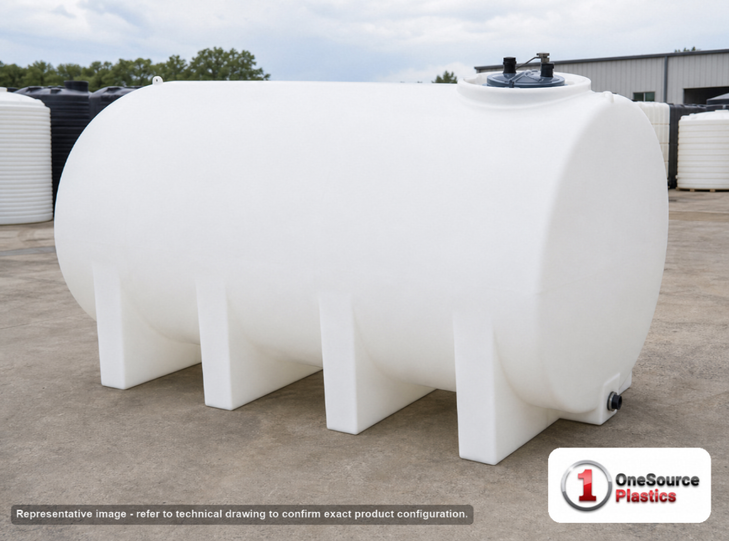
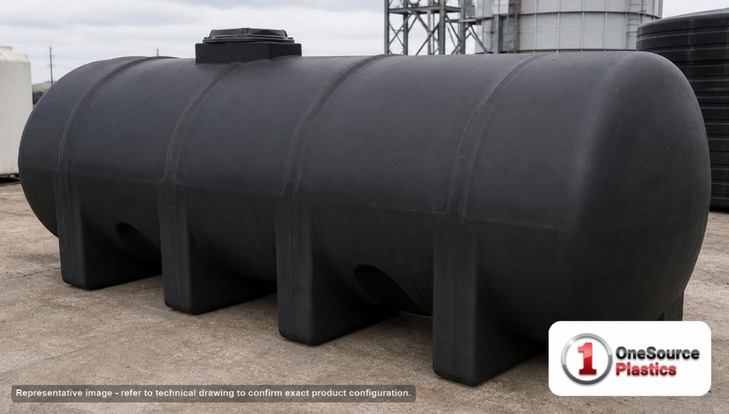
The Enduraplas 2200 Gallon White Horizontal Leg Tank (THF02200W) is a 2,200-gallon natural white polyethylene horizontal leg tank built for hauling and field transfer where you need the load to sit low and stable.It measures 130 inches long by 71 inches wide by 72 inches tall, riding on integrated legs so the tank cradles on a trailer or skid without a separate saddle.The natural white wall is translucent enough to eyeball the liquid level through the side, which matters on a transfer tank you load to weight rather than to volume.With a 1.9 specific gravity rating, it carries heavier liquids than a water-only tank, which is what makes it a workhorse for agricultural and chemical transport rather than just a horizontal water tank.
Will it work for your load?
Sizing is where horizontal leg tanks catch people off guard, so run the real numbers before you spec a trailer.Filled with water (specific gravity 1.9), the contents alone weigh about 18,348 pounds.At the tank's full 1.9 SG rating, the maximum rated contents weight climbs to roughly 34,861 pounds.That is the figure that drives your trailer rating, axle count, and tie-down plan, and it is why a "2,200 gallon" tank is never just about gallons.The footprint is 71.0 x 130.0 inches, so confirm your deck length and width before ordering.Use the Tank Sizing Calculator to match liquid weight to your equipment, and the Tank Sizing Guide if you are sizing a fleet.For DOT classification on farm and applicator use, the applicator and leg tank fertilizer guide and the loaf-style portable utility tank agricultural exemption breakdown are worth reading first.Factory fitting configuration is not listed in our specs for this model, so check the technical drawing on this page for fill, vent, and outlet locations, and call to confirm outlet size before you plumb it.
Chemical compatibility
This tank is molded in high-density linear polyethylene (HDLPE) with a 1.9 specific gravity rating, which covers the dense liquids most haul applications throw at it.Because the resin grade reads HDLPE pending confirmation, verify HDLPE versus cross-linked (XLPE) construction with our team before any chemical service.Always size to specific gravity: at SG 1.9 this tank handles concentrated and heavy solutions, but the right fittings and gaskets matter as much as the tank wall.Verified compatible chemicals from our chemical-resistance reference (concentration- and temperature-specific) include sulfuric acid (98%, CPVC fittings, Viton gaskets), hydrochloric acid (37%, PVC, Viton), phosphoric acid (85%, PVC, Viton), hydrofluoric acid (48%, PP/PVC, Viton), hydrofluosilicic acid (26%, PP/PVC, Viton), sodium hypochlorite (<16.5%, PVC, Viton), hydrogen peroxide (50%, PVC, Viton), ferric chloride (50%, PVC, EPDM), ferric sulfate (60%, PVC, EPDM), ferrous sulfate (20%, PVC, EPDM), aluminum sulfate (50%, PVC, EPDM), calcium chloride (40%, PVC, EPDM), magnesium chloride (30%, PVC, EPDM), acetic acid (60%, PP/PVC, EPDM), peracetic acid (30%, 316SS, Aflas), ethylene glycol (100%, PVC, EPDM), propylene glycol (PP/316SS, EPDM), urea solution (50%, PP/PVC, EPDM), potassium hydroxide (saturated, PVC, EPDM), potassium carbonate (50%, PVC, EPDM), sodium carbonate (30%, PVC, EPDM), sodium thiosulfate (40%, PVC, EPDM), sodium bisulfate (PVC/PP, EPDM), sodium bisulfite (PVC/PP, EPDM), polyaluminum chloride (PVC, EPDM), zinc orthophosphate (PP/316SS, EPDM), DEF (32.5%, 316SS fittings, EPDM), and ozonated water (up to 10 PPM, PVC, EPDM).One that trips people up: DEF needs 316 stainless fittings, not PVC, so do not carry over the PVC hardware you would use for a salt brine.Match every fitting and gasket material to the chemical, not just the tank, and always confirm against the chemical-resistance chart for your exact concentration and temperature.See our full chemical compatibility reference before finalizing service.
The mistake to avoid
The costly error on a haul tank like this is filling a heavy product to volume instead of to weight.The 1.9 SG rating is the ceiling, not a recommendation to brim every load.A trailer rated for water will be badly overloaded long before this tank is full of fertilizer or a dense acid, and over-trailering is how leg tanks crack at the saddle.Spec your equipment to the 34,861-pound rated maximum, then load to your actual product density and watch the level through the translucent wall.Stratification is also a real field problem with blended fertilizer in a horizontal tank, so review fertilizer-blend tank stratification if you are mixing on board.Check the technical drawing on this page for leg layout and fitting locations before mounting.
This horizontal leg tank ships LTL freight from the Enduraplas plant in Neche, North Dakota, quoted live to your ZIP, so buyers in the South and Southwest should run the lane before committing.Get an exact number with the Freight Cost Estimator, or call 866-418-1777 and our team will quote the haul and help you confirm fitting materials and trailer fit for your product.
Freight and documents
Ships from: Neche, ND. LTL freight is quoted to your ZIP with the freight cost estimator or by phone at 866-418-1777. The listed price is before freight.
See this tank
Interactive 3D model with live fill. This tank has an interactive 3D model built to its manufacturer dimensions. Rotate it, and set a fill level to see how much liquid it holds at any height. Open the 3D view on the product photo above. Download the 3D model (GLB).
Product video. Watch the Enduraplas 2200 Gallon White Horizontal Leg Tank video (63 seconds) with dimensions, fittings and shipping notes.
Ready to order?
Add it to your cart at the top of this page, get LTL freight to your ZIP, request a written quote, or call 866-418-1777. The listed price is before freight.