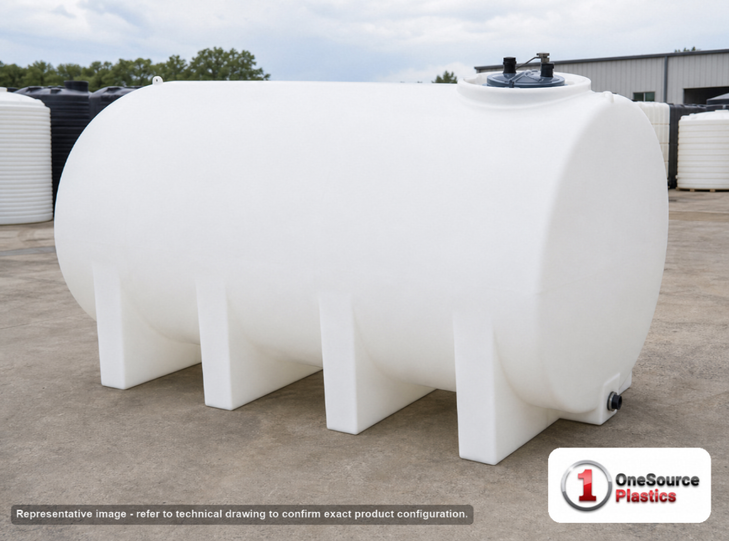
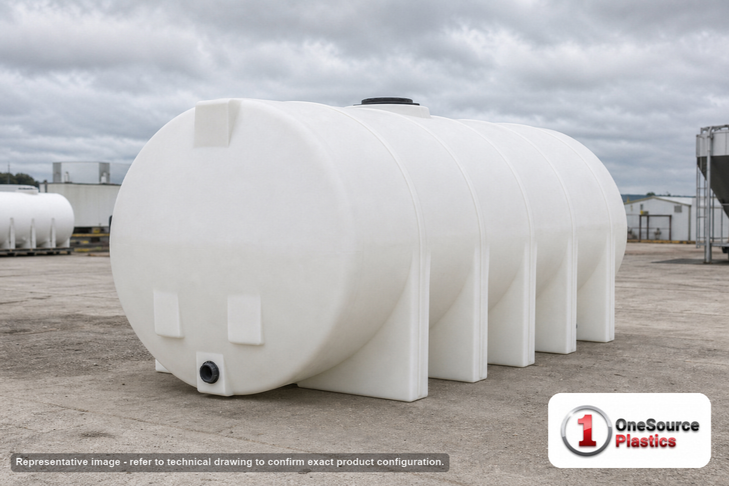
The Enduraplas 2500 Gallon White Horizontal Sump Bottom Leg Tank w/ Frame is a 2,500-gallon transport and storage tank built for moving liquid by the load. It measures 78 in. high, 87 in. wide, and 130 in. long, riding on an integrated frame with a sump bottom that drains to the low point so you empty the load fully instead of leaving product trapped in the belly. The polyethylene shell carries a 1.9 specific gravity rating - the high-density number you want when contents are heavier than water, which is why a horizontal leg tank like this is specified for fertilizer hauling and dense chemical service rather than the 1.0-1.5 ratings on lighter water tanks. One caveat up front: our data reads the resin as HDLPE with a question mark, so confirm HDLPE vs XLPE construction with us before any chemical service - the two crosslink differently and that distinction governs what you can store.
Will it work for your load?
Sizing comes down to weight, not just gallons. Filled with water this tank carries roughly 20,850 lb of contents, and at its 1.9 specific gravity ceiling it is rated to a maximum contents weight of about 39,615 lb - so before you fill, multiply your liquid's actual specific gravity by the volume and confirm the trailer, frame, and ground beneath it are rated for that load. A 2,500-gallon batch of a 1.9 SG product is a far heavier proposition than 2,500 gallons of water. The footprint runs 87.0 x 130.0 in., so plan the pad, trailer deck, or skid accordingly. Fitting and sump-outlet configuration is not listed in our data - confirm manhole, fill, vent, and drain sizes with us before ordering valves and plumbing. If you are sizing across a fleet, run the numbers through our Tank Sizing Calculator and read the Tank Sizing Guide before you commit to a capacity.
Chemical compatibility
This is a polyethylene tank carried at a 1.9 specific gravity rating, with the HDLPE vs XLPE resin question above to settle first. The OEM chemical-resistance chart is concentration- and temperature-specific, so match your exact strength and operating temperature before ordering fittings. Within that chart, this tank is shown compatible with chemicals including Acetic Acid (60%, PP/PVC fittings, EPDM gaskets), Aluminum Sulfate (50%, PVC, EPDM), Calcium Chloride (40%, PVC, EPDM), DEF at 32.5% (316SS fittings, EPDM gaskets), Ethylene Glycol (100%, PVC, EPDM), Ferric Chloride (50%, PVC, EPDM), Ferric Sulfate (60%, PVC, EPDM), Ferrous Sulfate (20%, PVC, EPDM), Hydrochloric Acid (37%, PVC, Viton), Hydrofluoric Acid (48%, PP/PVC, Viton), Hydrofluosilicic Acid (26%, PP/PVC, Viton), Hydrogen Peroxide (50%, PVC, Viton), Magnesium Chloride (30%, PVC, EPDM), Peracetic Acid (30%, 316SS fittings, Aflas gaskets), Phosphoric Acid (85%, PVC, Viton), Polyaluminum Chloride (PVC, EPDM), Potassium Carbonate (50%, PVC, EPDM), Potassium Hydroxide (saturated, PVC, EPDM), Propylene Glycol (PP/316SS, EPDM), Sodium Bisulfate (PVC/PP, EPDM), Sodium Bisulfite (PVC/PP, EPDM), Sodium Carbonate (30%, PVC, EPDM), Sodium Hypochlorite (under 16.5%, PVC, Viton), Sodium Thiosulfate (40%, PVC, EPDM), Sulfuric Acid (98%, CPVC fittings, Viton gaskets), Urea Solution (50%, PP/PVC, EPDM), Zinc Orthophosphate (PP/316SS, EPDM), and Ozonated Water (up to 10 PPM, PVC, EPDM). Match the fitting and gasket material to your specific chemical - the aggressive oxidizers and strong acids here call for Viton or Aflas rather than EPDM, and DEF and peracetic acid call for 316 stainless fittings. See each chemical's page under our chemical compatibility reference - for example Sulfuric Acid or Sodium Hypochlorite - and confirm concentration and temperature against the OEM chart before service. (An ozonated-water reference page is not yet available, so confirm that one with us directly.) The 1.9 SG rating is this configuration's rated ceiling and the high-density option here; for products denser than that, contact us rather than assuming headroom.
The mistake to avoid
The single most common error on a tank like this is treating the 1.9 specific gravity rating as a license to fill it with anything. The rating means the shell can structurally carry contents up to 1.9 times the weight of water; it does not mean every 1.9-or-lower chemical is chemically compatible, and it does not mean you can ignore the resin question. Verify in order: HDLPE vs XLPE construction, the chemical against the concentration-specific OEM chart, and the total filled weight against your trailer and frame rating. And because a loaded 1.9 SG tank can reach nearly 39,615 lb, confirm DOT and non-roadable-trailer scope for your specific use before any road transport - the guides below explain that scope but do not make this tank road-legal as configured. Skipping the weight math is how a horizontal leg tank gets overloaded on the road.
This tank ships LTL freight from the Enduraplas plant in Neche, North Dakota, with the rate quoted live to your ZIP code. Get your number from our Freight Cost Estimator, or call 866-418-1777 and we will quote it for you. For fertilizer and DOT-scope guidance on horizontal leg tanks, see our guides on applicator and leg tanks for fertilizer and fertilizer-blend tank stratification.
Freight and documents
Ships from: Neche, ND. LTL freight is quoted to your ZIP with the freight cost estimator or by phone at 866-418-1777. The listed price is before freight.
Technical drawing (PDF) for Enduraplas THD02500KW.
See this tank
Interactive 3D model with live fill. This tank has an interactive 3D model built to its manufacturer dimensions. Rotate it, and set a fill level to see how much liquid it holds at any height. Open the 3D view on the product photo above. Download the 3D model (GLB).
Ready to order?
Add it to your cart at the top of this page, get LTL freight to your ZIP, request a written quote, or call 866-418-1777. The listed price is before freight.