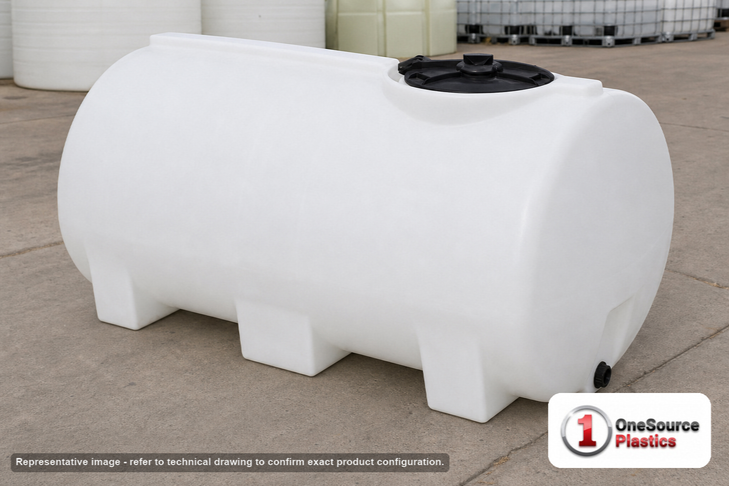
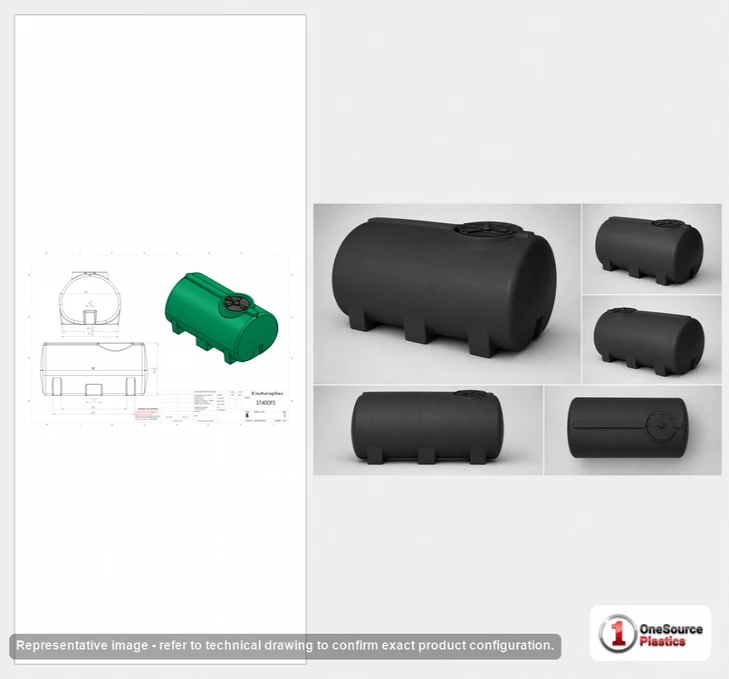
The Enduraplas 400 Gallon Green Horizontal Sump Bottom Leg Tank (SKU THD00400G) is a low-slung polyethylene haul tank built to carry liquid down the road on a trailer or skid without the high center of gravity that makes upright tanks dangerous in transit.It holds 400 gallons inside a 42-inch-tall body measuring 46 inches wide by 74 inches long, and the molded leg design lets the tank sit flat across its legs.The wall is rated to a 1.9 specific gravity, which is what makes this a real chemical and fertilizer hauler rather than a water-only tote.The molded sump bottom drains to a low point, so the tank empties more completely between loads and chemicals - useful when you reuse the same tank across the different products in the compatibility list below.
Will it work for your load?
Match the contents to the wall, not just the gallons.Filled with plain water this horizontal tank carries 3,336 pounds, but the polyethylene is rated to handle up to 6,338 pounds of contents at its 1.9 specific gravity ceiling.That spread is the whole point of a 1.9 SG horizontal leg tank: you can run dense fertilizer blends and heavy chemical solutions that a 1.9 SG tank is not rated to hold.That 1.9 SG rating is a 70F figure, so derate it for warm fertilizer or heated chemical service before you size to the maximum.Before you commit a load, run the numbers through the Tank Sizing Calculator and read the Tank Sizing Guide so the trailer axle rating and the tank rating agree.The 46-by-74-inch footprint also tells you the deck size you need to support the tank fully across its legs.
Chemical compatibility
The specific gravity rating of 1.9 is confirmed, but the exact resin type is not in our records, so confirm with us or the OEM whether this tank is high-density linear (HDLPE) or cross-linked (XLPE) polyethylene before any chemical fill - the two resins do not handle every chemical the same way.The chemicals below are listed as compatible in our compatibility data, and that compatibility is always concentration- and temperature-specific, so verify your exact strength and operating temperature before filling:
- Acetic Acid (60%) - PP/PVC fittings, EPDM gaskets - details
- Aluminum Sulfate (50%) - PVC fittings, EPDM gaskets - details
- Calcium Chloride (40%) - PVC fittings, EPDM gaskets - details
- DEF (32.5%) - 316SS fittings, EPDM gaskets - details
- Ethylene Glycol (100%) - PVC fittings, EPDM gaskets - details
- Ferric Chloride (50%) - PVC fittings, EPDM gaskets - details
- Ferric Sulfate (60%) - PVC fittings, EPDM gaskets - details
- Ferrous Sulfate (20%) - PVC fittings, EPDM gaskets - details
- Hydrochloric Acid (37%) - PVC fittings, Viton gaskets - details
- Hydrofluoric Acid (48%) - PP/PVC fittings, Viton gaskets - details
- Hydrofluosilicic Acid (26%) - PP/PVC fittings, Viton gaskets - details
- Hydrogen Peroxide (50%) - PVC fittings, Viton gaskets - details
- Magnesium Chloride (30%) - PVC fittings, EPDM gaskets - details
- Peracetic Acid (30%) - 316SS fittings, Aflas gaskets - details
- Phosphoric Acid (85%) - PVC fittings, Viton gaskets - details
- Polyaluminum Chloride - PVC fittings, EPDM gaskets - details
- Potassium Carbonate (50%) - PVC fittings, EPDM gaskets - details
- Potassium Hydroxide (Saturated) - PVC fittings, EPDM gaskets - details
- Propylene Glycol - PP/316SS fittings, EPDM gaskets - details
- Sodium Bisulfate - PVC/PP fittings, EPDM gaskets - details
- Sodium Bisulfite - PVC/PP fittings, EPDM gaskets - details
- Sodium Carbonate (30%) - PVC fittings, EPDM gaskets - details
- Sodium Hypochlorite (<16.5%) - PVC fittings, Viton gaskets - details
- Sodium Thiosulfate (40%) - PVC fittings, EPDM gaskets - details
- Sulfuric Acid (98%) - CPVC fittings, Viton gaskets - details
- Urea Solution (50%) - PP/PVC fittings, EPDM gaskets - details
- Zinc Orthophosphate - PP/316SS fittings, EPDM gaskets - details
- Ozonated Water (up to 10 PPM) - PVC fittings, EPDM gaskets
Do not default to standard EPDM bulkhead fittings on this tank.Match the wetted hardware to YOUR chemical from the rows above - Sulfuric Acid at 98% calls for CPVC with Viton, the acids like Hydrochloric and Phosphoric call for Viton, Peracetic Acid calls for Aflas, and DEF and Peracetic Acid both call for 316 stainless.Reuse the wrong plastic or gasket and the fitting will fail fast even though the tank wall holds.Every figure here is concentration- and temperature-specific per the OEM chemical-resistance chart; for a full breakdown of any of these, see the chemical compatibility hub.
The mistake to avoid
The single most common error on a 1.9 SG hauler is treating the gallon number as the limit.The real limit is weight, not volume - a full load can put up to 6,338 pounds of contents on your trailer, and if your axles and tongue weight are not rated for that you have an overweight problem before you leave the yard.Pair that with the resin question above: confirm HDLPE versus XLPE before any chemical fill, and do not assume potable or food-grade duty.If you are spec'ing this for fertilizer or DOT-relevant transport, the guides on applicator and leg tanks for fertilizer, portable utility tank DOT classification, and fertilizer-blend stratification walk through the field details.
This horizontal leg tank ships LTL freight from the Enduraplas plant in Neche, North Dakota, quoted live to your ZIP - get your number from the Freight Cost Estimator or call 866-418-1777.Because it ships from North Dakota, buyers in the upper Midwest and northern plains typically see the best freight on this 400 gallon horizontal tank; the farther south you are, the more the LTL lane will add, so quote it before you finalize the build.
Freight and documents
Ships from: Neche, ND. LTL freight is quoted to your ZIP with the freight cost estimator or by phone at 866-418-1777. The listed price is before freight.
Technical drawing (PDF) for Enduraplas THD00400G.
See this tank
Interactive 3D model with live fill. This tank has an interactive 3D model built to its manufacturer dimensions. Rotate it, and set a fill level to see how much liquid it holds at any height. Open the 3D view on the product photo above. Download the 3D model (GLB).
Product video. Watch the Enduraplas 400 Gallon Green Horizontal Sump Bottom Leg Tank video (62 seconds) with dimensions, fittings and shipping notes.
Ready to order?
Add it to your cart at the top of this page, get LTL freight to your ZIP, request a written quote, or call 866-418-1777. The listed price is before freight.