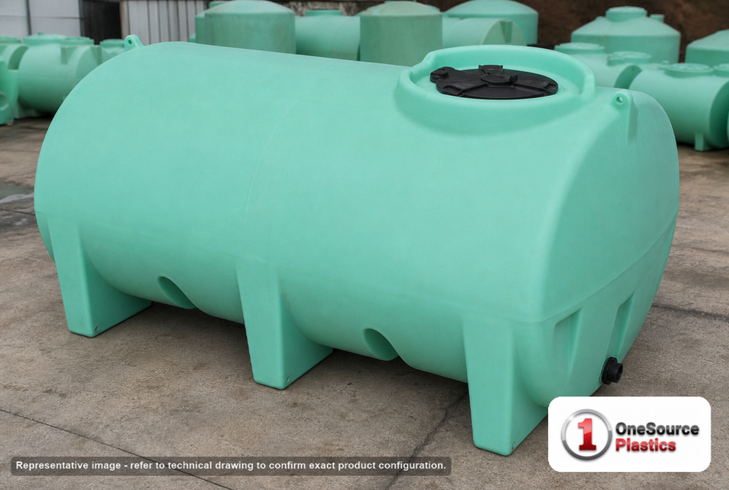
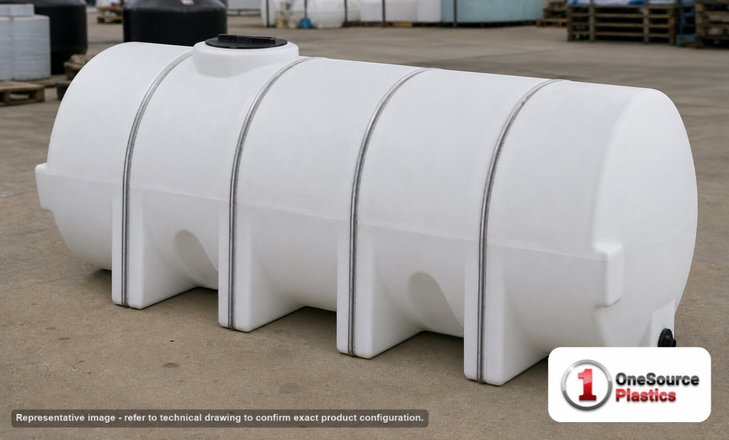
The Enduraplas 800 Gallon Green Horizontal Sump Bottom Leg Tank is a transport-oriented poly tank built for hauling water and chemical loads down rough field roads, then drawing the last of the contents out through its sump bottom. The horizontal leg-tank body sits on integrated legs for a stable cradle in a skid or trailer, and the sump bottom pitches the liquid toward the lowest point for a cleaner draw-down at the end of a run. It holds 800 gallons, measures 94 inches long by 60 inches wide by 55 inches high, and is molded in green polyethylene with a 1.9 specific gravity rating - a heavy-duty rating that lets it carry dense agricultural and industrial chemistries, not just water.
Will this horizontal leg tank work for your load?
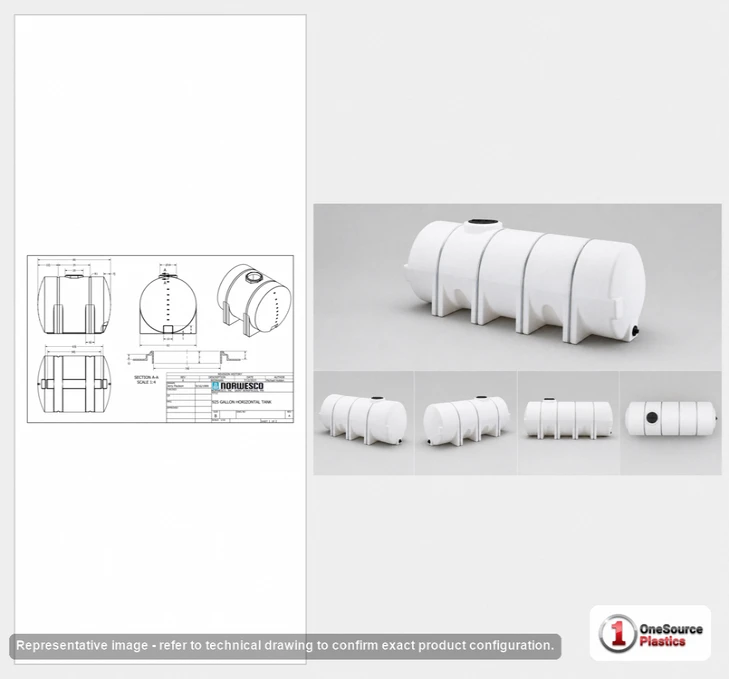
Start with weight, because that is what decides whether your trailer, skid, and tie-downs are rated for the job. Filled with water this tank carries about 6,672 pounds of contents; at its full 1.9 specific-gravity rating it is built to hold up to 12,677 pounds of product - roughly 6,000 pounds more than water. That gap is the real failure mode: a deck and strap system sized only for water is under-rated by nearly half once you load a dense chemistry. The footprint is 60.0 x 94.0 inches and the tank stands 55 inches tall, so plan your mounting deck, strap points, overhead clearance, and loaded center-of-gravity around that 60 x 94 in span plus a 55 in stack height before you order. If you are matching tank capacity to a spray or fertilizer program, the Tank Sizing Calculator and Tank Sizing Guide walk you through translating gallons-per-acre into the right tank, and because this tank ships from a single North Dakota point, run the Freight Cost Estimator early to see your LTL cost to ZIP. For the regulatory side of running a horizontal tank on a non-roadable trailer, our guide on applicator and leg tanks for fertilizer and the companion piece on portable utility tanks and the agricultural exemption explain DOT classification and farm-fleet scope. See the technical drawing on this page for the sump detail and fitting locations - factory fitting count and sizes are not in our data, so confirm them by phone before ordering.
Chemical compatibility
This tank is molded polyethylene rated to 1.9 specific gravity, which is what allows it to carry dense chemistries rather than water alone. The resin grade is flagged for confirmation in our data, so confirm whether it is HDLPE or XLPE before committing it to chemical service - the distinction drives chemical resistance. When you spec fittings and gaskets, match the wetted materials to the product; the materials below come from the OEM chemical-resistance chart and are concentration- and temperature-specific, so verify your exact concentration and operating temperature before service.
Verified-compatible chemistries for this 1.9 SG tank include Acetic Acid (60%, PP/PVC fittings, EPDM gaskets), Aluminum Sulfate (50%, PVC, EPDM), Calcium Chloride (40%, PVC, EPDM), DEF (32.5%, 316SS, EPDM), Ethylene Glycol (100%, PVC, EPDM), Ferric Chloride (50%, PVC, EPDM), Ferric Sulfate (60%, PVC, EPDM), Ferrous Sulfate (20%, PVC, EPDM), Hydrochloric Acid (37%, PVC, Viton), Hydrofluoric Acid (48%, PP/PVC, Viton), Hydrofluosilicic Acid (26%, PP/PVC, Viton), Hydrogen Peroxide (50%, PVC, Viton), Magnesium Chloride (30%, PVC, EPDM), Peracetic Acid (30%, 316SS, Aflas), Phosphoric Acid (85%, PVC, Viton), Polyaluminum Chloride (PVC, EPDM), Potassium Carbonate (50%, PVC, EPDM), Potassium Hydroxide (saturated, PVC, EPDM), Propylene Glycol (PP/316SS, EPDM), Sodium Bisulfate (PVC/PP, EPDM), Sodium Bisulfite (PVC/PP, EPDM), Sodium Carbonate (30%, PVC, EPDM), Sodium Hypochlorite (under 16.5%, PVC, Viton), Sodium Thiosulfate (40%, PVC, EPDM), Sulfuric Acid (98%, CPVC, Viton), Urea Solution (50%, PP/PVC, EPDM), Zinc Orthophosphate (PP/316SS, EPDM), and Ozonated Water (up to 10 PPM, PVC, EPDM). Several of these - Polyaluminum Chloride, Propylene Glycol, Sodium Bisulfate, Sodium Bisulfite, and Zinc Orthophosphate - carry no reference concentration in our data, so confirm your working concentration before relying on the listed fitting and gasket pairing. Always cross-check your specific chemical, concentration, and temperature on the OEM chemical-resistance chart and our chemical compatibility reference before service.
The mistake to avoid
The common error on a 1.9 SG tank is fitting-material drift. Read the gasket column carefully: several of the harsher chemistries above call for Viton or Aflas rather than the default EPDM, and an acid like sulfuric steps up to CPVC fittings while DEF and peracetic acid call for 316SS. Putting an EPDM gasket on a Viton-required service, or a PVC fitting where the chart calls for 316SS, is what causes weeping fittings and premature failures - not the tank wall. The 1.9 SG rating governs the density of liquid the tank body can carry; it does not make every wetted accessory compatible. Confirm the resin grade, then match every fitting and gasket to the chart for your exact product.
This tank ships LTL freight from the Enduraplas plant in Neche, ND, the named shipping point, with freight quoted live to your ZIP. Get your freight estimate with the Freight Cost Estimator, or call us at 866-418-1777 to confirm fittings, the resin grade, and routing before you order.
Freight and documents
Ships from: Neche, ND. LTL freight is quoted to your ZIP with the freight cost estimator or by phone at 866-418-1777. The listed price is before freight.
Technical drawing (PDF) for Enduraplas THD00800G.
See this tank
Interactive 3D model with live fill. This tank has an interactive 3D model built to its manufacturer dimensions. Rotate it, and set a fill level to see how much liquid it holds at any height. Open the 3D view on the product photo above. Download the 3D model (GLB).
Product video. Watch the Enduraplas 800 Gallon Green Horizontal Sump Bottom Leg Tank video (64 seconds) with dimensions, fittings and shipping notes.
Ready to order?
Add it to your cart at the top of this page, get LTL freight to your ZIP, or call 866-418-1777. The listed price is before freight.