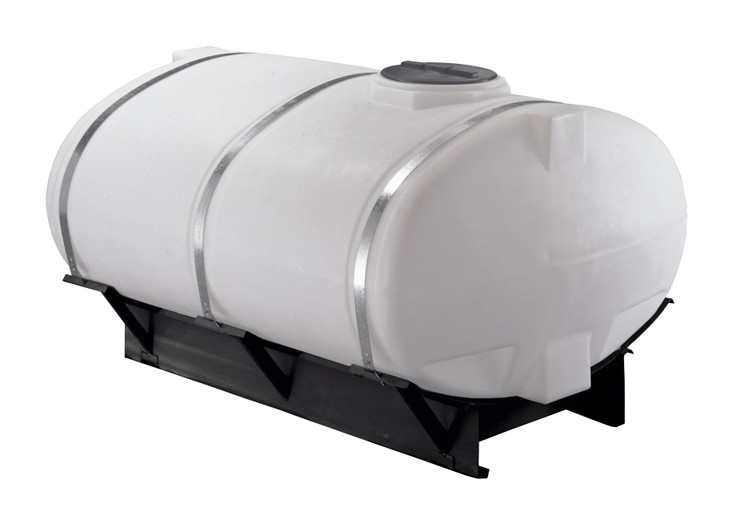
750 gallons with securing hoops, nine feet nine inches of body
The Snyder SII-1300000C26 is a 750 gallon horizontal leg tank with securing hoops, in white polyethylene, 117 inches long, 46 inches wide and 48 inches tall, listed at 210 pounds empty and 210 pounds to ship, molded at Lincoln, Nebraska. It stands on its own molded feet, so it needs no cradle and no stand, and the sheet names the securing hoops as part of what it is. The wall is rated at a specific gravity of 1.9, which is where the 11,884 pound maximum contents figure comes from, against 6,255 pounds for 750 gallons of water at 8.34 pounds per gallon. It carries a 2 inch outlet and an 18 inch lid, with a service limit of 120 F / 48 C. Freight is class OVS. The sheet publishes no warranty term for this part number, so this page states none; ask us and we will get Snyder's current terms in writing.
Ordering for a plant or a bid? Request a written quote with freight to your ZIP for the file; a single 750 gallon tank goes straight to the cart above.
The hoops decide the mount: strapping a 117 inch tank to a deck
Nine feet nine inches of tank, 46 inches wide and 48 inches tall, is a long, low, narrow body, and the hoops named on the sheet are the reason it is easy to tie down. A hooped tank gives the strapping a defined path across the crown instead of leaving the installer to guess where a band will sit and whether it will walk under load, which on a body this long is the difference between a mount that holds for years and one that chafes a flat spot into the wall in a season. Where it belongs is a flat deck: a tandem-axle trailer, a flat-bed truck body, a long skid frame that a telehandler sets down as a unit, or a yard slab where it stands as a stationary supply. The proportions are the selling point. At 46 inches wide it will go down the middle of a deck with room either side for a pump pack, a hose reel, a generator or a toolbox, and at 48 inches tall it keeps the load low, which is what a driver feels on a corner and what a trailer's springs feel on a rough field entrance. What it costs is length, and 117 inches of tank needs a deck that long before anything else goes on it. Underneath, level and continuous carries the whole argument. A rotationally molded floor bears on the whole surface it touches and nothing else, so a rib, a raised lip, a broken deck board or a hollow becomes the bearing point for 6,255 pounds of water, or up to 11,884 pounds of contents at the rating, instead of the feet sharing it. Deck it out flat with a mat, plywood or a timber frame that follows the feet. Then design for surge, because a 117 inch body gives 750 gallons a long run and the wave under braking is worst at part-full: restrain it fore and aft as well as across, through the feet and the hoops rather than a pair of ratchet straps thrown over the top. How leg and applicator tanks are classified once they travel, and what an agricultural exemption covers, is set out in the applicator and leg tank classification guide, and the portable utility case in the loaf-style portable utility tank guide. Size the volume against the real duty in the tank sizing calculator, with the reserve and the freeboard from the tank sizing guide.
Two 750s, one 730 and a 1025 on the same sheet
| Part | Gallons | Length x width x height | Empty weight |
|---|---|---|---|
| SII-1300000C26 (this tank, with securing hoops) | 750 | 117 x 46 x 48 in | 210 lb |
| SII-1300000N45 (the same figures under a second part number) | 750 | 117 x 46 x 48 in | 210 lb |
| SII-1360000C26 (smaller, much shorter and taller) | 730 | 80 x 54 x 57.5 in | 240 lb |
| SII-1440000C26 (larger, longer, slightly taller) | 1025 | 139 x 48 x 50 in | 290 lb |
The first thing to know about this family is that two part numbers on it are the same tank on paper. The SII-1300000N45 carries 750 gallons in the same 117 by 46 by 48 inch body at the same 210 pounds, and the sheet gives no difference between them; we print what it says and we will confirm which number your order carries rather than inventing a distinction. The real choices are the other two rows. The 730 gallon SII-1360000C26 holds twenty fewer gallons in a body 80 inches long, 54 inches wide and 57.5 inches tall at 240 pounds, so it is thirty-seven inches shorter, eight inches wider, nearly ten inches taller and heavier on the sheet than this tank: that is the buy for a short deck with width to spare. The 1025 gallon SII-1440000C26 goes the other way, 139 inches long, 48 inches wide and 50 inches tall at 290 pounds, which is the upgrade that keeps this tank's low, narrow shape and adds volume by adding length, and it is a better move than carrying two tanks because one tank means one mount, one outlet and one hose. So the order of decisions is deck length, then width, then height, then volume. Tell us which of those is fixed and we will point you at the row that fits it.
Need the taller or the wider one? Every row links to its page with freight to your ZIP on each; 866-418-1777 will check the ceiling and the pad.
The 2 inch outlet and the 18 inch lid on a low, long body
- Outlet: a 2 inch outlet, as the sheet lists it, at the low end of the body above the feet. On 750 gallons that is a genuine transfer port: it feeds a spray boom or a transfer pump at a working rate, and it gravity-drains into a large hose without taking all day. Size the pump to the fitting rather than the other way round.
- The last gallons: a 48 inch body spread over 117 inches of length has a very broad floor, so a level deck leaves a residue at the bottom and a deck tilted toward the outlet does not. Shim the far end of a skid, or park with the outlet downhill, and do it before you need the tank empty rather than after.
- Valve and first joint: a shut-off valve at the outlet on its own support off the deck, then a flexible connector before any hard pipe. With 6,255 pounds of liquid running the length of a 117 inch body, the load that reaches the fitting on a hard stop is the largest in this batch.
- The hoops: the sheet names securing hoops on this tank, so use them for what they are, a defined strapping path across the crown, and keep the bands square to them rather than angled across the body where they can walk.
- No inlet on this sheet, so none is asserted. Filling is through the 18 inch lid, with the hose down inside the body.
- Access: an 18 inch lid, the largest opening in this family and the reason this tank is genuinely cleanable. A person can get a hand, a brush, a light and a wash hose into it, which is what makes a tank worth keeping when the product changes between seasons. Keep it closed in transit and keep the vent path clear.
- Service limit: 120 F / 48 C. No warranty term is published on this sheet.
Name the liquid at order and the fitting, the gasket and the valve material get matched to it against Snyder's current documentation instead of guessed at. Where the product is a blended fertilizer solution, the risk lives in the blend rather than the tank: a long, shallow horizontal body is exactly the geometry that lets layers settle out quietly, and the fertilizer blend stratification guide covers both the physics and the field verification that catches a stratified tank early. Where the site requires the liquid to be held inside a second barrier, a single-wall leg tank does not provide it and the Captor double wall containment walkthrough sets out what a contained installation has to do to count. In freezing weather, drain the valve, the outlet and the hose and leave the body alone.
Field transport, dust control and brine on a flat-deck trailer
This is a haulage shape. The duties that suit it: a nurse or transport tank on a tandem trailer, keeping a sprayer or a planter fed across a long day; water hauled in quantity to livestock, a planting crew, a fence gang or a remote building; dust control and compaction water on a construction or pipeline job, where the low centre of gravity is what keeps the trailer honest on a rough haul road; de-icing brine on a contractor or municipal deck that goes out full at dawn and comes back part-full; wash-down and equipment rinse water at a yard; a standing supply on a barn or shop floor, filled by bulk delivery and drawn down through the week by pump. What they share is a long flat deck and a driver, which is what the hoops and the 46 inch width are for. Two limits, said plainly. There is no secondary containment on this tank, so it is not the buy where the liquid has to be held inside something else. And the sheet's 120 F / 48 C limit covers the liquid and the tank standing in the sun, which on a dark deck in July is a number you can reach. Beyond those, what ends a tank this length early is a mount that was never flat: two feet carrying what six should share, a band angled across the body, or a rigid pipe holding the outlet while the deck flexes under it.
Liquids this resin is rated to store
These entries are the manufacturer's ratings for this resin, each with the concentration limit and the fitting and gasket to specify. Your concentration and temperature are confirmed on the chemical page or in the chemical compatibility database before ordering.
- Acetic Acid at 60% (PP/PVC fittings, EPDM gaskets)
- Aluminum Sulfate at 50% (PVC, EPDM)
- Calcium Chloride at 40% (PVC, EPDM)
- DEF at 32.5% (note the 316SS fitting requirement, which stands out against the otherwise PVC list and EPDM gaskets)
- Ethylene Glycol at 100% (PVC, EPDM)
- Ferric Chloride at 50% (PVC, EPDM)
- Ferric Sulfate at 60% (PVC, EPDM)
- Ferrous Sulfate at 20% (PVC, EPDM)
- Hydrochloric Acid at 37% (PVC fittings, Viton gaskets)
- Hydrofluoric Acid at 48% (PP/PVC, Viton)
- Hydrofluosilicic Acid at 26% (PP/PVC, Viton)
- Hydrogen Peroxide at 50% (PVC, Viton)
- Magnesium Chloride at 30% (PVC, EPDM)
- Peracetic Acid at 30% (316SS, Aflas)
- Phosphoric Acid at 85% (PVC, Viton)
- Polyaluminum Chloride (PVC, EPDM)
- Potassium Carbonate at 50% (PVC, EPDM)
- Potassium Hydroxide saturated (PVC, EPDM)
- Propylene Glycol (PP/316SS, EPDM)
- Sodium Bisulfate (PVC/PP, EPDM)
- Sodium Bisulfite (PVC/PP, EPDM)
- Sodium Carbonate at 30% (PVC, EPDM)
- Sodium Hypochlorite below 16.5%, a hard concentration ceiling and not a guideline (PVC, Viton)
- Sodium Thiosulfate at 40% (PVC, EPDM)
- Sulfuric Acid at 98% (CPVC, Viton)
- Urea Solution at 50% (PP/PVC, EPDM)
- Zinc Orthophosphate (PP/316SS, EPDM), and Ozonated Water up to 10 PPM (PVC, EPDM). Match your fitting and gasket material to the chemical you are running, and
An oversize class on 210 pounds out of Lincoln, Nebraska
The SII-1300000C26 is molded at Lincoln, Nebraska and the sheet gives its freight class as OVS, at 117 by 46 by 48 inches and 210 pounds. That is the point worth planning around: at nine feet nine inches long this is a dimensional load rather than a heavy one, so the cost and the schedule are driven by the shape of the shipment and the route, not by the weight. The freight cost estimator prices the lane to your ZIP, and the listed price is before freight. Tell us at order whether there is a dock, a forklift or a telehandler at the address, and walk the approach before delivery day: a gate, a cattle grid, a tight turn or a low branch refuses more deliveries of a 117 inch shipment than a rate ever does. Take it off with a machine or four sets of hands and never by dragging it on its feet. Have the deck built, the anchor points in and the straps on hand first, then water-test it on the mount it will live on, drive it slowly and look at the feet, the hoop path, the outlet and the lid afterwards. Mark the strap positions on the deck in paint once you have them right, so the tank goes back down in the same place every time it comes off. A strap that is checked once a season is a strap that holds; put it on the same calendar as the gutters.
Freight and documents
Ships from: Lincoln, NE. LTL freight is quoted to your ZIP with the freight cost estimator or by phone at 866-418-1777. The listed price is before freight.
Technical drawing (PDF) for Snyder Industries 1300000C26.
See this tank
Interactive 3D model with live fill. This tank has an interactive 3D model built to its manufacturer dimensions. Rotate it, and set a fill level to see how much liquid it holds at any height. Open the 3D view on the product photo above. Download the 3D model (GLB).
Product video. Watch the Snyder Industries 750 Gallon Plastic Horizontal Leg Tank with Securing Hoops video (61 seconds) with dimensions, fittings and shipping notes.
Ready to order?
Add it to your cart at the top of this page, get LTL freight to your ZIP, request a written quote, or call 866-418-1777. The listed price is before freight.