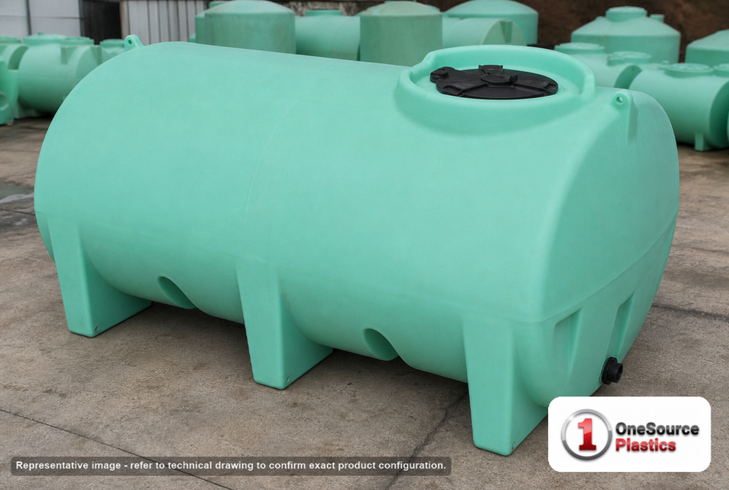
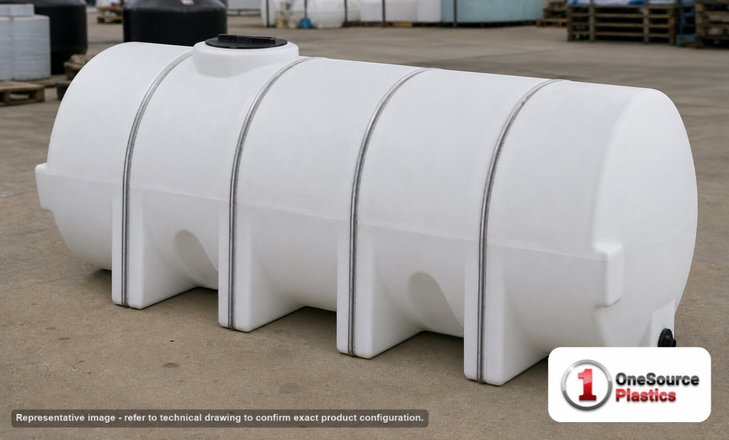
The Enduraplas 800 Gallon Green Horizontal Sump Bottom Leg Tank ships as a complete unit with its supporting frame, built for mobile and stationary haul service where a low, stable profile matters.The polyethylene tank measures 94 inches long, 60 inches wide, and 56 inches high, and the sump bottom drains toward a single low point so you can empty it nearly completely between loads.Carried at a 1.9 specific gravity rating, this horizontal leg tank is built for dense liquids well beyond the weight of plain water, which is what separates it from a standard water-only horizontal tank.
Will it work for your liquid and load?
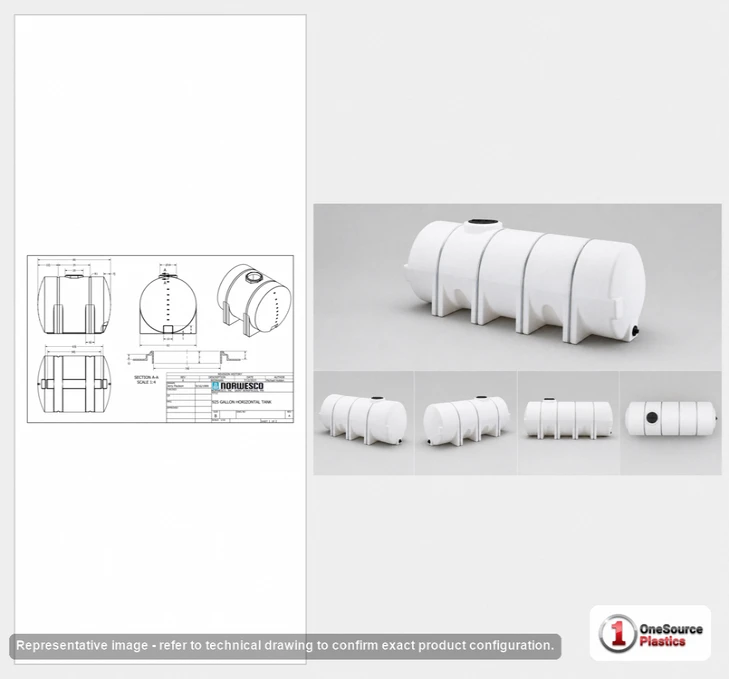
Sizing is a weight question first.Filled to 800 gallons of water, the contents weigh about 6,672 pounds.The 1.9 specific gravity rating allows a maximum rated contents weight of 12,677 pounds, so you have real headroom for heavier-than-water fluids like fertilizer blends and many of the chemicals below.Here is the practical way to read that: a 1.9 SG fertilizer blend filled to the full 800 gallons weighs roughly 9,340 pounds, comfortably under the 12,677-pound ceiling, while a true 1.9 SG fluid at full volume is right at the limit the wall is built for.Confirm the loaded weight your truck, trailer, or pad can carry before you fill.The 60 x 94 inch footprint and integrated frame keep the center of gravity low for road and yard handling.Run your numbers through the Tank Sizing Calculator and review the Tank Sizing Guide.For DOT and trailer-scope questions on hauling fertilizer in leg and applicator tanks, the guides on applicator and leg tanks for fertilizer and portable utility tanks under 49 CFR 173.5 walk through the classification details.See the technical drawing on this page for fitting locations and frame dimensions.
Chemical compatibility
This is a polyethylene tank rated at 1.9 specific gravity, which is the maximum density wall offered for this model — there is no heavier-rated version to step up to, so a dense-liquid buyer already has the strongest option here.The exact resin grade should be confirmed with the manufacturer before committing to chemical service, since cross-linked and linear polyethylene behave differently with aggressive media.Compatibility below is drawn from the manufacturer's chemical-resistance chart, which is concentration- and temperature-specific; match your exact concentration and operating temperature against that chart before filling.The tank ships without chemical-service fittings pre-installed, so order bulkhead fittings in the material each chemical row calls for, with the matching gasket.Watch the outliers: DEF needs 316 stainless fittings, and Peracetic Acid needs 316 stainless with Aflas gaskets — do not default-order PVC and EPDM hardware for those.
Chemicals this tank can handle, with the fitting and gasket materials to specify for each: Acetic Acid (60%, PP/PVC fittings, EPDM gaskets), Aluminum Sulfate (50%, PVC, EPDM), Calcium Chloride (40%, PVC, EPDM), DEF (32.5%, 316SS, EPDM), Ethylene Glycol (100%, PVC, EPDM), Ferric Chloride (50%, PVC, EPDM), Ferric Sulfate (60%, PVC, EPDM), Ferrous Sulfate (20%, PVC, EPDM), Hydrochloric Acid (37%, PVC, Viton), Hydrofluoric Acid (48%, PP/PVC, Viton), Hydrofluosilicic Acid (26%, PP/PVC, Viton), Hydrogen Peroxide (50%, PVC, Viton), Magnesium Chloride (30%, PVC, EPDM), Peracetic Acid (30%, 316SS, Aflas), Phosphoric Acid (85%, PVC, Viton), Polyaluminum Chloride (PVC, EPDM), Potassium Carbonate (50%, PVC, EPDM), Potassium Hydroxide (saturated, PVC, EPDM), Propylene Glycol (PP/316SS, EPDM), Sodium Bisulfate (PVC/PP, EPDM), Sodium Bisulfite (PVC/PP, EPDM), Sodium Carbonate (30%, PVC, EPDM), Sodium Hypochlorite (under 16.5%, PVC, Viton), Sodium Thiosulfate (40%, PVC, EPDM), Sulfuric Acid (98%, CPVC, Viton), Urea Solution (50%, PP/PVC, EPDM), Zinc Orthophosphate (PP/316SS, EPDM), and Ozonated Water (up to 10 PPM, PVC, EPDM).For the full matrix and to confirm your media, see the chemical compatibility resource.
The mistake to avoid
The most common error on a 1.9 SG tank is specifying the wrong fitting and gasket material for the chemical, then blaming the tank when a gasket fails.The polyethylene shell handles a wide range of media, but the bulkhead fittings and gaskets are the wear point — note how Viton is called for on the oxidizers and strong acids above while EPDM covers the salts and glycols.The second mistake is reading "1.9 specific gravity rating" as permission to fill with anything; that number sets the maximum density the wall is built for, not a blanket chemical clearance.Always confirm resin type, concentration, and temperature against the OEM chart first.
This tank ships LTL freight from the Enduraplas plant in Neche, North Dakota, quoted live to your ZIP code based on its size and the frame.Get a freight quote in seconds with the Freight Cost Estimator, or call 866-418-1777 and we will line up the freight and answer fitting questions before you order.
Freight and documents
Ships from: Neche, ND. LTL freight is quoted to your ZIP with the freight cost estimator or by phone at 866-418-1777. The listed price is before freight.
See this tank
Interactive 3D model with live fill. This tank has an interactive 3D model built to its manufacturer dimensions. Rotate it, and set a fill level to see how much liquid it holds at any height. Open the 3D view on the product photo above. Download the 3D model (GLB).
Ready to order?
Add it to your cart at the top of this page, get LTL freight to your ZIP, request a written quote, or call 866-418-1777. The listed price is before freight.