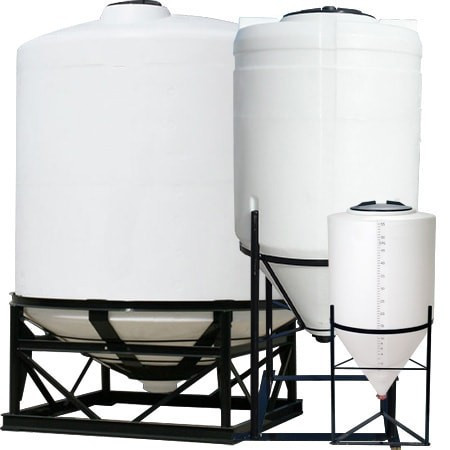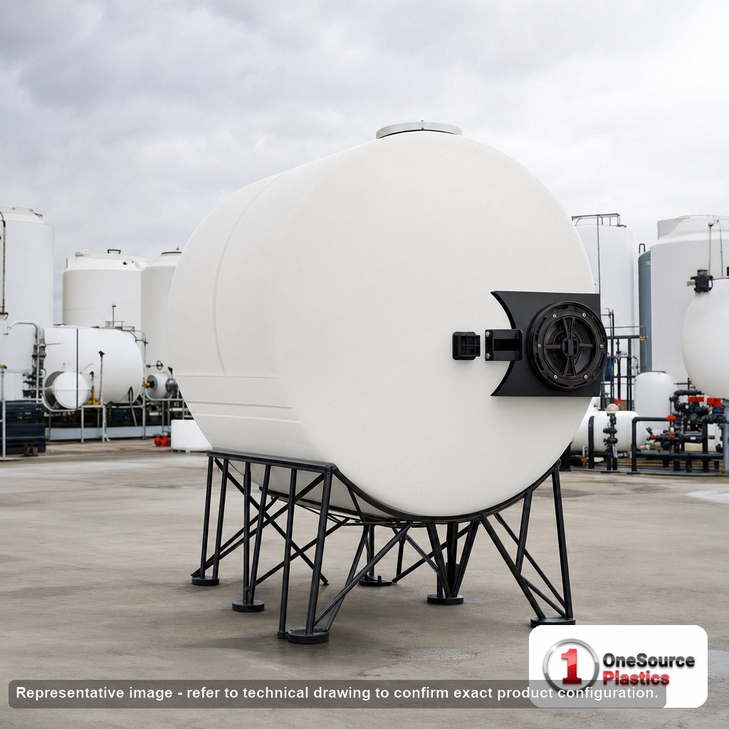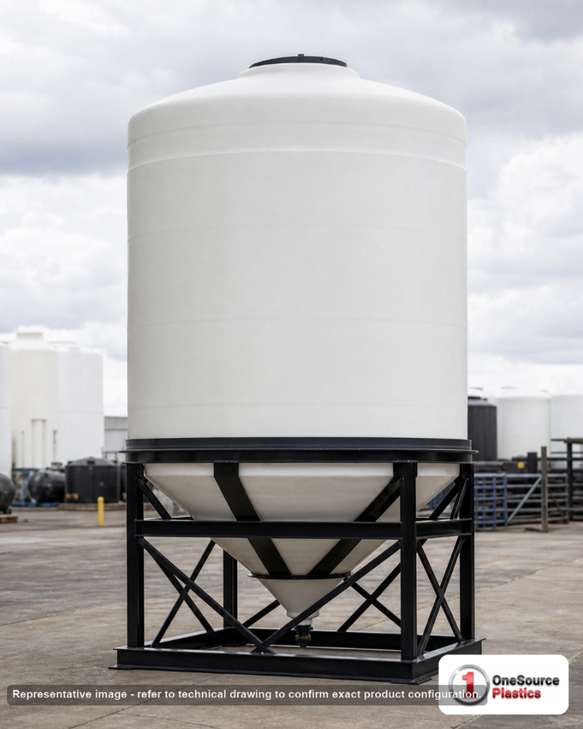
Four hundred and seventy pounds of wide, short cone bottom tank
Four hundred and seventy pounds empty in a 95 by 95 by 104 inch envelope is what the Snyder 8350000N40 is: 2,500 gallons in the shortest shell this family offers, at 470 pounds empty and 470 pounds shipping, in Natural White, with the material field reading Crosslinked Linear Polyethylene. The wall is rated at a specific gravity of 1.5, and the sheet gives 31,275 pounds of max contents against a full water weight of 20,850 pounds at 8.34 pounds per gallon. The opening on top is an 18 inch threaded vented manway. The outlet field reads 1 Manway / Lid, which names an opening rather than a discharge, and no discharge size is published on this sheet. The service limit is 100 F / 37 C and the freight class reads 400 beside an LTL ship mode. This sheet publishes no cone angle, no inlet, no lid size, no structural lug or flange detail, no stand, no warranty term and no NMFC number, and this page asserts none of them.
Two ways to buy. Add it to your cart above with freight quoted to your ZIP, or request a written quote for a job that needs paperwork.
A California plant, a California lane, and the height you get back
This tank is moulded at Chowchilla, California, and California is the state the sheet gives as its origin, which is the first thing to weigh if you are comparing it against the Nebraska-moulded 2,500 gallon listings. From a western site this is the short lane; from the eastern half of the country it is the long one, and on a 95 by 95 by 104 inch package weighing 470 pounds the carrier charges for the space rather than the weight, so distance is most of the bill. Pull the figure for your own ZIP from the freight cost estimator before the part number is fixed; the listed price is before freight. What arrives is the squattest tank in the range, and that is the reason to want it. At 104 inches the shell is under nine feet before the stand goes underneath, which is close to two feet shorter than the taller 2,500 gallon shell, and in a building with a fixed ceiling those two feet decide whether a cone bottom tank is possible at all. Do the sum honestly: the stand, plus 104 inches of shell, plus clearance over the manway for a person and a fill line, and separately the room under the cone for whatever the discharge feeds. Measure down from the lowest fixed thing over the spot rather than from the ridge. The structure is not on this sheet and has to be bought on its own: no stand, no legs, no skirt, no support ring and no bolt pattern is published, a cone bottom tank has no flat bottom to rest on, and this page therefore gives no stand height, rated load or material. Settle it with the cone bottom tank stand compatibility matrix and with us against this part number. The pad below takes 470 pounds of empty tank, 20,850 pounds of water and up to 31,275 pounds of rated contents through a handful of stand feet inside a 95 inch circle rather than across a slab, which is designed ground with a bearing area at each foot. Size the volume first with the tank sizing calculator and take the freeboard from the tank sizing guide.
The wide 2500 read against the tall 2500
| Part | Gallons | Length x width x height | Empty weight |
|---|---|---|---|
| 8350000N40 (this tank, natural white, rated 1.5) | 2500 | 95 x 95 x 104 in | 470 lb |
| 5110000N40 (the taller 2500 shell, natural white) | 2500 | 90 x 90 x 125 in | 375 lb |
| 5110000N46 (the taller shell, same weight) | 2500 | 90 x 90 x 125 in | 375 lb |
| 5110000N48 (the taller shell, heavier listing) | 2500 | 90 x 90 x 125 in | 400 lb |
| 5070000N40 (2000 gallons, 102 inches tall) | 2000 | 90 x 90 x 102 in | 325 lb |
| 5100000N40 (2600 gallons, 139 inches tall) | 2600 | 90 x 90 x 139 in | 500 lb |
The interesting comparison in this table is not a rating, it is a shape. Four rows read 2,500 gallons and they sit on two different shells: this one, a 95 inch circle at 104 inches, and the 5110000 listings, a 90 inch circle at 125 inches. Twenty-one inches of height against five inches of width, for exactly the same volume. Under a low roof that is the entire decision, and it is made with a tape measure before anyone opens a specification; where floor space is the scarce thing instead, the taller shell is the better tenant. Treat them as two tanks on a drawing, because the pad, the stand and the bund are not shared. Within this shell, the reason to take this listing is that the rating matches ordinary duty. A rating of 1.5 with 31,275 pounds of max contents covers water, treated water and the broad run of process liquids no heavier than water, which is the majority of what a 2,500 gallon cone actually holds. The sheet lists another listing on this same shell at a heavier grade for denser product; if your liquid is genuinely heavier than water, take that one rather than running this one part full, and if it is not, the difference stays in your pocket. The bottom two rows are the size ladder on the narrower shell: 5070000N40 at 2,000 gallons and 102 inches, and 5100000N40 at 2,600 gallons and 139 inches, which is a hundred gallons more than this tank for nearly three feet more height. Two long reads cover the capacity properly: the 2,500 gallon cone bottom tank buyer's guide, and the 2,500 gallon cone bottom guide covering a poly stand, which is where the support question belongs rather than on this page.
Torn between two rows? Call 866-418-1777 with the liquid and the ceiling height, or ask for a quote on both and compare the freight.
Access, venting, and the fitting list this sheet does not carry
- The opening on top: an 18 inch threaded vented manway at 104 inches plus the stand. On the shortest shell in the range that is the easiest manway here to reach and to work at, but it is still above head height once a stand is under it, so plan the platform or fixed ladder and the fall protection with the structure rather than afterwards.
- The vent: it comes with the manway on this sheet rather than as a separate item, so there is nothing extra to specify and nothing to leave off. Keep it clear, inspect it whenever the tank is opened, and never blank, paint or tape it to control a smell.
- Filling: this sheet publishes no inlet, so the fill route is designed rather than assumed. Land the line at a coupling at working level instead of carrying a hose up, and size the air path to the faster of the fill rate and the draw rate.
- The outlet field: it reads 1 Manway / Lid. That names an opening and not a discharge, and we print it exactly as it reads rather than turning it into a pipe size. No outlet dimension, thread, bulkhead or valve is published or claimed. Tell us the line size, the valve type and the product and we will confirm what 8350000N40 carries before anything is ordered.
- Below the cone: carry the valve, any reducer and the first run of pipe on steelwork off the stand, never on the tank, with a flexible connector at the first joint so pump vibration stays out of the wall. Up to 31,275 pounds of rated contents stands above that joint when the tank is full.
- What the sheet does not carry: no cone angle field, no lug or flange count, no lid size, no inlet, no warranty term and no NMFC number, so no lifting point and no angle is described anywhere on this page. Published: a specific gravity rating of 1.5, 20,850 pounds of water at 2,500 gallons, 31,275 pounds of max contents and a service limit of 100 F / 37 C.
Where the tank stands over ground or a floor that would have to be recovered after a release, containment is its own question rather than an extension of the tank specification, and the Captor containment comparison is the honest place to start it.
Rinse-down duty where a full drain saves a disposal ticket
This is the low-roof workhorse: 2,500 gallons of ordinary liquid in a vessel that gives all of it back, in a building that could not take a taller tank. Process and treated water holding, liquid fertiliser and crop input blending at an agricultural retailer, polymer and coagulant make-up at a water or wastewater works, food and beverage duty where the vessel is washed between products, wash and rinse water systems emptied between runs, and batch preparation in manufacturing where the tank changes product and cannot carry the last one forward. The changeover is the whole case for the shape. On a flat floor the last inches sit in a ring and become somebody's disposal problem; on a cone the liquid keeps running toward one low point until the vessel is genuinely empty, and at 2,500 gallons that difference is a line on a budget rather than a nuisance. The wide, short shell brings a second advantage that is easy to miss: a wide column stratifies less readily than a tall slim one, so a blend that wants to separate is a slightly easier problem here, and the working height for everything on top is lower. The natural white wall gives an operator a rough level in daylight without climbing, which is useful and is not a measurement, so the instrument still belongs on the order. The limits are the sheet's own: a rating of 1.5, so denser product belongs on the heavier listing, and a service limit of 100 F / 37 C on anything filled warm. Check your liquid in our chemical compatibility reference before the gaskets and valves are chosen.
Chemicals this resin is rated for, with the fitting and gasket to order
These are the chemicals listed for this tank at the concentrations shown. Each links to the full compatibility page; confirm your exact concentration and temperature there or in the chemical compatibility database before ordering.
- acetic acid at 60%
- aluminum sulfate at 50%
- calcium chloride at 40%
- ferrous sulfate at 20%
- magnesium chloride at 30%
- sodium carbonate at 30%
- urea solution at 50%, and ozonated water up to 10 PPM. Most of these call for PVC fittings with EPDM gaskets, while acetic acid and urea solution allow P
- DEF spec 316SS at every wetted port.
- ethylene glycol
- ferric chloride
- ferric sulfate
- hydrofluosilicic acid
- polyaluminum chloride
- potassium carbonate
- potassium hydroxide
- propylene glycol and
- sodium thiosulfate. On that 1.9 SG tank, two of these also break the usual PVC/EPDM default: hydrofluosilicic acid calls for Viton gaskets instead of EPDM, a
Class 400 from Chowchilla, and the first fill with clean water
The shipped package is 95 inches by 95 inches by 104 inches at 470 pounds, class 400 beside an LTL ship mode, with no NMFC number published and Chowchilla, California on the sheet as the moulding plant. Broad and low rather than long, it is the easiest shape in this family to get through a gate and around a corner, and it still prices on the deck it occupies rather than on the scale ticket; the freight cost estimator gives you the lane figure for your own ZIP, and the listed price is before freight. It arrives lying down and is stood up at your end. No lug count is published on this sheet, so plan the lift under the body and never off the manway, and no crane, rigging, permit or escort detail is published either, so settle the offload arrangement and the window with us before the truck is booked rather than on the morning. Have the stand set, levelled and anchored first; there is nowhere sensible to park a cone bottom tank while a foundation cures. Keep it restrained as soon as it is vertical. Then commission it with clean water rather than product: take it to the 20,850 pound water load, walk the manway seal, the cone joint, the stand feet and the pad edge with a torch, and leave it standing full overnight before anything is connected. Chalk the full-water line on the outside of the shell after that first fill; on a translucent wall it is the cheapest gauge you will ever own and it is the mark every later reading gets checked against. The first fill is the only cheap time to find a problem, so do it in daylight with someone watching the base.
Freight and documents
Ships from: Chowchilla, CA. LTL freight is quoted to your ZIP with the freight cost estimator or by phone at 866-418-1777. The listed price is before freight.
Technical drawing (PDF) for Snyder Industries 8350000N40.
See this tank
Interactive 3D model with live fill. This tank has an interactive 3D model built to its manufacturer dimensions. Rotate it, and set a fill level to see how much liquid it holds at any height. Open the 3D view on the product photo above. Download the 3D model (GLB).
Ready to order?
Add it to your cart at the top of this page, get LTL freight to your ZIP, request a written quote, or call 866-418-1777. The listed price is before freight.