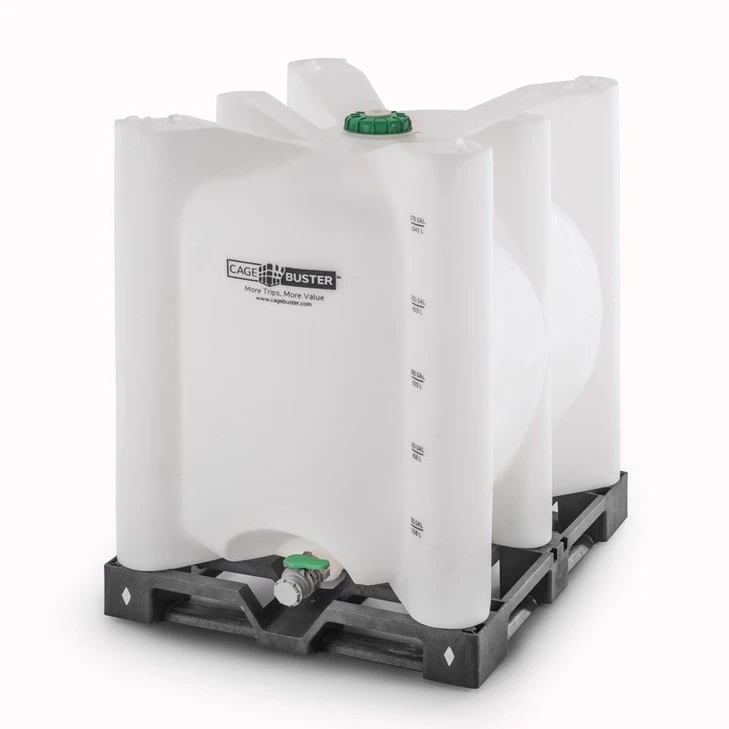
260 gallons in a 36 inch square standing 57 and a quarter inches tall
The Snyder SII-1032400N95401 is a 260 gallon cubetainer with a brass dispense fitting: a white high density linear polyethylene container 36 inches by 36 inches on the floor, 57.25 inches tall, weighing 185 pounds empty and the same 185 pounds to ship, molded at St. Bonifacius, Minnesota. It is a square vessel built to be filled once, set down, and drawn from by hand for weeks, not a tank plumbed into a process. The sheet rates the wall at a specific gravity of 1.9, which is where the 4,120 pound figure for maximum contents comes from, against 2,168 pounds for 260 gallons of water at 8.34 pounds per gallon. Access is an 8 inch lid. This sheet publishes no service temperature limit and no warranty term, so this page asserts neither; ask us and we will get Snyder's current terms in writing.
Want it on your site? Get LTL freight to your ZIP, add it to your cart above, or call 866-418-1777 and a tank specialist will confirm the fit.
Where it sits: a 36 inch square of floor, and nothing hanging off the sides
Start with the square, because on a cubetainer the footprint is the specification that decides everything else. Thirty-six inches by 36 inches is pallet-scale, which means this container goes where a pallet goes: lifted on its pallet by a forklift or a pallet jack, slotted into a bay of pallet racking, set on a flatbed beside other pallet loads, rolled into a box truck without wasting a corner, stood in the corner of a wash bay or a mix room against two walls. Nothing projects past the square except the dispense fitting, and that is the one thing to keep pointed at the open side. Height is the other half of it. At 57.25 inches the lid is a little under five feet up, which is chest height for most people: a hose goes in without a platform, a light goes in without a ladder, and the fitting at the bottom of the body still sits high enough to put a pail or a five gallon can under it. That combination, a small square base and a tall body, is what a 260 gallon container is for. It buys volume upward instead of outward, so nine square feet of floor holds the better part of five drums. What it costs is stability against handling: a tall square body carried part-full is more willing to rock than a low one, so it gets filled where it will stand and it stays there. Underneath, flat and continuous is not a nicety. A rotationally molded floor bears on the whole surface it is resting on and nothing else, so a cracked pallet deck board, a bowed bench top or a hollow in a slab becomes the bearing point for 2,168 pounds of water, or up to 4,120 pounds of contents at the rating. Where this container stands on concrete rather than on its pallet, the framework for getting that slab right is in the concrete pad sizing guide, and it scales down to a footprint this size. Before you settle on 260 gallons, run it against your real daily draw and the interval between refills in the tank sizing calculator, and take the working reserve you should never dip into and the headspace a warming liquid needs from the tank sizing guide.
One cubetainer sheet, two neighbours, and a 180 gallon step down
| Part | Gallons | Length x width x height | Empty weight |
|---|---|---|---|
| SII-1032400N95401 (this container, white, brass dispense fitting) | 260 | 36 x 36 x 57.25 in | 185 lb |
| SII-1032300N95401 (smaller, same square base, shorter body) | 180 | 36 x 36 x 44 in | 105 lb |
| SII-5740102N95704 (used oil containment tank with level gauge) | 275 | 47 x 47 x 63 in | 200 lb |
The only like-for-like choice on this sheet is height. The 180 gallon SII-1032300N95401 stands on the identical 36 inch square and stops at 44 inches, which is thirteen inches shorter and eighty pounds lighter empty, and it is the one to take when the container has to live under a shelf, under a mezzanine, or low enough for a short person to see into the lid without a step. This one buys eighty more gallons in the same square by going up instead of out, and on a floor where the square is fixed and the ceiling is free that is the better trade every time. The third part on the sheet is a different kind of product and worth naming honestly rather than folding into a family: the SII-5740102N95704 is listed as a 275 gallon used oil containment tank with a level gauge, 47 by 47 inches and 63 inches tall at 200 pounds, and we print that name as the sheet gives it without asserting a containment figure, a code or a duty for it. If the job is to hold a liquid the site rules say must be contained, then it is that class of product you should be asking about and not this one. Two questions settle most calls on this page. Does the vessel have to move while there is liquid in it, because a container handled full is a different buy from one filled in place. And is the liquid drawn by gravity through a fitting or lifted by a pump, because this part number is named for the first and the sheet describes nothing about the second. Tell us the liquid as well, and we will confirm compatibility against Snyder's current documentation before you order rather than after.
Picked the 260 gallon tank? Add it to your cart above; freight is quoted to your ZIP before you pay anything.
The brass dispense fitting, the 8 inch lid, and two numbers with no units
- The dispense fitting: a brass dispense fitting is what this part number is named for and it is the reason to buy this container rather than a plain one. Metal takes daily handling that a plastic tap does not, and daily handling is exactly what a fitting on a container people draw from by hand is exposed to. Keep it clear of the edge of whatever the container stands on so nobody sets a load against it, and never move or lever the container by it.
- The outlet as the sheet lists it: the sheet gives the outlet as 1 and prints no unit for it. So this page prints the figure and stops. It is not a pipe size and we will not present it as one. Tell us what you intend to connect and we will confirm the thread and the fitting against Snyder's documentation before you buy pipe.
- The inlet as the sheet lists it: the sheet gives the inlet as 2, again with no unit published. The same discipline applies. In practice a container this shape is filled through the lid, from a hose or a jug, already standing in the place it will be drawn from.
- Access: an 8 inch lid, a little under five feet off the floor. That is enough to get a hose in, a light in and a hand in for a wipe-out, which on a container holding a product somebody meters out by hand is the maintenance that actually gets done. Keep it closed between draws.
- No service limit on this sheet: no maximum operating temperature is published for this item, so no figure is stated here. A closed container standing in direct sun gets hotter than people expect, so keep it inside or shaded and ask us if the liquid arrives warm.
The rest is handling discipline, because a container like this is hurt by people rather than by pressure. Fill it where it will stand. At 185 pounds empty it is a pallet-jack item rather than a lift, and full it is not a lift at all: 2,168 pounds of water, or up to 4,120 pounds of contents at the rating, wants a forklift under the pallet. Put a shut-off between the dispense fitting and anything permanent, support any hose off the floor rather than off the fitting, and break the first joint with a flexible connector if a line ever runs from it, so nothing rigid is bolted to a polyethylene wall. Label the container with the one product it holds and keep it to that product, because a vessel this size is easy to rinse and hard to prove clean. Read the level by eye through the lid rather than by weight; on a 36 inch square, one inch of depth is a lot of gallons. And keep a spare gasket for the fitting on the shelf rather than on a purchase order.
Bulk dispensing where a drum is too small and a tank is too much
The work this container is bought for is metering at volume: a maintenance shop drawing lubricant, coolant or cleaner into jugs and pails all day, a grounds or turf crew filling backpack and hand sprayers off a bench, a truck or fleet wash keeping a working supply of detergent at the bay, a food or beverage plant holding one ingredient at a station, a plating or laboratory line drawing measured volumes, a farm shop keeping an additive at the mixing bench instead of walking to a drum. In every one of those the same two things are true: somebody opens a fitting by hand several times a day, and the vessel stands on a floor rather than sitting in a cradle or on legs. That is what a tall square body with a brass dispense fitting is for. Two honest limits. There is no secondary containment on this item of any kind, so it is not the product where the rules say the liquid has to be contained. And people do buy stored water on rural property with firefighting in the back of their minds; a container this size is not a fire reserve, and what makes a reserve real rather than nominal, the draw rate, the connection and the freeze protection around it, is argued out properly in the fire-water reservoir design guide rather than assumed. When 260 gallons stops being enough, the honest move is up to bulk storage rather than out to several containers, because the handling cost of a row of vessels overtakes the price difference quickly.
St. Bonifacius, Minnesota, at 185 pounds on a square footprint
This container is molded at St. Bonifacius, Minnesota and the sheet gives its freight class as LTL. The freight cost estimator prices the lane to your ZIP, and the listed price is before freight. At 36 inches square and 57.25 inches tall it rides as a pallet shipment rather than a parcel, so tell us at order whether the delivery address has a dock, a forklift, or neither: a tall square load arriving at a door with no dock is a curbside drop and a pallet jack across a car park. Look at the base, the lid seal and the brass fitting before the driver leaves, and photograph the fitting from the side; a slow weep is easier to compare against a photograph than to describe on the phone. Keep the pallet the container arrives on. It is the handling equipment for the rest of this item's life, it is what a pallet jack picks up, and it is what keeps the base off a wet floor. Write the product name and the fill date on the lid in paint marker the day it goes into service, because the first question anybody asks about a container at a bench is what is in it and how long it has been there. Keep the delivery paperwork with the tank; the serial number on the shell is what a warranty claim starts from.
Freight and documents
Ships from: St. Bonifacius, MN. LTL freight is quoted to your ZIP with the freight cost estimator or by phone at 866-418-1777. The listed price is before freight.
Technical drawing (PDF) for Snyder Industries 1032400N95401.
See this tank
Product video. Watch the Snyder Industries 260 Gallon Cubetainer Tank with Brass Dipense Fitting video (62 seconds) with dimensions, fittings and shipping notes.
Ready to order?
Add it to your cart at the top of this page, get LTL freight to your ZIP, request a written quote, or call 866-418-1777. The listed price is before freight.