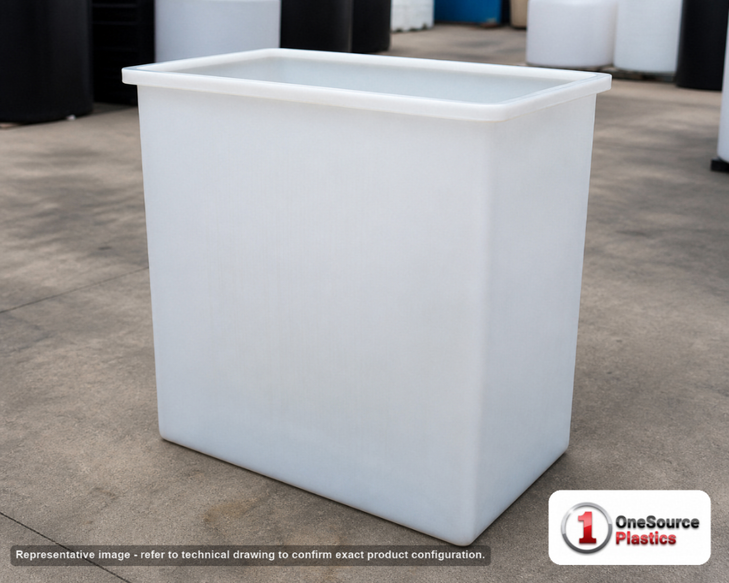
275 gallons in a Cagebuster tote, 48 by 40 inches
Snyder names the shape on the sheet: the SII-6998601B97204 is a white high density polyethylene stackable Cagebuster tote holding 275 gallons on a 48 by 40 inch footprint, 52 inches tall, 203 pounds empty, listed among the non-caged totes and molded at Lincoln, Nebraska. The wall is rated at a specific gravity of 1.9 and the sheet lists 4358 pounds of contents against the 2294 pounds that 275 gallons of water weigh at 8.34 pounds per gallon. The fittings it names are a 2 inch ball valve outlet and a threaded lid, given as 5 inches in one field and 6 inches in another; no inlet is listed. The service limit is 105 F / 41 C, lower than anything else in this family, and the sheet publishes no warranty term. Freight is LTL, NMFC 156600-03.
Spec sheet in hand? Call 866-418-1777 and read us the liquid and the pad; or get freight to your ZIP and add it to your cart above.
What a Cagebuster replaces
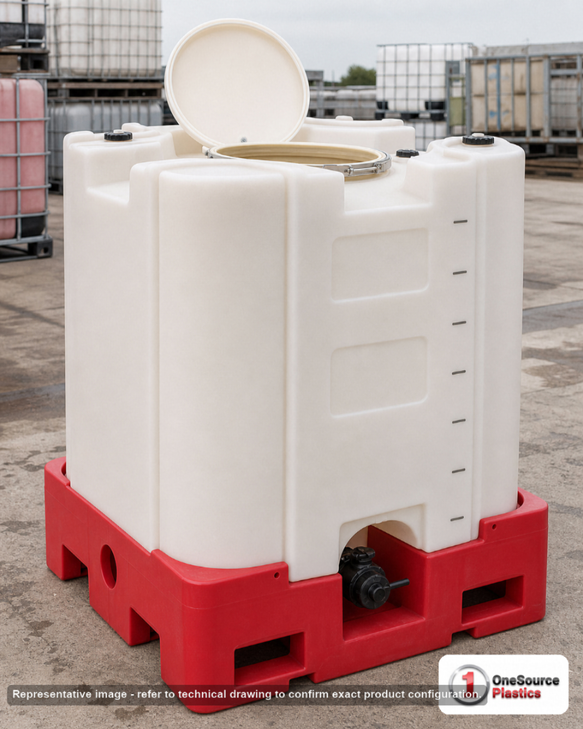
The name on this sheet is an argument, and the argument is with the caged tote. A caged unit is a thin bottle inside a steel frame: the frame stacks, the frame gets damaged, the frame traps whatever runs down the outside, and when the frame is condemned the bottle goes with it. This one is listed as a non-caged stackable tote and carries its own load in a molded body, which is why the sheet puts it at 203 pounds empty. Against the other 275 gallon totes on its own sheet that is the lightest figure of the three, and it sits on a 48 by 40 inch footprint rather than a square one, which is the difference that decides most installations: a rectangle indexes against a wall, a rack opening or the next unit the same way every time, and a floor already laid out on that module does not need re-planning. The sheet asks two things back. The first is the service limit, 105 F / 41 C, which is lower than the rest of this family and is a real specification rather than a formality: a product that arrives warm, a steam-cleaned tote put straight back into service, or a unit standing in afternoon sun on a black asphalt yard can all reach it, so this is not the tote for a hot fill. The second is that the sheet gives no base, pocket or lift detail, so how the unit will be moved on your floor is a question to settle at order. Check the increment too: 275 gallons against your turnover in the tank sizing calculator, with the working reserve and the expansion room from the tank sizing guide.
The 275s, the 330 and the stainless 245
| Part | Gallons | Length x width x height | Empty weight |
|---|---|---|---|
| SII-6998601B97204 (this tote, Cagebuster, lightest) | 275 | 48 x 40 x 52 in | 203 lb |
| SII-6620030B97203 (square footprint, tallest, heaviest) | 275 | 45 x 45 x 56 in | 269.5 lb |
| SII-6620030B97205 (payloader system, Viton gaskets) | 275 | 46 x 46 x 54 in | 244.2 lb |
| SII-6610056B97205 (larger, red, tallest of all) | 330 | 45 x 45 x 64 in | 268 lb |
| SII-6984000B51318 (smaller, 304 stainless steel, side drain) | 245 | 42 x 48 x 35.25 in | 384 lb |
Three totes here hold 275 gallons and the footprint is what separates them. The SII-6620030B97203 puts the same volume on a 45 inch square base and stands 56 inches tall at 269.5 pounds, and the SII-6620030B97205 is the payloader system version on a 46 inch square base at 54 inches and 244.2 pounds, listed with Viton gaskets on its own sheet. Both are square; this one is the rectangle, 48 by 40 inches, the lowest of the three at 52 inches and the lightest at 203 pounds, which is what makes it the one to pick when the floor, the rack or the trailer is laid out on that module and when overall height under a low ceiling or a mezzanine is tight. Above them the 330 gallon SII-6610056B97205 is the red one, 45 inches square and 64 inches tall at 268 pounds, which buys more product per handling on much the same floor area. The odd entry is the SII-6984000B51318, which is not a plastic tote at all but a 245 gallon 304 stainless steel Supertainer with a side drain at 384 pounds; it is on this sheet as an alternative for products that want steel, and everything about it lives on its own sheet rather than this one.
Two rows look the same? The difference is the wall; call 866-418-1777 with the liquid and we will say which, or ask for a quote on both.
A threaded lid the sheet names, and a ball valve under it
- Vent: the sheet describes the top opening as a threaded lid and says nothing about a vent in it. Settle that at order. A tote drained through a 2 inch valve has to take air in as fast as the product leaves, and a body meant to carry another unit on top of it should not be doing that against a vacuum. Ask for a vented lid or fit a breather matched to the draw, and keep its screen clear.
- Headspace: 275 gallons is the rated volume and the sheet gives no separate fill line. With a 105 F / 41 C service limit, the air above the liquid is also the room a warming product needs, so leave it and do not fill to the rim of the opening.
- The opening itself: the sheet gives two figures for the top, 5 inches in its manway field and 6 inches in its lid field. Both are on the sheet and we print what it says rather than choosing between them; confirm the one you need with us before you order a fitting to suit it.
- Outlet: a 2 inch ball valve, as the sheet lists it, and no inlet listed, so the lid is the fill point. This is the only sheet in this family that names a valve style rather than a bare size, and a ball valve is the one an operator uses by hand: mount the unit so the handle is reachable, keep the outlet capped between uses, and chain the cap to the tote.
- Limits: 105 F / 41 C, and 4358 pounds of contents at a specific gravity of 1.9. No warranty term is published; ask us and we will get Snyder's current terms in writing.
A tote earns its keep by moving, and moving is what breaks the valve. Close it, cap it, and check that it is closed before the unit leaves the floor, because a ball valve knocked open in transit empties without asking. Wash the outside as well as the inside; there is no cage to hide behind and no cage to trap product either, which is the point. Keep a record of what each unit has held, and mark the unit rather than the pallet it is standing on.
Process fluids on a forklift, inside a building
A Cagebuster on a 48 by 40 inch footprint is bought for indoor, repeat handling: a process fluid fed to a line at a working height, a wash or rinse solution beside a machine, consolidated drums of one product, collected used fluid held for disposal, and a movable supply where a plumbed tank is not worth the pipe. The 105 F / 41 C service limit points it at ambient work rather than hot fills, and the light empty weight points it at floors where things get moved several times a week. Whether a tote is the right tier at all is a numbers question, not a habit: the container versus tank comparison sets out where a tote, a drum, a cube and a tank each belong, and the drum, tote and bulk tank break-even analysis does the annual volume, turnover and footprint arithmetic that answers it. If what goes in is a hazardous waste, the obligations are explicit: 40 CFR 264.193 governs secondary containment for tank systems, the leak detection options and the inspection cadence, and the secondary containment article works through what complying with it actually looks like on a floor with totes on it.
What this tank is listed to hold
Each line is a liquid the resin is rated for, at the concentration shown, with the fitting and gasket to order. Follow the link for the full rating, or search the chemical compatibility database before ordering.
- Hydrochloric Acid (37%, PVC fittings, Viton gasket)
- Sulfuric Acid (98%, CPVC fittings, Viton gasket)
- Sodium Hypochlorite (under 16.5%, PVC, Viton)
- Phosphoric Acid (85%, PVC, Viton)
- Ferric Chloride (50%, PVC, EPDM), and
- Hydrogen Peroxide (50%, PVC, Viton) all require the full 1.9 rating this tank sits at, so there is no SG margin left for denser or hotter versions of those s
- DEF (32.5%, EPDM)
- Peracetic Acid (30%, Aflas gasket), and
- Zinc Orthophosphate.Lighter-duty chemistries such as
- Acetic Acid (60%)
- Calcium Chloride (40%), and
- Sodium Carbonate (30%) require only a 1.9 SG tank, which this 1.9 rating exceeds.Match both the fitting body and gasket material to the chemical, cite the O
Lincoln by the pallet, not by the permit
The SII-6998601B97204 is molded at Lincoln, Nebraska, and the sheet gives the freight class as LTL with NMFC 156600-03, shipping at 48 inches by 40 inches by 52 inches. That is the quiet advantage of the whole format: 203 pounds on a 48 by 40 inch base rides inside a trailer as ordinary freight, with no permit, no escort and no crane, and several units ship on one truck. The freight cost estimator prices the lane to your ZIP, and the listed price is before freight. The delivery question is therefore the dock, not the route: confirm whether there is a dock, whether the truck has a liftgate, and who moves the unit once it is on the ground. When it arrives, water-fill it on the floor it will work on, leave it standing, and read the base, the lid seat and the valve before any product goes in. Then set the valve handle position you want as the standing convention across every unit you own; on a floor of identical totes, a handle that means the same thing on all of them is worth more than any label. Mark the vent and the outlet on the outside of the shell so nobody caps the wrong one in the dark.
Freight and documents
Ships from: Lincoln, NE. LTL freight is quoted to your ZIP with the freight cost estimator or by phone at 866-418-1777. The listed price is before freight.
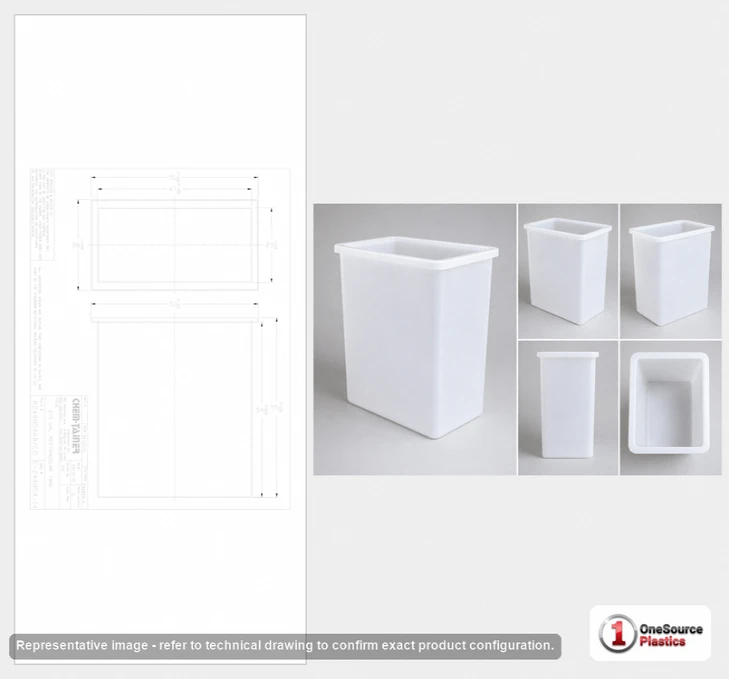
Technical drawing (PDF) for Snyder Industries 6998601B97204.
See this tank
Product video. Watch the Snyder Industries 275 Gallon HDPE Stackable Cagebuster IBC Tote in White video (72 seconds) with dimensions, fittings and shipping notes.
Ready to order?
Add it to your cart at the top of this page, get LTL freight to your ZIP, request a written quote, or call 866-418-1777. The listed price is before freight.