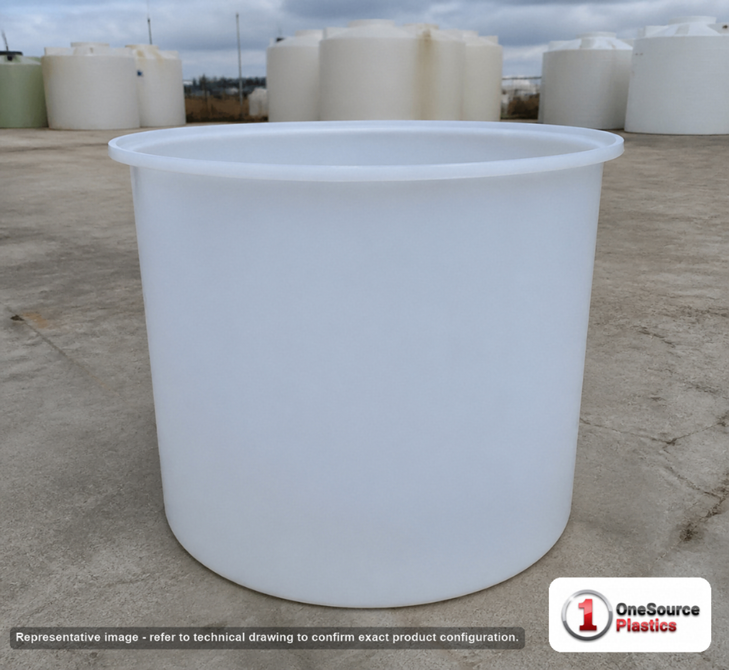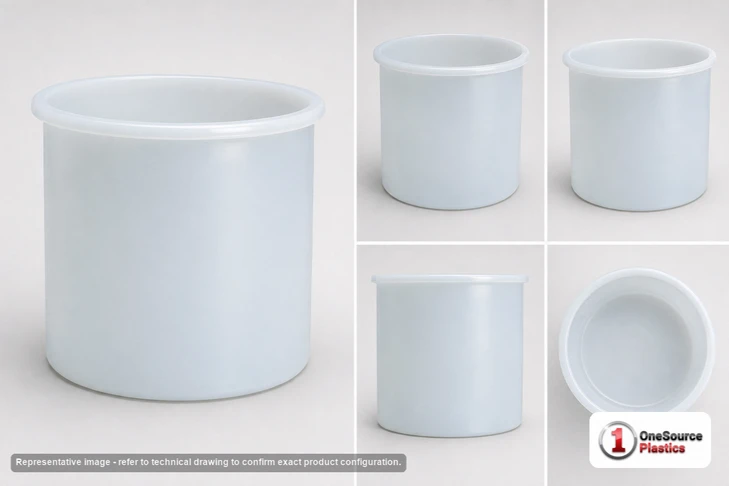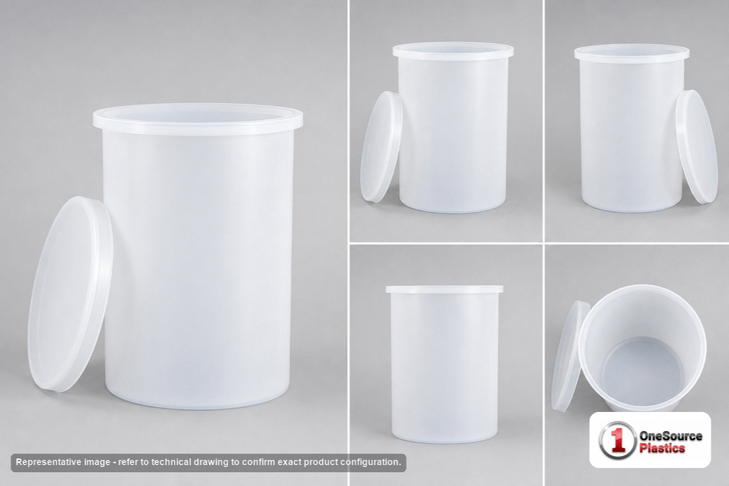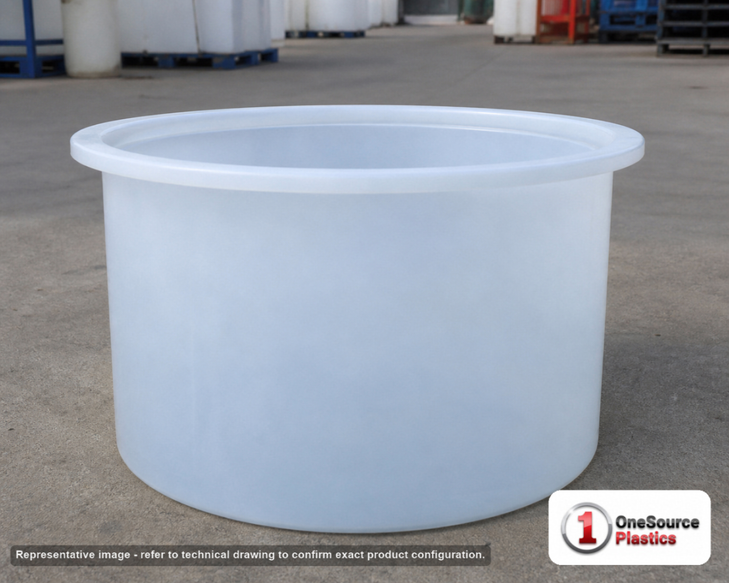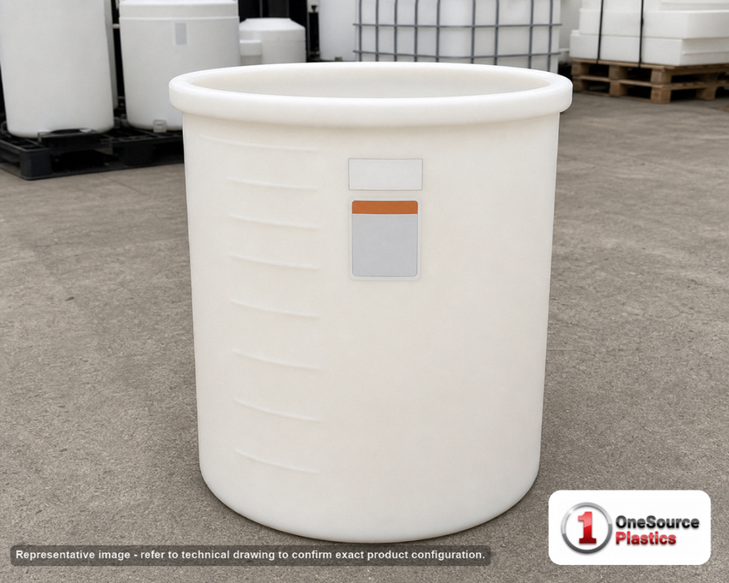
Ninety gallons in an open top polyethylene batch tank
The Snyder SII-56900VOT45 is a 90 gallon plastic open top batch storage tank in white high density linear polyethylene, listed at 30 inches long, 34 inches wide and 36 inches tall, and 100 pounds empty. It is a polyethylene tank and not a steel vessel, and it is written here as the sheet describes it. The wall is rated at a specific gravity of 1.9, which the sheet writes as 1.9 with a maximum of 15.87 pounds per gallon, and it gives 751 pounds for 90 gallons of water at 8.34 pounds per gallon with 1,426 pounds of max contents. Its lid field and its manway field both read 34 inches; both are printed as the sheet gives them and nothing is reconciled between them and the 30 inch length. The sheet publishes no outlet, no inlet, no maximum operating temperature and no warranty term, so this page asserts none of them, and it claims no cover, no gasket and no seal on an open top. Freight is LTL under NMFC 156600-04, moulded at Marked Tree, Arkansas.
Want it on your site? Get LTL freight to your ZIP, add it to your cart above, or call 866-418-1777 and a tank specialist will confirm the fit.
Batch make-up work where the operator needs the top open
The duty that buys an open top tank is one where somebody has to get at the contents. A closed vessel is better at holding things; an open one is better at being worked in, and that is the whole trade. Ninety gallons of open top goes to operations that mix, dissolve, soak, wash, decant or inspect: cleaning and sanitising solution make-up, nutrient and feed blending at a nursery or greenhouse, parts washing and soaking, dye, pigment and ink mixing, small-scale treatment chemical batching, and any bench or floor process where a measured quantity is prepared fresh and used the same day. In every one of them the operator adds material by hand, puts a mixer shaft or a paddle in, watches what happens, takes a sample and then draws the batch off. None of that is possible through a small bung. The tank's proportions suit exactly that. At 36 inches tall the rim sits around waist height for most people, which is where you want it for adding, stirring and reading a batch, and the sheet lists the lid and the manway both at 34 inches, which is an opening as wide as the tank itself. It is 30 inches long and 34 inches wide on the plan, so it occupies about as much floor as a drum on its end but gives a working top instead of a bung. Stand it on a flat, level, continuous surface that carries the whole base rather than on rails or a shimmed corner; the sheet gives 751 pounds of water and 1,426 pounds of max contents at the rating it publishes, and every pound of that reaches the floor through the bottom of the tank. The concrete pad sizing guide for above-ground polyethylene tanks sets out the framework for that surface and where its boundary lies. Size the batch and not the tank: run your real make-up quantity through the tank sizing calculator, and take the freeboard from the tank sizing guide, because a mixed batch needs headroom that a stored one does not and an open top gives you nowhere to hide a surge.
The ninety and the hundred and twenty
| Part | Gallons | Length x width x height | Empty weight |
|---|---|---|---|
| SII-56900VOT45 (this tank) | 90 | 30 x 34 x 36 in | 100 lb |
| SII-570TDVOT-45 (taller, narrower, lighter) | 120 | 30 x 30 x 46.6 in | 50 lb |
Two tanks, and the comparison between them is not the one you would expect. The larger tank is the lighter one: SII-570TDVOT-45 holds 120 gallons and is listed at 50 pounds empty, half the weight of this 90 gallon tank at 100 pounds. It is also narrower on the plan at 30 inches square against this tank's 30 by 34 inches, and much taller at 46.6 inches against 36. The sheet gives those figures and offers no explanation of the weight difference, so we print them and offer none either. What the numbers do tell you is which tank suits which job. This one is the short, wide, heavy one: the rim is lower, so reaching in, stirring and adding material is easier, and the greater empty weight means it is less inclined to shift when somebody works in it or when a hose is dragged past. The 120 gallon tank is the tall, slim, light one: more volume on less floor, easier for one person to move empty, and a rim high enough that a short operator will be working at shoulder height rather than waist height. Decide on the job rather than the gallons. If the tank is a working vessel that people put their hands and a mixer into every day, the lower rim of this one is worth more than thirty extra gallons. If it is mostly a holding vessel that gets filled and drawn off, the taller one uses the room better. There is also a floor-space point worth making: at 30 by 34 inches this tank is not square, so measure both dimensions against the space you have rather than assuming a circle.
Picked the 90 gallon tank? Add it to your cart above; freight is quoted to your ZIP before you pay anything.
No outlet on the sheet, and a 34 inch opening on top
- How the batch leaves: the sheet publishes no outlet, no drain, no bulkhead and no valve, so no size, thread or position is claimed on this page. On a vessel arranged like this the working method is to draw the batch off over the top with a pump and a suction line, or to transfer it by hand, and the wide opening is what makes that practical. If you need a bottom discharge, say so at order time, because that is a specification and not an accessory.
- Where the suction sits: set a strainer or a foot clear of the tank floor so the last of any settled material is not the first thing the pump takes at the start of the next transfer, and clamp the suction hose to a frame rather than letting it hang on the rim.
- The inlet: none is published either, so the fill route is over the top as the arrangement allows. That is the normal way an open top batch tank is used.
- The top: the lid field and the manway field both read 34 inches. An opening that size is the reason to buy this tank: it takes a mixer shaft, a paddle, a lance, a sample cup, a hand and a hose without fuss, and it can be inspected and cleaned without equipment.
- What an open top is not: this page claims no cover, no gasket, no seal and no vapor control. An open vessel evaporates, takes in whatever falls into it, and offers nothing against a splash, so what goes in it and where it stands are decisions to take deliberately.
- Limits: a specific gravity rating of 1.9, written on the sheet as 1.9 with a maximum of 15.87 pounds per gallon, and nothing else. No maximum operating temperature and no warranty term appears.
Any mixer, agitator or shaft is a separate item on its own frame, never carried on the tank rim. Name the liquid when you order so anything we fit is matched to it rather than left generic.
Mixing, washing and water handling at working height
Ninety gallons with a wide open top turns up in cleaning and sanitising make-up, greenhouse and nursery nutrient mixing, parts washing and soaking, dye and pigment blending, small treatment chemical batching, livestock and animal care water, and as a simple catch, transfer or holding vessel in a water handling arrangement. That last duty is worth a word, because an open vessel has a place in a wider water system as a break tank, a collection point or a working reservoir rather than as the main storage. Where the site is building a reuse arrangement from grey water, rainwater or condensate, the industrial water reuse tank topology guide sets out how the stages are sequenced and where a vessel like this fits. Where the water is being stored against a fire risk on a rural or remote site, that is a different discipline with its own sizing rules, and the fire water reservoir design guide is where to start rather than sizing by eye.
Marked Tree, Arkansas and a hundred pound shipment
This tank is moulded at Marked Tree, Arkansas, which puts the mid-South and the Delta on a short lane and everywhere else on a planned one. The freight class field reads LTL, a shipping mode rather than a numeric class, under NMFC 156600-04. Price the lane to your ZIP with the freight cost estimator; the listed price is before freight. At 100 pounds empty, two people take it off a truck by hand or one person moves it with a pallet truck, so no dock appointment and no forklift booking is strictly needed, though a lift gate makes an easier job of it. Lift it by the body and never by the rim. Set it on the finished, level surface in its working position before anything goes in it, then fill it with clean water and let that 751 pound load stand while you walk all four sides and look at the base and the surface under it. Look again the next morning; a floor or a pad that is going to move shows it at the outside edge first. Mark the working level you actually use on the outside of the tank with a paint marker once you have made the first real batch, because on an open top vessel with no gauge, a line on the shell is the only level indication anybody will ever have. Keep the delivery paperwork with the tank; the serial number on the shell is what a warranty claim starts from.
Freight and documents
Ships from: Marked Tree, AR. LTL freight is quoted to your ZIP with the freight cost estimator or by phone at 866-418-1777. The listed price is before freight.
Technical drawing (PDF) for Snyder Industries 56900VOT45.
See this tank
Interactive 3D model with live fill. This tank has an interactive 3D model built to its manufacturer dimensions. Rotate it, and set a fill level to see how much liquid it holds at any height. Open the 3D view on the product photo above. Download the 3D model (GLB).
Product video. Watch the Snyder Industries 90 Gallon Plastic Open Top Batch Storage Tank video (64 seconds) with dimensions, fittings and shipping notes.
Ready to order?
Add it to your cart at the top of this page, get LTL freight to your ZIP, request a written quote, or call 866-418-1777. The listed price is before freight.