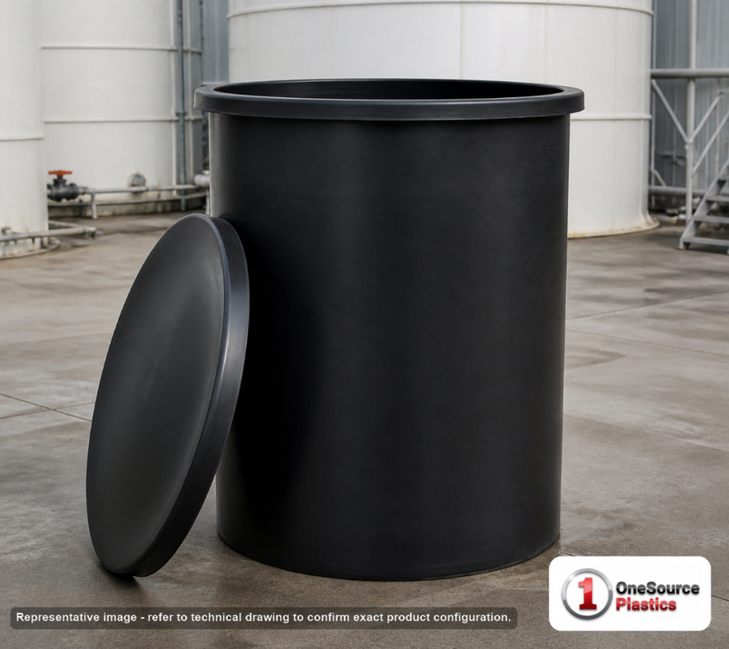
A hundred and twenty gallons, open top, 46.6 inches tall
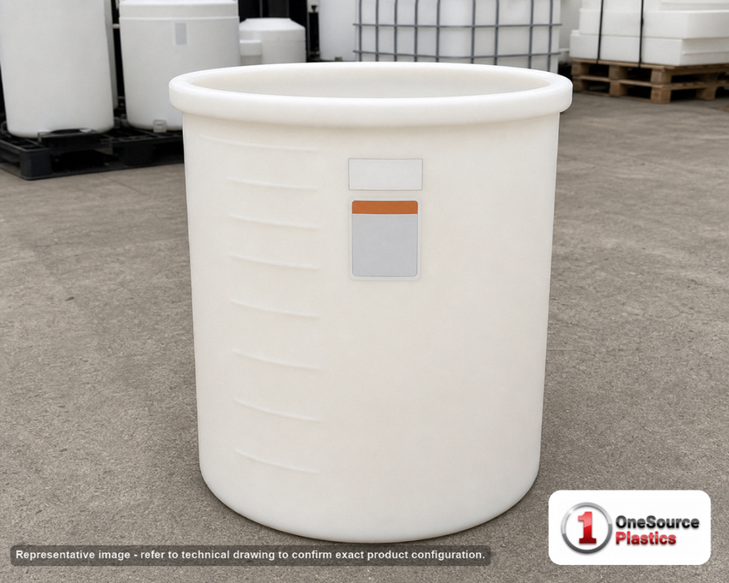
The Snyder SII-570TDVOT-45 is a 120 gallon open top batch storage tank in white polyethylene, listed at 30 inches long, 30 inches wide and 46.6 inches tall, and 50 pounds empty. It is a cylindrical open top vessel: the top is open, and the sheet describes no cover, no gasket, no seal and no vent, so this page claims none of them. It does carry a 10 inch lid field and a 10 inch manway field, both bare numbers with no description attached, and we print those exactly as the sheet gives them without reconciling them against the open top name. The wall is rated at a specific gravity of 1.9, and the sheet gives 1,001 pounds for 120 gallons of water at 8.34 pounds per gallon with 1,902 pounds of max contents. The service limit is 120 F / 48 C. There is no outlet, no inlet and no warranty term on this sheet, so no drain, no bulkhead and no valve is asserted here. Freight is LTL under NMFC 156600-02, out of Marked Tree, Arkansas.
Replacing a tank that failed? Call 866-418-1777 with what it held and how long it lasted; or check freight to your ZIP and put the 120 gallon tank in your cart above.
Open batch work and the reach into the tank
An open top tank is bought by somebody whose hands and eyes have to go into the vessel. That is the duty, and it is a completely different one from storage. The operator is adding a solid to a liquid and watching it dissolve, dropping parts in and lifting them out, scooping, skimming, sampling, brushing the wall down at the end of a shift, or simply reading the level at a glance rather than through a gauge. A closed tank with a manway makes every one of those jobs slower and some of them impossible. What you give up in exchange is the top: an open vessel has no vapour control, no protection from whatever falls into it, and no way to stop the contents evaporating or picking up dust and rain. That is the trade, and it is worth stating plainly rather than dressing up. So the number that decides this purchase is the height. At 46.6 inches the rim sits around chest height on most people standing beside it, which is the practical limit for reaching the bottom of a 30 inch diameter vessel without a step. Below that, work is comfortable; much above it, the operator is working blind over a rim. Pair that with a footprint of only 30 inches square and you have a vessel that fits against a bench, in a corner of a process room or beside a line, and that a person can walk right around. Support it on flat, continuous, level bearing across the whole base, not on two rails and not on a soft pallet board, and remember what is standing on it: 1,001 pounds of water at capacity, and 1,902 pounds at the rating this sheet publishes, on a 30 inch square. Where that surface is a poured slab rather than a structural floor, the concrete pad sizing guide for above-ground polyethylene tanks sets out the framework and where its boundary lies. Size the batch honestly, because on an open tank the freeboard is not only about thermal expansion; it is about what happens when somebody stirs vigorously or drops something in. Put your batch volume through the tank sizing calculator and take the headroom discipline from the tank sizing guide, then leave more than the arithmetic says. Where the vessel is part of a train holding water of varying quality rather than a single make-up tank, the industrial water reuse tank topology guide covers how quality-banded storage trains are sequenced.
Ninety, one twenty and one seventy-five open tops
| Part | Gallons | Length x width x height | Empty weight |
|---|---|---|---|
| SII-570TDVOT-45 (this tank, tallest and narrowest) | 120 | 30 x 30 x 46.6 in | 50 lb |
| SII-56900VOT45 (smaller volume, heavier) | 90 | 30 x 34 x 36 in | 100 lb |
| SII-1550200N39 (largest volume, lowest rim) | 175 | 42 x 42 x 30 in | 75 lb |
Three open tops, and the volume column is the least informative one in the table. Start with the rim height instead, because on an open vessel that is what the operator lives with. This tank is the tall one at 46.6 inches. SII-56900VOT45 holds 90 gallons with its rim ten inches lower at 36 inches, on a 30 by 34 inch plan, and it is listed at 100 pounds, which is twice this tank's empty weight for three quarters of the volume; the sheet explains nothing about that weight and neither do we. SII-1550200N39 is the interesting one: 175 gallons, nearly half as much again as this tank, with its rim at just 30 inches, which is waist height, on a 42 inch square plan at 75 pounds. Its wall is rated at a specific gravity of 1.35 where this tank is rated at 1.9. Put the three in a line and the rule is easy to state. If somebody has to work in the vessel all day, buy the low wide one and give up the floor space. If the floor is what you are short of and the work is mostly adding and drawing off rather than reaching in, buy this tall narrow one. If the product is heavier than water, read the rating on each sheet before anything else, because the ratings are not the same across this family and that decides the shortlist before the ergonomics do. On a vessel this size there is no penalty for changing your mind except the pad, so measure the bench and the reach of the person who will actually use it.
Want the certified one or the plain one? Call 866-418-1777 and say what the inspector asks for; or request a quote on the row you need.
No outlet on the sheet, and what that means for the pump
- The discharge: this sheet publishes no outlet, no inlet and no bulkhead. No size, thread or position is claimed here. That is the first thing to settle when a pump is involved, so tell us how the liquid is meant to leave and we will confirm what this part number carries before it ships.
- Pumping from an open top: with no published outlet, the arrangement is a suction line over the rim with a foot valve, which is easy to set up and easy to get wrong. Keep the foot valve off the floor of the tank so it does not draw settled material on start-up, clamp the line to a frame rather than resting it on the rim, and site the pump below the liquid line if the layout allows it so it is not lifting on every start.
- Total drain: an open top with no published outlet does not empty itself. Plan how the last few gallons and the rinse water get out, whether that is a portable pump, a siphon or a tip, and plan it before the vessel goes into a corner where none of that will fit.
- The top: the sheet carries a 10 inch lid field and a 10 inch manway field as bare numbers with no description, and it describes no cover, no gasket and no vent. We print the fields and claim nothing from them. If a cover matters to your process, ask us to confirm what the part carries.
- Level: no sight tube, no gauge and no graduation is published. On an open vessel the level is read by eye, which is a genuine advantage right up to the point where somebody needs a number.
- Limits: 120 F / 48 C is the service limit, the wall is rated at a specific gravity of 1.9, and no warranty term appears on this sheet.
Tell us the liquid when you order so any fitting we add is matched to it. On an open vessel one more thing is worth saying out loud: whatever is in it is reachable, so the guarding, the lid arrangement and the access to the rim are part of the installation and not an afterthought.
Batching, reuse water and the vessel you can see into
A hundred and twenty gallons with an open top goes into parts washing and dip work in a machine shop, plating and metal finishing lines, cleaning and sanitising solution make-up at food and beverage plants, dye and pigment mixing, laboratory and pilot scale batching, greenhouse and nursery nutrient mixing, aquaculture and hatchery holding, and collection duty for rinse water, condensate or recovered process water that is going to be treated or reused rather than discharged. The common factor is that somebody interacts with the contents directly instead of through pipework. The failure this duty punishes is the one nobody plans for: an open vessel collects everything in the room, so it needs a cleaning routine, a covered store if the contents evaporate, and a clear rule about what is allowed to be set down on the rim. Decide those on the day it is commissioned, not after the first contaminated batch.
Marked Tree, Arkansas, fifty pounds shipped
This tank is moulded at Marked Tree, Arkansas, which puts the mid-South, the Gulf and the lower Midwest on a short lane. The sheet gives the freight class as LTL, a mode rather than a numeric class, under NMFC 156600-02, and it measures 30 inches square by 46.6 inches tall. Price the lane to your ZIP with the freight cost estimator; the listed price is before freight. At 50 pounds it comes off the truck in one person's arms, so no forklift and no dock appointment is needed, but an open top vessel travels with nothing over it and arrives as a receptacle for whatever the yard has: look inside before it goes anywhere near a process, and wash it out. Set it on its final level support, then fill it with clean water and hold that 1,001 pound load while you read the base and the wall all the way round at the seam height. Drain it and dry it before the working liquid goes in. Then do the one thing an open tank rewards more than any other: mark a fill line on the inside wall at the working volume, in permanent marker, so every batch after that is measured by eye against the same line. Where the freeboard question is the one you are actually wrestling with, the freeboard sizing guide on thermal expansion, chemistry and density works through the real usable volume. Keep one spare gasket for the outlet fitting on the shelf; it is the part that fails on a holiday.
Freight and documents
Ships from: Marked Tree, AR. LTL freight is quoted to your ZIP with the freight cost estimator or by phone at 866-418-1777. The listed price is before freight.
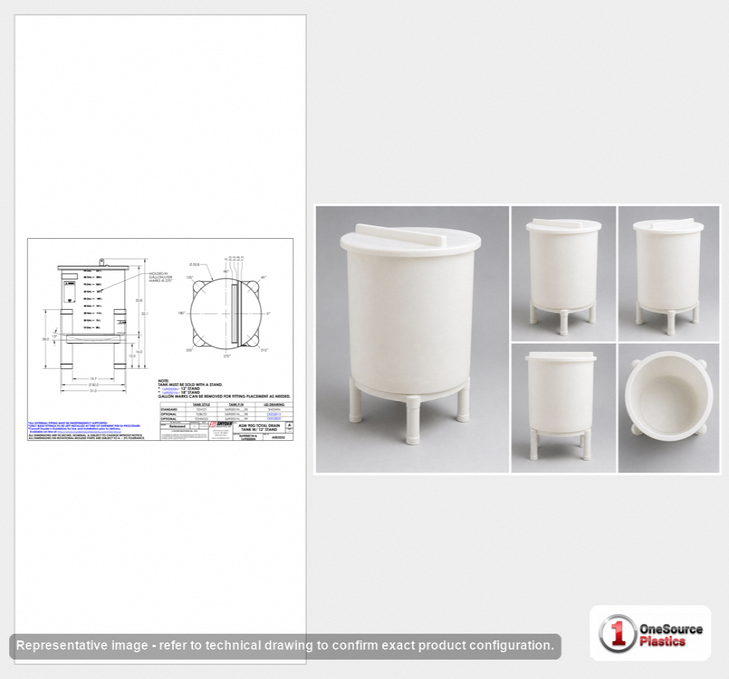
Technical drawing (PDF) for Snyder Industries 570TDVOT-45.
See this tank
Interactive 3D model with live fill. This tank has an interactive 3D model built to its manufacturer dimensions. Rotate it, and set a fill level to see how much liquid it holds at any height. Open the 3D view on the product photo above. Download the 3D model (GLB).
Product video. Watch the Snyder Industries 120 Gallon Plastic Open Top Batch Storage Tank in White video (62 seconds) with dimensions, fittings and shipping notes.
Ready to order?
Add it to your cart at the top of this page, get LTL freight to your ZIP, request a written quote, or call 866-418-1777. The listed price is before freight.