400 gallons of cross-linked polyethylene on a 45 inch square of floor
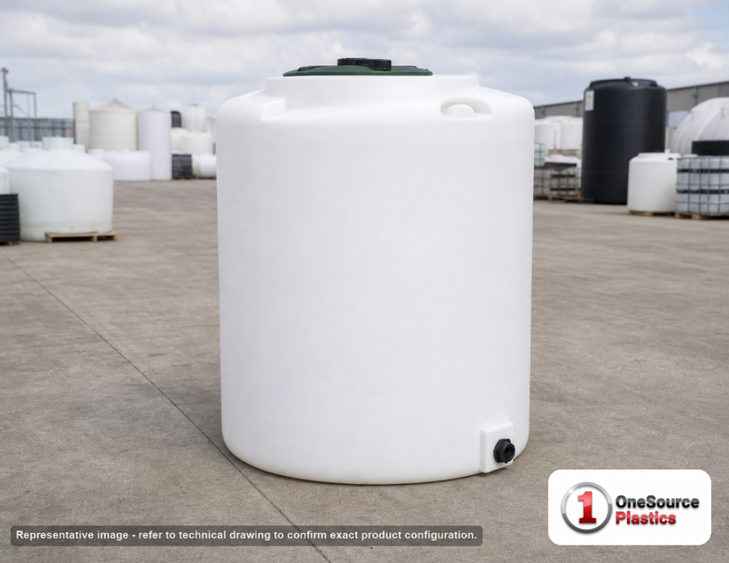
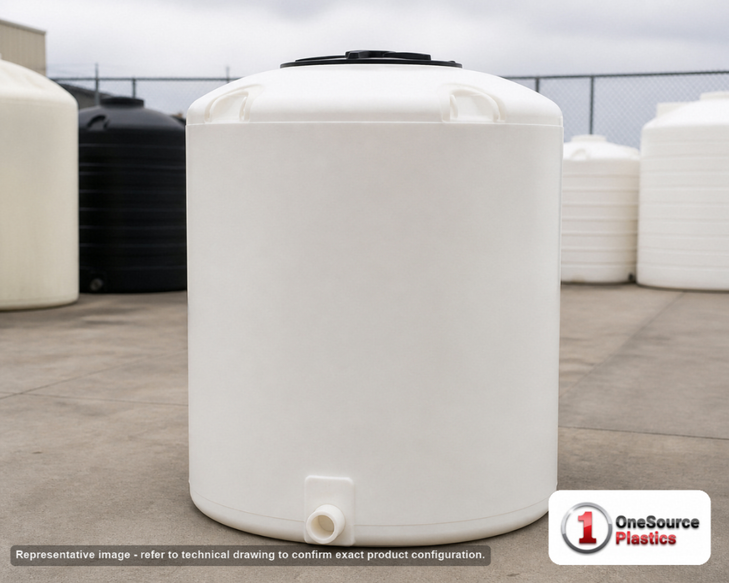
Small, heavy-walled and bought by the square foot: the Snyder SII-1740000N42 holds 400 gallons in a white cross-linked polyethylene shell 45 inches across and 64 inches tall, and weighs 85 pounds empty. The sheet rates the wall at a specific gravity of 1.9 and gives the maximum contents as 6,338 pounds, against 3,336 pounds for 400 gallons of water at 8.34 pounds per gallon. It lists an 18 inch threaded vented manway on top and gives the outlet as 2 inches, with no material and no fitting style named and no inlet at all. Freight is class 400 on an ordinary LTL deck out of Lincoln, Nebraska. The sheet publishes no temperature limit and no warranty term, so this page asserts neither; ask us for Snyder's current terms in writing.
Price it in one step. Freight to your ZIP shows in seconds; add the 400 gallon tank to your cart above, or call 866-418-1777 if the site has a question in it.
A 45 inch base, 64 inches of height, and the doorway it will not pass
This tank is chosen by measuring the room. At 45 inches across it wants a 45 inch square of clear, flat, load-bearing floor plus working space around it, and at 64 inches tall it stands comfortably under a 96 inch ceiling with the manway reachable from the ground or a low step, which is exactly why small verticals like this live indoors. Do the doorway arithmetic before the order, though, because a 45 inch diameter shell will not pass through a 36 inch door and no amount of tilting changes that; check the route in, the turns, and anything overhead, and if the only way in is a 36 inch door then the tank has to go in before the wall does or it has to be a different tank. On the floor itself, the rules do not relax with the size: a rotationally molded base bears on the whole surface it touches, so it sits on a flat, level, continuous surface rather than on two joists, a pallet or a patch of broken concrete, and at the rating on the sheet the full weight is 6,338 pounds standing on that small circle, which is a real point load for a suspended floor or a mezzanine and is worth checking against the structure rather than assuming. The pad discipline that applies outdoors applies in miniature indoors and is set out in the concrete pad sizing guide. Outdoors, an 85 pound empty tank is light enough for one gust to put on its side, so strap it before it is filled, every time. And confirm the volume is the one the process needs: put the batch size, the draw and the refill interval through the tank sizing calculator, then take the reserve and the headspace numbers from the tank sizing guide.
Four ways Snyder builds a 400, with a 360 and a 440 either side
| Part | Gallons | Diameter x height | Empty weight |
|---|---|---|---|
| SII-1740000N42 (this tank, white, cross-link) | 400 | 45 x 64 in | 85 lb |
| SII-1740000N45 (white, same shell height) | 400 | 45 x 64 in | 85 lb |
| 1740000N48 (black, heavy duty) | 400 | 45 x 62 in | 85 lb |
| 1740000N51 (black, heavy duty) | 400 | 45 x 62 in | 85 lb |
| 5760100N42 (smaller, wider base) | 360 | 53 x 59 in | 116 lb |
| 5770100N42 (larger, wider base) | 440 | 53 x 69 in | 130 lb |
Inside the 400 gallon group the footprint never changes: every one of them is 45 inches across and listed at 85 lb, and the only dimensional difference on the sheet is height, 64 in on this tank and the white tank beside it against 62 in on the two black heavy duty grades. So the choice is made on the wall and on the colour. This one is the white cross-linked shell rated 1.9 on its own sheet, which is the buy when the liquid is heavier than water and an operator wants to see a shadow line through the wall to judge the level without opening the lid. The black grades keep sunlight off a liquid that light spoils, at the cost of seeing nothing from outside; each carries its own rating on its own sheet and this page claims none of them. Step outside the 400 and the footprint changes rather than the height: 5760100N42 holds 360 gallons on a 53 inch base at 59 in and 116 lb, and 5770100N42 holds 440 gallons on the same 53 inch base at 69 in and 130 lb, so both trade eight more inches of floor for a lower or slightly taller shell. If floor space is the constraint, the 45 inch shells win; if headroom is the constraint, the wider 53 inch pair are the ones to look at.
Settled on the 400 gallon tank? Freight to your ZIP and add to cart above; a written quote is one click away for the paperwork.
An outlet the sheet gives as 2 inches, and nothing else about it
- Outlet: the sheet lists the outlet as 2 inches and names no material, no thread form and no fitting style for it, which is worth knowing before you buy pipe. Tell us the liquid and how the tank is being plumbed and we will confirm the fitting and the gasket against Snyder's current specification in writing rather than guessing at it from the size alone.
- Head at that outlet: 64 inches of shell puts a little over five feet of liquid above the base when the tank is full, which is modest suction head. Mount the pump below the outlet so the column keeps it flooded, or use a self-priming pump if it has to sit level with the tank; a pump set above the fitting will lose prime at the end of every draw and sound like a failing pump rather than a bad layout.
- Rating at the base: the wall is rated at a specific gravity of 1.9 and the sheet gives the maximum contents as 6,338 pounds, so a dense liquid puts more pressure on the base fitting than water would. Rate the valve, the gaskets and the first run of pipe for the liquid, and support the valve independently rather than hanging it on the tank.
- No inlet on the sheet: the fill point is specified rather than supplied, and on a tank this size that usually means a connection at working height rather than a hose dropped through the lid. Think about how a batch is measured in as well as how it goes in.
- Access: an 18 inch threaded vented manway on top at 64 in, reachable from the floor or a step, which is the practical advantage of a small vertical. Keep it closed, keep the vent clear, and never let a transfer pump draw against a blocked vent, because a small shell collapses just as readily as a large one.
Plumb a small tank as if it will be moved, because it usually is. A flexible first joint at the outlet, a union close to the tank, and a valve on its own support mean this vessel can be drained, unbolted and relocated in an afternoon rather than cut out of a rigid line; that flexibility is most of the reason a plant buys a 400 rather than plumbing everything into one large tank. Where it sits on a bunded floor or inside secondary containment, keep the whole base visible and leave room to get a hand and a light right around the wall. Label the tank with the liquid, the date it went into service and the outlet size, and label it in a way that survives a wash-down.
Day tanks, batch make-up and small volume holding on a plant floor
400 gallons is a shift, a batch or a delivery rather than a month of supply, which is exactly what makes it useful: a day tank feeding a dosing pump from a larger bulk vessel, batch make-up and dilution at a plant or a car wash, a small chemical or additive store at a workshop, mix water and rinse water held indoors where a large tank would not fit, and holding for a heavier-than-water solution where the 1.9 rating on this sheet is the point. Where the tank is one stage in a system that collects, holds and returns a liquid rather than a standalone vessel, the industrial water reuse tank topology article shows where a small vessel belongs in the sequence and what has to be true either side of it. And where somebody is holding 400 gallons of water against a fire risk on a remote site, the honest reading of what that does and does not buy is in the fire-water reservoir design guide.
Lincoln, Nebraska on an ordinary LTL deck at 85 pounds
This is the easy one to buy freight for. The SII-1740000N42 is molded at Lincoln, Nebraska and moves as ordinary LTL freight at class 400 as the sheet lists it, shipping at 45 inches by 45 inches by 64 inches, which fits on a standard deck without a permit and without the route survey a wide load needs. The freight cost estimator prices the lane to your ZIP, and the listed price is before freight. At 85 pounds two people can handle it off a liftgate, but handle it by the body and not by the manway, and keep it upright, because a small shell dropped on its shoulder takes a flat spot that will never sit properly on a floor again. Check the wall and the base for dents and scuffs while the driver is still there, and inspect the outlet area closely, since a 2 inch fitting on a 45 inch shell is the thing a pallet jack finds. Then water test it in place before the liquid goes in: fill it, leave it standing for a day, and look underneath. The one thing a small tank rewards more than a big one is being unbolted and checked twice a year, because it is light enough that you actually will. Note the pad height and the outlet height on the site plan while the tape is out; the next pipe run will need both.
Freight and documents
Ships from: Lincoln, NE. LTL freight is quoted to your ZIP with the freight cost estimator or by phone at 866-418-1777. The listed price is before freight.
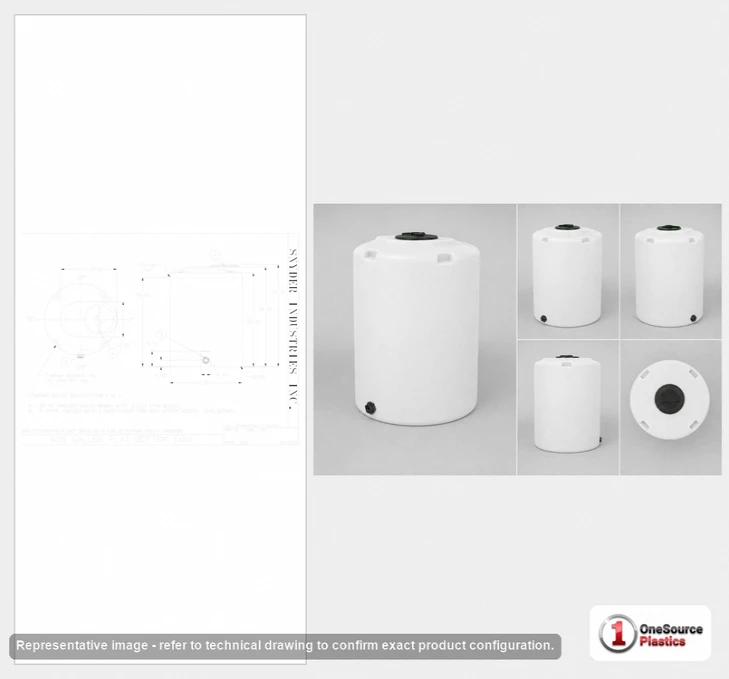
Technical drawing (PDF) for Snyder Industries 1740000N42.
See this tank
Interactive 3D model with live fill. This tank has an interactive 3D model built to its manufacturer dimensions. Rotate it, and set a fill level to see how much liquid it holds at any height. Open the 3D view on the product photo above. Download the 3D model (GLB).
Product video. Watch the 400 Gallon Crosslink Vertical Storage Tank in White video (71 seconds) with dimensions, fittings and shipping notes.
Ready to order?
Add it to your cart at the top of this page, get LTL freight to your ZIP, request a written quote, or call 866-418-1777. The listed price is before freight.