Forty-four hundred gallons, seventeen hundred pounds empty, rated 1.9
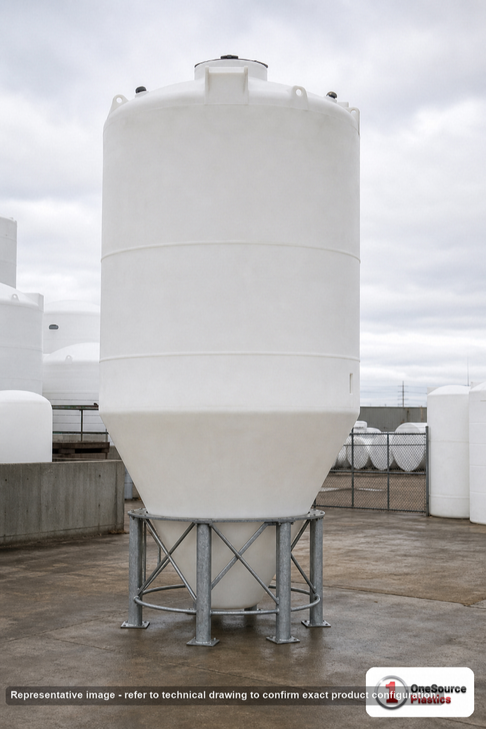
The Snyder 5200000N45 is a 4,400 gallon cone bottom tank listed 90 inches long, 90 inches wide and 200 inches tall on a 90 inch diameter, at 1,700 pounds empty and 1,700 pounds shipping, with the colour field reading White and the material field reading Polyethylene. The wall carries a specific gravity rating of 1.9, and the sheet gives 69,722 pounds of max contents against 36,696 pounds of water at 4,400 gallons and 8.34 pounds per gallon. Thirty degrees is the angle in the maker's name for this listing; the cone degrees field is empty on the sheet, so no measured angle is stated here. The opening on top is an 18 inch threaded vented manway and the lid size field reads 18 inches. The outlet and inlet fields are both empty, so no discharge hardware is claimed below. It is moulded at Lincoln, Nebraska, ships from Nebraska, and the freight class reads 500 beside an oversize ship mode. No max operating temperature, no warranty term, no stand, no lug count and no NMFC number is published on this sheet.
Want it on your site? Get LTL freight to your ZIP, add it to your cart above, or call 866-418-1777 and a tank specialist will confirm the fit.
One plant, one origin state, and the lane your ZIP sits on
This tank is moulded at Lincoln, Nebraska, and Nebraska is the origin state on the sheet. On a vessel this size that single fact belongs at the top of the page rather than buried at the bottom, because the lane from central Nebraska to your gate is a real part of what this purchase costs and it is decided before anything about the specification is. The plains and the Midwest are close. The Gulf, the Southwest and both coasts are a long way, and at 90 inches by 90 inches by 200 inches the load takes trailer space out of all proportion to its 1,700 pounds. That is the economics of hollow moulded goods: you are buying the space, not the tonnage, and the class 500 rating beside an oversize ship mode says so plainly. So get the lane figure before you get attached to the part number, and get it for the site the tank will actually stand on rather than for the office that is buying it. Two things follow from the lane that people work out too late. The first is the delivery window. An oversize move is not something a carrier slides onto a part load at short notice, so the date moves in weeks rather than days and the stand, the pad and the pipework should be planned against that rather than against a hope. The second is the offload. The truck arrives with sixteen feet of tank lying down, and everything that happens next is yours to arrange: the machine, the person, the clear ground to turn it in and the room above to stand it up. The sheet publishes no crane, no rigging, no permit and no escort detail, so none is described on this page. Underneath all of it sits the structure, because a cone bottom tank has no flat floor and cannot stand on its own bottom. This sheet publishes no stand, no legs, no skirt, no support ring and no bolt pattern, so the support is a separate item and no stand height, rated load, leg count or material appears here; what the sheet does publish is the load case, 1,700 pounds of empty tank, 36,696 pounds full of water and up to 69,722 pounds of contents at the rating, arriving on a few feet inside a 90 inch circle. Size the volume with the tank sizing calculator, take the freeboard from the tank sizing guide, and settle the geometry against the cone angle selection guide.
Three rows on the two hundred inch shell and a wider alternative
| Part | Gallons | Length x width x height | Empty weight |
|---|---|---|---|
| 5200000N45 (this tank, white, rated 1.9) | 4400 | 90 x 90 x 200 in | 1700 lb |
| 5200000N42 (same shell, heavy duty listing) | 4400 | 90 x 90 x 200 in | 1700 lb |
| 5200000N46 (same shell, lighter listing) | 4400 | 90 x 90 x 200 in | 1400 lb |
| 5200000N48 (same shell, heavy duty listing) | 4400 | 90 x 90 x 200 in | 1700 lb |
| 5180000N40 (a size down, same circle) | 4100 | 90 x 90 x 197 in | 1000 lb |
| 8050100C75501 (more gallons, wider circle, much shorter) | 4600 | 102 x 102 x 154 in | 1200 lb |
The last row is the one to look at hardest, because it is the only row here that changes the building. 8050100C75501 holds 4,600 gallons on a 102 inch circle at 154 inches tall, so it carries more liquid than this tank in a shell that is nearly four feet shorter and a foot wider. If your headroom is the binding constraint, that is the row to price first and the footprint argument can follow; if your floor is tight and the roof is high, the 90 inch column is the one. Everything above it stands on the same 90 inch circle, which means moving between those rows is a drawing change rather than a civils change, and that is worth knowing before the concrete is specified. Within the 4,400 gallon group the sheet separates the rows by empty weight and by the name it prints on each: 1,700 pounds on this listing and on two others, 1,400 pounds on the fourth. The sheet accounts for that spread nowhere, so this page accounts for it nowhere either. What it does publish per row is the rating, and on this listing that is 1.9 with 69,722 pounds of max contents. That is the figure to match against your own liquid's weight per gallon, because it is the only comparison in this table that has anything to do with what you are storing rather than with where you are storing it. The 4,100 gallon row directly beneath sits on the same circle at 197 inches; it is the honest buy when the real batch is a little smaller than the round number in the specification, and it hands back nothing in footprint.
Picked the 4400 gallon tank? Add it to your cart above; freight is quoted to your ZIP before you pay anything.
Start at the eighteen inch vented manway
- The fill opening: an 18 inch threaded vented manway, with the lid size field also reading 18 inches. That is where product goes in, where an inspection torch goes in and where the air path lives, and on this sheet it is the only opening dimensioned at all. Eighteen inches is a working opening rather than a port, which matters when a hose end, a dip tape or a light has to go through it.
- The vent that comes with it: the vent arrives as part of the manway rather than as a separate item, and it is doing structural work whenever a pump draws the tank down, because a shell that cannot take air in takes the load in its wall instead. Keep it clear, look at it every time the tank is open, and never blank, wrap or tape it to control an odour.
- Getting to it: the manway sits at the top of 200 inches of shell plus whatever stand carries the tank. No ladder lugs and no structural attachments are counted on this sheet, so the access arrangement belongs to the structure, and the fill line should land at a coupling at working level rather than being carried up by hand.
- The outlet: this sheet publishes none, and the inlet field is empty too. No discharge dimension, thread, bulkhead, drain or valve is claimed. Tell us the line size you need to land, the valve type and the liquid, and we will confirm what this part number carries before anything is ordered.
- What you hang at the low point: whatever goes there carries the column above it, and this sheet allows that column to reach 69,722 pounds. Support the valve, any reducer and the first pipe run on steelwork off the stand rather than on the tank, with a flexible connector at the first joint.
- Published limits: a specific gravity rating of 1.9, 36,696 pounds of water at 4,400 gallons and 69,722 pounds of max contents. No max operating temperature and no warranty term is published on this sheet, and neither is claimed here.
Thirty degrees is the maker's name word for this listing and the cone degrees field is empty, so nothing on this page is measured off a photograph; ask us to confirm the geometry against the part number if drainage behaviour is what decides the purchase.
Heavy concentrate held in bulk between deliveries
A 1.9 rating with 69,722 pounds of max contents is not bought because it sounds better. It is bought because the product weighs more than water and somebody wants to fill the vessel rather than fill half of it and call the rest freeboard. Concentrated mineral and salt solutions in a process building, liquid fertiliser and crop protection concentrates at an agricultural retailer, treatment chemistry held at working strength, brines, spent liquor and pickling solution in a metals plant, slurries and suspensions that carry solids and still have to leave the vessel clean, and heavy recovered streams held between collections. The 4,400 gallon size is the other half of the argument: it takes a full bulk drop in one vessel, which means one connection, one label and one set of paperwork rather than a split delivery into two tanks. The cone is the quiet third reason. Dense product left across a flat floor is heavier, more valuable and more of a disposal problem than a light one, so full-drain geometry pays back faster at high specific gravity than at low. Two honest limits belong with that. This sheet publishes no temperature figure, so a hot fill is a conversation rather than an assumption. And a tall column of dense liquid puts genuine load into everything below it, which makes the stand, the pad and the anchors the wrong place to economise on this particular listing. Bring us the liquid, its weight per gallon and its temperature at fill, and start the check yourself in our chemical compatibility reference, because the gasket and the trim are chosen from the chemistry rather than from the vessel.
Service list by chemical
One line per liquid the maker rates for this resin, with the concentration it is rated to and the fitting and gasket to order. Take your own concentration and temperature to the linked page or the chemical compatibility database before ordering.
- aluminum sulfate at 50%
- calcium chloride at 40%
- ethylene glycol at 100%
- ferric chloride at 50%
- ferric sulfate at 60%
- ferrous sulfate at 20%
- magnesium chloride at 30%
- polyaluminum chloride
- potassium carbonate at 50%
- potassium hydroxide saturated
- sodium carbonate at 30%
- sodium thiosulfate at 40%, ozonated water up to 10 PPM, plus
- sodium bisulfate and
- sodium bisulfite on PVC/PP fittings.
- Acetic acid at 60%
- hydrofluoric acid at 48%
- hydrofluosilicic acid at 26%, and
- urea solution at 50% step up to PP/PVC fittings.
- hydrochloric acid at 37%
- hydrogen peroxide at 50%
- phosphoric acid at 85%
- sodium hypochlorite below 16.5%, and
- sulfuric acid at 98% (which moves to CPVC fittings).
- Peracetic acid at 30% is its own case, calling for 316SS fittings and an Aflas gasket. A few service chemicals run metal trim rather than PVC:
- DEF at 32.5% uses 316SS fittings with EPDM, and
- propylene glycol and
- zinc orthophosphate run PP/316SS with EPDM. Matching the wrong gasket to a strong oxidizer - EPDM where Viton or Aflas is called for - is the most common failu
Oversize freight, class 500, and what happens at the kerb
The freight class on this sheet reads 500 beside an oversize ship mode, and no NMFC number is published. The shipping size is listed at 90 by 200 by 200 inches, which is the tank lying down, at 1,700 pounds. Price the lane to your own ZIP with the freight cost estimator before you commit; the listed price is before freight. Then plan the twenty minutes after the truck stops, because that is where these deliveries go wrong. The tank travels on its side and is stood up at your end, which needs clear ground wide enough to swing sixteen feet of shell, clear air above the trailer, and a machine and an operator nominated in advance rather than found on the day. The sheet publishes no crane, no rigging, no permit and no escort detail, so none is described here; agree the offload equipment and the delivery window with us before the truck is booked. Have the stand set, levelled and anchored first, because a cone bottom tank with nowhere to stand is a tank lying in your yard occupying the space you needed for something else. No lifting lugs are counted on this sheet, so do not assume any: sling under the body, never off the manway, and restrain the shell from the moment it is upright. Commission with clean water rather than product, hold the 36,696 pound water load, then read the manway seal, the cone joint, the stand feet and the pad edge in that order and leave it standing full overnight. Walk the base again after the first hard rain, because a pad that is going to shift under this load shows it at the edge before it shows it anywhere else. Keep the delivery paperwork with the tank; the serial number on the shell is what a warranty claim starts from.
Freight and documents
Ships from: Lincoln, NE. LTL freight is quoted to your ZIP with the freight cost estimator or by phone at 866-418-1777. The listed price is before freight.
Technical drawing (PDF) for Snyder Industries 5200000N45.
See this tank
Interactive 3D model with live fill. This tank has an interactive 3D model built to its manufacturer dimensions. Rotate it, and set a fill level to see how much liquid it holds at any height. Open the 3D view on the product photo above. Download the 3D model (GLB).
Product video. Watch the 4400 Gallon 30 Degree Plastic Cone Bottom Tank video (74 seconds) with dimensions, fittings and shipping notes.
Ready to order?
Add it to your cart at the top of this page, get LTL freight to your ZIP, request a written quote, or call 866-418-1777. The listed price is before freight.