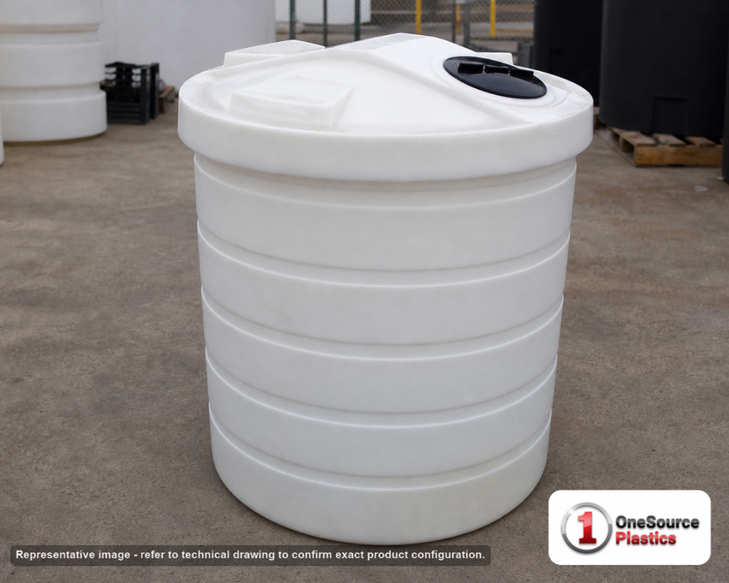
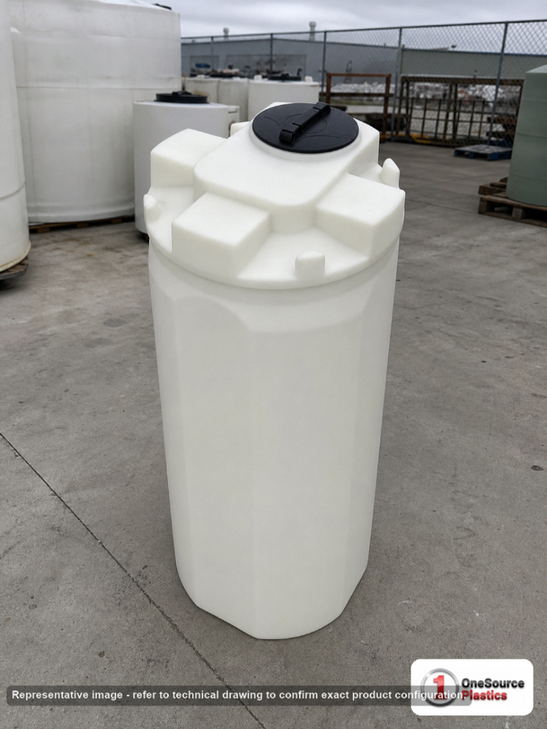
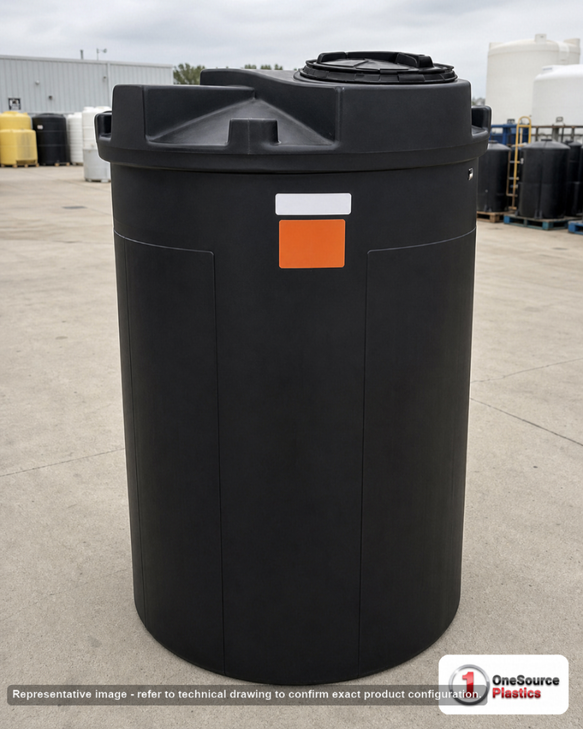
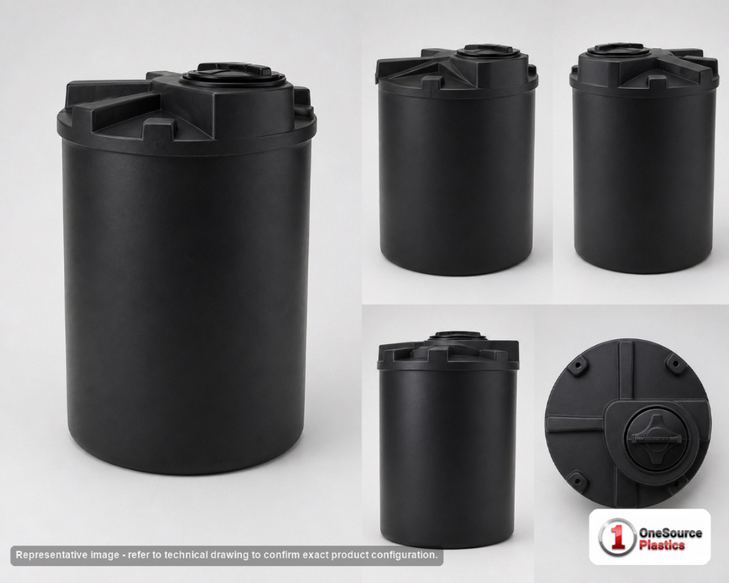
The Chem-Tainer 150 Gallon Vertical Double Wall Liquid Chemical Storage Tank (SKU TC3448DC) is a self-contained primary-plus-secondary containment unit built for chemical service where a leak from the inner tank has to be caught without a separate berm. It holds 150 gallons in a 34 x 34 inch footprint, stands 48 inches tall, and uses its outer wall as integral secondary containment - the core reason to specify a double wall vertical storage tank over a cheaper single-wall plus a poured curb. The polyethylene inner tank carries a 1.9 specific gravity rating, so it handles dense liquids well above water-weight chemistries. When site rules require containment built into the tank itself, this is the unit to spec.
Will it work for your liquid?
Start with weight, because that is where double wall tanks surprise people. Filled with water this 150 gallon tank carries about 1,251 pounds of contents; at its 1.9 specific gravity ceiling the contents alone can reach roughly 2,377 pounds. Size the pad, anchoring, and any structural support to the heavier number for your actual chemistry, not to the water figure - that 2,377 lb max-rated figure also drives the freight class on your LTL quote, so it pays to know it early. The 34 x 34 inch footprint keeps this storage tank compact for indoor rooms and skid layouts. Run your numbers through the Tank Sizing Calculator and the Tank Sizing Guide to match volume and weight to your space before you commit.
Secondary containment without a separate berm
Because the outer wall captures any release from the inner tank, this double wall tank can satisfy site secondary-containment requirements without building a separate berm or dike around it - a real advantage for indoor installs and tight pad layouts. If your project falls under SPCC oil/chemical containment rules, walk through the design logic in our guide on double-wall tanks for SPCC 40 CFR 112 compliance, and pair the tank with proper overfill protection using our level gauge selection guide for chemical service before you finalize the build.
Chemical compatibility
The tank is molded from polyethylene with a 1.9 specific gravity rating. The resin reads as HDLPE but should be confirmed - verify HDLPE versus XLPE with us before placing any aggressive oxidizer or solvent into service, since cross-linked and linear polyethylene behave differently with certain chemistries. The chemicals below come from the OEM chemical-resistance chart and are concentration- and temperature-specific; always match your exact concentration, temperature, and the listed fitting and gasket materials before ordering. One callout for the DEF and urea crowd: DEF (32.5%, EPDM gaskets) requires 316SS fittings, not PVC - the wrong metal corrodes and contaminates the fluid, so do not substitute here.
Common services this tank supports include acetic acid (60%, PP/PVC fittings, EPDM gaskets), aluminum sulfate (50%, PVC, EPDM), calcium chloride (40%, PVC, EPDM), ethylene glycol (100%, PVC, EPDM), ferric chloride (50%, PVC, EPDM), ferric sulfate (60%, PVC, EPDM), ferrous sulfate (20%, PVC, EPDM), hydrochloric acid (37%, PVC, Viton), hydrofluoric acid (48%, PP/PVC, Viton), hydrofluosilicic acid (26%, PP/PVC, Viton), hydrogen peroxide (50%, PVC, Viton), magnesium chloride (30%, PVC, EPDM), peracetic acid (30%, 316SS, Aflas), phosphoric acid (85%, PVC, Viton), polyaluminum chloride (PVC, EPDM), potassium carbonate (50%, PVC, EPDM), potassium hydroxide (saturated, PVC, EPDM), propylene glycol (PP/316SS, EPDM), sodium bisulfate (PVC/PP, EPDM), sodium bisulfite (PVC/PP, EPDM), sodium carbonate (30%, PVC, EPDM), sodium hypochlorite (under 16.5%, PVC, Viton), sodium thiosulfate (40%, PVC, EPDM), sulfuric acid (98%, CPVC, Viton), urea solution (50%, PP/PVC, EPDM), zinc orthophosphate (PP/316SS, EPDM), and ozonated water (up to 10 PPM, PVC, EPDM). Watch the gasket spec closely: most services run on EPDM, but the oxidizers - hydrogen peroxide, sodium hypochlorite, and sulfuric acid - require Viton, and peracetic acid needs Aflas. Do not reuse an EPDM gasket on those four. Cross-check your liquid in the Chemical Compatibility Database before you build out the fitting package.
The mistake to avoid
The costliest error on a double wall chemical tank is matching the fitting and gasket material to the tank instead of to the chemical. This tank will hold a wide range of liquids, but a PVC fitting and EPDM gasket that are fine for aluminum sulfate will not survive concentrated sulfuric acid, where CPVC and Viton are required - and DEF needs 316SS, not PVC. Confirm the specific gravity of your liquid against the 1.9 rating, settle the HDLPE-versus-XLPE question for aggressive oxidizers, and spec wetted materials per the chart, not per habit.
This double wall tank ships LTL freight from the Chem-Tainer plant in Merced, CA - a single West Coast origin, so build extra transit time and freight zone into far-East ZIP planning. Get a freight estimate to your exact ZIP with our Freight Cost Estimator (quoted live - never a freight price), or call 866-418-1777 to confirm fittings, secondary-containment requirements, and the right tank for your chemistry before you order.
Freight and documents
Ships from: Merced, CA. LTL freight is quoted to your ZIP with the freight cost estimator or by phone at 866-418-1777. The listed price is before freight.
Technical drawing (PDF) for Chem-Tainer TC3448DC.
See this tank
Interactive 3D model with live fill. This tank has an interactive 3D model built to its manufacturer dimensions. Rotate it, and set a fill level to see how much liquid it holds at any height. Open the 3D view on the product photo above. Download the 3D model (GLB).
Product video. Watch the Chem-Tainer 150 Gallon Plastic Vertical Double Wall Liquid Chemical Storage Tank video (62 seconds) with dimensions, fittings and shipping notes.
Ready to order?
Add it to your cart at the top of this page, get LTL freight to your ZIP, request a written quote, or call 866-418-1777. The listed price is before freight.