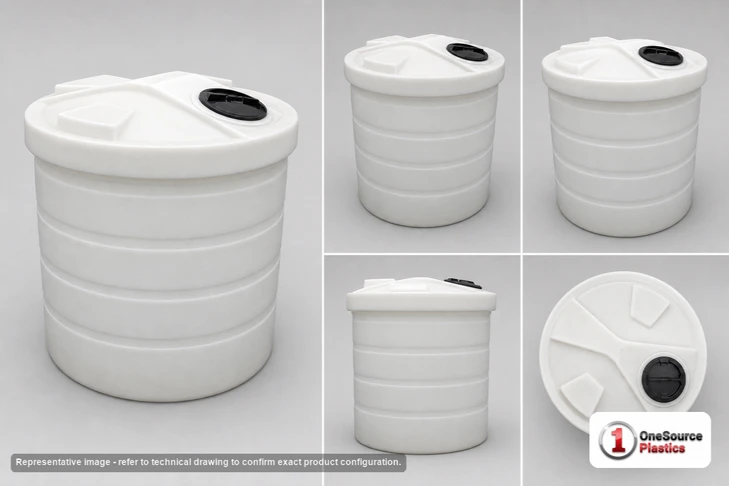
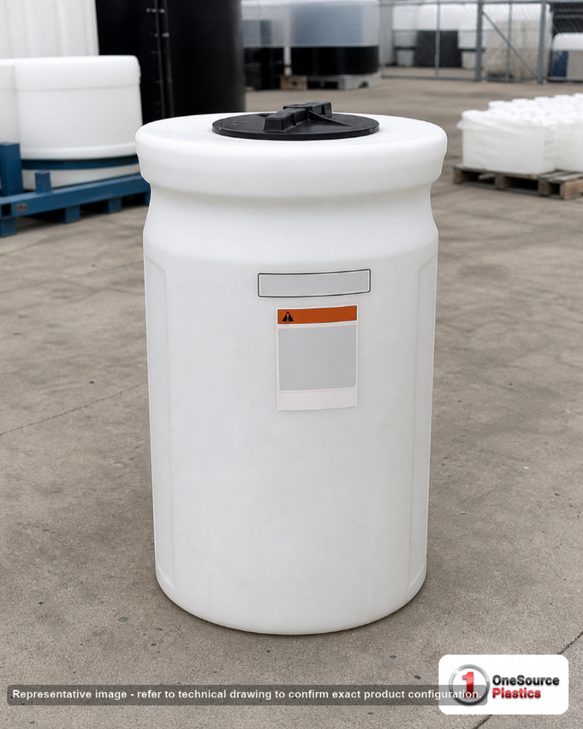
The Chem-Tainer 100 Gallon Vertical Double Wall Liquid Chemical Storage Tank (SKU TC3539DC) is built for aggressive liquids that demand secondary containment. The integrated double-wall design seats a primary chemical tank inside an outer containment shell, so a primary breach is caught instead of reaching your floor or berm. It carries a 1.9 specific gravity rating, engineered to hold dense liquids up to a contents weight of 1,585 lb, and the natural white polyethylene wall lets an operator eyeball the liquid level through the shell.
Will it work for your application?
This is a 100 gallon vertical storage tank with a compact 35 in by 35 in footprint and a 39 in overall height, so it fits tight chemical feed rooms and skid layouts. Filled with plain water it carries roughly 834 lb; at its full 1.9 SG rating the contents can reach 1,585 lb. That gap is the number that drives your install: size the pad, the outer containment shell, and any berm to the 1,585 lb worst case, not the water weight. The 1.9 SG headroom covers liquids up to about 1.9 g/mL, which is what lets it carry dense chemistries like 50% ferric chloride or 98% sulfuric acid rather than just water-weight fluids. Use the Tank Sizing Calculator and Tank Sizing Guide to confirm this 100 gallon size against your fill rate and turnover.
Chemical compatibility
This tank is molded from polyethylene (the resin is recorded as HDLPE, not yet confirmed) and rated to 1.9 specific gravity. Before committing it to chemical service, confirm the exact resin with us at 866-418-1777, because the HDLPE-versus-XLPE distinction changes which chemicals it can safely hold. Two things gate your order: your chemical's concentration must sit at or below the listed limit, and the fittings and gaskets must be matched to the chemistry, not just the tank wall. The tightest concentration ceilings to check first are sodium hypochlorite at under 16.5%, peracetic acid at 30%, and hydrofluoric acid at 48% — if your stored strength exceeds the listed value, this is not the right setup. Based on the OEM chemical-resistance chart, which is concentration- and temperature-specific, the following are compatible with this resin at 1.9 SG:
- Acetic Acid (60%) — PP/PVC fittings, EPDM gaskets
- Aluminum Sulfate (50%) — PVC fittings, EPDM gaskets
- Calcium Chloride (40%) — PVC fittings, EPDM gaskets
- DEF (32.5%) — 316SS fittings, EPDM gaskets
- Ethylene Glycol (100%) — PVC fittings, EPDM gaskets
- Ferric Chloride (50%) — PVC fittings, EPDM gaskets
- Ferric Sulfate (60%) — PVC fittings, EPDM gaskets
- Ferrous Sulfate (20%) — PVC fittings, EPDM gaskets
- Hydrochloric Acid (37%) — PVC fittings, Viton gaskets
- Hydrofluoric Acid (48%) — PP/PVC fittings, Viton gaskets
- Hydrofluosilicic Acid (26%) — PP/PVC fittings, Viton gaskets
- Hydrogen Peroxide (50%) — PVC fittings, Viton gaskets
- Magnesium Chloride (30%) — PVC fittings, EPDM gaskets
- Peracetic Acid (30%) — 316SS fittings, Aflas gaskets
- Phosphoric Acid (85%) — PVC fittings, Viton gaskets
- Polyaluminum Chloride — PVC fittings, EPDM gaskets
- Potassium Carbonate (50%) — PVC fittings, EPDM gaskets
- Potassium Hydroxide (saturated) — PVC fittings, EPDM gaskets
- Propylene Glycol — PP/316SS fittings, EPDM gaskets
- Sodium Bisulfate — PVC/PP fittings, EPDM gaskets
- Sodium Bisulfite — PVC/PP fittings, EPDM gaskets
- Sodium Carbonate (30%) — PVC fittings, EPDM gaskets
- Sodium Hypochlorite (<16.5%) — PVC fittings, Viton gaskets
- Sodium Thiosulfate (40%) — PVC fittings, EPDM gaskets
- Sulfuric Acid (98%) — CPVC fittings, Viton gaskets
- Urea Solution (50%) — PP/PVC fittings, EPDM gaskets
- Zinc Orthophosphate — PP/316SS fittings, EPDM gaskets
- Ozonated Water (up to 10 PPM) — PVC fittings, EPDM gaskets
Notice how the gasket spec shifts with the chemistry: oxidizers and strong acids such as hydrogen peroxide, sodium hypochlorite, phosphoric, hydrochloric, hydrofluoric, and sulfuric acid call for Viton (or Aflas on peracetic acid) instead of EPDM, and sulfuric acid steps the fitting body up to CPVC. This tank ships without fittings installed, so plan to order them: confirm the fitting count and locations on the technical drawing on this page, then order the PVC, CPVC, PP, or 316SS body with the EPDM, Viton, or Aflas gasket matched to your chemical. The single most common mistake on a tank like this is matching the resin to the chemical but leaving an EPDM gasket on an oxidizer line. Verify every chemical, concentration, and temperature against the OEM chemical-resistance chart and our Chemical Compatibility Database before you order. For instrumentation and overfill protection, see our guides on level gauge selection for chemical service and spillover redundancy engineering.
Containment and compliance
A double wall tank provides integrated secondary containment, with the outer shell built to capture a primary breach — which is also why your pad and any surrounding berm need to carry that 1,585 lb rated load. If your storage falls under SPCC, walk through the requirements alongside our double-wall tanks for SPCC 40 CFR 112 walkthrough. For broader brand-line context on how Chem-Tainer compares to Snyder and Norwesco on vertical tanks, our brand comparison covers the trade-offs (it is written around a larger size, so treat it as line-level context rather than a same-size match). Consult the technical drawing on this page for fitting locations and exact dimensions.
Freight
This tank ships LTL from a single Chem-Tainer plant in Merced, CA, with freight quoted live to your ZIP. Because it ships from one West Coast origin, East and Midwest buyers should expect LTL to be the dominant cost — quote your ZIP first rather than guess. Get a number in seconds with our Freight Cost Estimator, or call 866-418-1777 and we will quote it for you and help confirm the right fittings and gasket package for your chemical. Listed price is before freight.
Freight and documents
Ships from: Merced, CA. LTL freight is quoted to your ZIP with the freight cost estimator or by phone at 866-418-1777. The listed price is before freight.
Technical drawing (PDF) for Chem-Tainer TC3539DC.
See this tank
Interactive 3D model with live fill. This tank has an interactive 3D model built to its manufacturer dimensions. Rotate it, and set a fill level to see how much liquid it holds at any height. Open the 3D view on the product photo above. Download the 3D model (GLB).
Product video. Watch the Chem-Tainer 100 Gallon Plastic Vertical Double Wall Liquid Chemical Storage Tank video (62 seconds) with dimensions, fittings and shipping notes.
Ready to order?
Add it to your cart at the top of this page, get LTL freight to your ZIP, request a written quote, or call 866-418-1777. The listed price is before freight.