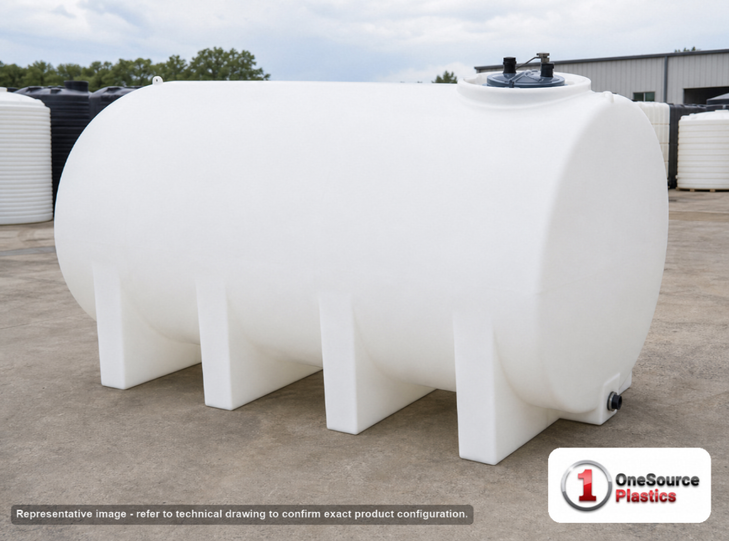
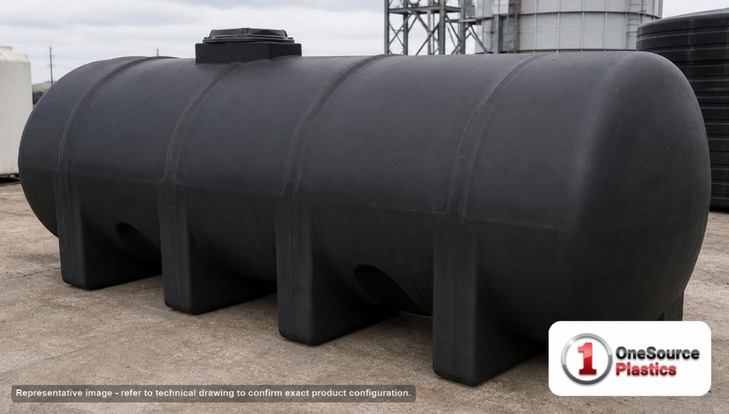
The Enduraplas 2200 Gallon Green Horizontal Sump Bottom Leg Tank (SKU THD02200G) is a 2,200-gallon polyethylene horizontal leg tank built to haul heavy liquids and ag chemistry on a transport skid or nurse trailer. It measures 130 inches long by 71 inches wide by 75 inches tall, riding on integral legs with a sump bottom that drains the load toward the low point so you empty it cleanly instead of leaving product pooled in the belly. The green polyethylene body carries a 1.9 specific gravity rating, which is what lets it haul dense fertilizer blends, DEF, and the heavy acids and salts most water tanks cannot safely carry. Because it ships from a single plant in Neche, ND, pull a delivered freight number early - the section below shows how.
Will it work for your load?
The 1.9 SG rating is the number to plan around. Filled with plain water this tank carries about 18,348 lb of contents, but at its full rated capacity it is engineered to hold up to 34,861 lb of denser product. That headroom is why this is a haul-class leg tank and not a water-storage drum: it is sized so a heavy fertilizer or chemical load stays within the wall's structural rating. The 71 x 130 inch footprint sits the tank low and wide on its legs for transport stability. If you are matching tank capacity to a spreader pass, dose schedule, or trailer weight limit, run the numbers through our Tank Sizing Calculator and the Tank Sizing Guide before you commit a fill weight to an axle. For DEF and urea hauling specifically, this tank is paired in our data with DEF at 32.5% and urea solution at 50% - note DEF wants 316SS fittings, not the PVC most of the other chemicals use.
Chemical compatibility
This is a polyethylene tank with a 1.9 specific gravity rating. The resin reads as HDLPE on our data, but the source is not fully confirmed - before you put any chemical in this tank, confirm with us whether the wall is HDLPE or XLPE, because that distinction changes what it can safely hold, and it matters most for the aggressive acids below. The chemicals listed are drawn from our chemical-resistance data and are concentration- and temperature-specific, so match your actual product strength and operating temperature to the data before service. Fitting and gasket materials matter as much as the tank wall - the wrong gasket fails before the polyethylene does.
At the listed concentrations, this tank is paired in our data with: Acetic Acid (60%, PP/PVC fittings, EPDM gaskets), Aluminum Sulfate (50%, PVC, EPDM), Calcium Chloride (40%, PVC, EPDM), DEF (32.5%, 316SS fittings, EPDM), Ethylene Glycol (100%, PVC, EPDM), Ferric Chloride (50%, PVC, EPDM), Ferric Sulfate (60%, PVC, EPDM), Ferrous Sulfate (20%, PVC, EPDM), Hydrochloric Acid (37%, PVC, Viton), Hydrofluoric Acid (48%, PP/PVC, Viton), Hydrofluosilicic Acid (26%, PP/PVC, Viton), Hydrogen Peroxide (50%, PVC, Viton), Magnesium Chloride (30%, PVC, EPDM), Peracetic Acid (30%, 316SS, Aflas), Phosphoric Acid (85%, PVC, Viton), Polyaluminum Chloride (PVC, EPDM), Potassium Carbonate (50%, PVC, EPDM), Potassium Hydroxide (saturated, PVC, EPDM), Propylene Glycol (PP/316SS, EPDM), Sodium Bisulfate (PVC/PP, EPDM), Sodium Bisulfite (PVC/PP, EPDM), Sodium Carbonate (30%, PVC, EPDM), Sodium Hypochlorite (under 16.5%, PVC, Viton), Sodium Thiosulfate (40%, PVC, EPDM), Sulfuric Acid (98%, CPVC, Viton), Urea Solution (50%, PP/PVC, EPDM), Zinc Orthophosphate (PP/316SS, EPDM), and Ozonated Water (up to 10 PPM, PVC, EPDM). For the full picture and to verify your exact chemical, concentration, and temperature, see our chemical compatibility reference.
The mistake to avoid
Do not pick the fitting or gasket by habit. In our data the right gasket changes per chemical - EPDM holds for salts, glycols, and most acids here, but Hydrochloric, Hydrofluoric, Hydrogen Peroxide, Phosphoric, Sodium Hypochlorite, and Sulfuric Acid all call for Viton, and Peracetic Acid needs Aflas. Sulfuric at 98% even moves the fitting up to CPVC, and DEF and Peracetic want 316SS. Spec a gasket that does not match your chemical and you will have a leak at the fitting long before the tank wall ever complains. If you are running a fertilizer blend, read up on how dense blends stratify in transport in our guide on fertilizer-blend tank stratification, and for the DOT side of hauling on a non-roadable trailer see our notes on applicator and leg tanks for fertilizer and loaf-style portable utility tank DOT classification.
This tank ships LTL freight from the Enduraplas plant in Neche, ND, with the rate quoted live to your ZIP - because it leaves from a single northern-plains origin, get your freight number early so freight is not a surprise at checkout. Pull your number from our Freight Cost Estimator or call us at 866-418-1777. Tell us your delivery ZIP and whether you need a liftgate or limited-access delivery, and we will line up the freight to match the load. See the technical drawing on this page for fitting locations and the sump detail.
Freight and documents
Ships from: Neche, ND. LTL freight is quoted to your ZIP with the freight cost estimator or by phone at 866-418-1777. The listed price is before freight.
See this tank
Interactive 3D model with live fill. This tank has an interactive 3D model built to its manufacturer dimensions. Rotate it, and set a fill level to see how much liquid it holds at any height. Open the 3D view on the product photo above. Download the 3D model (GLB).
Ready to order?
Add it to your cart at the top of this page, get LTL freight to your ZIP, request a written quote, or call 866-418-1777. The listed price is before freight.